
Equinor (OB:EQNR) Stock May Be 10% Undervalued After Lithium Project PEA
Equinor stock has delivered very strong 5 year gains, yet current checks on both its market multiples and a Discounted Cash Flow (DCF) intrinsic value estimate suggest the shares now trade close to what the underlying cash flows may justify, rather than looking clearly cheap or clearly stretched.
- Over 5 years, Equinor has returned about 206%, which puts current investors squarely in the position of asking how much of the past success is already reflected in the price.
- New lithium and energy storage projects in the United States can support future cash flow potential, while exposure to oil and gas project execution and commodity price swings may limit how much confidence investors place on longer term forecasts.
- The broader checks, including an intrinsic value estimate that sits roughly in line with the market price and valuation multiples that screen about right, point to a mixed picture rather than a clear bargain or clear overvaluation, consistent with a value score of 4.
The issue now is whether Equinor's current valuation leaves enough room for investors to be compensated for the project and commodity risks that come with the next phase of its energy transition plans.
Spot other energy transition plays that combine established cash flow with new projects by reviewing the hand picked 91 nuclear energy infrastructure stocks.Where Does Equinor Sit on Cash Flow?
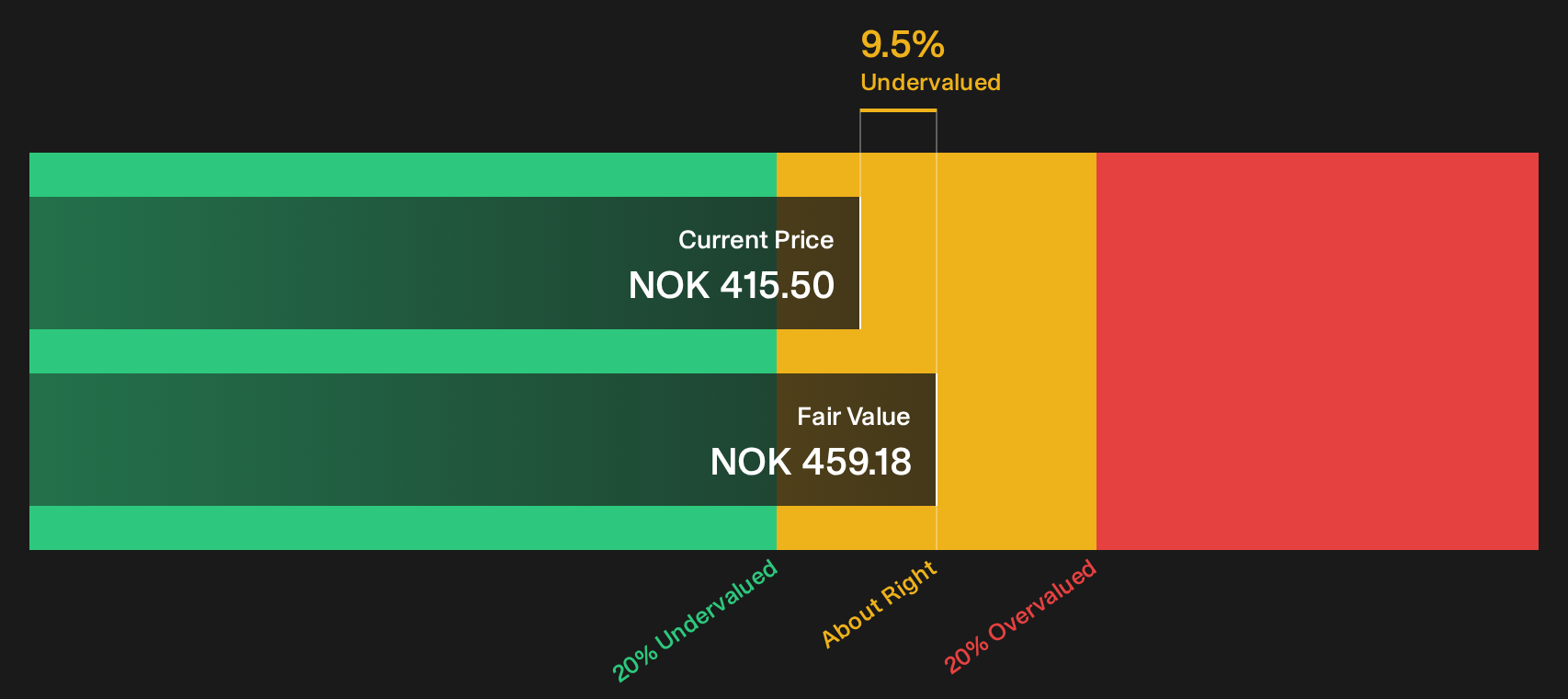
The Discounted Cash Flow (DCF) model here uses projected free cash flows and discounts them back to today to estimate what Equinor might be worth per share. On this view, the business generated about US$9.9b of free cash flow over the last twelve months, then assumes a broadly declining cash flow path rather than aggressive future expansion. That stream of cash is capitalised into an intrinsic value estimate of around NOK459 per share.
Set against the current market price, the DCF output implies Equinor trades about 9.5% below that intrinsic estimate, so the stock screens as modestly undervalued rather than wildly mispriced. The positive Preliminary Economic Assessment for the Franklin lithium project helps explain why investors may still be willing to pay close to full value despite softer long term free cash flow assumptions, since it adds an extra leg of potential future cash generation on top of the existing oil and gas base.
On balance, the DCF work suggests Equinor looks roughly fairly valued, with only a small margin of undervaluation implied at current levels.
Equinor is fairly valued according to our Discounted Cash Flow (DCF), but this can change at a moment's notice. Track the value in your watchlist or portfolio and be alerted on when to act.
Is Equinor Fairly Priced on Earnings?
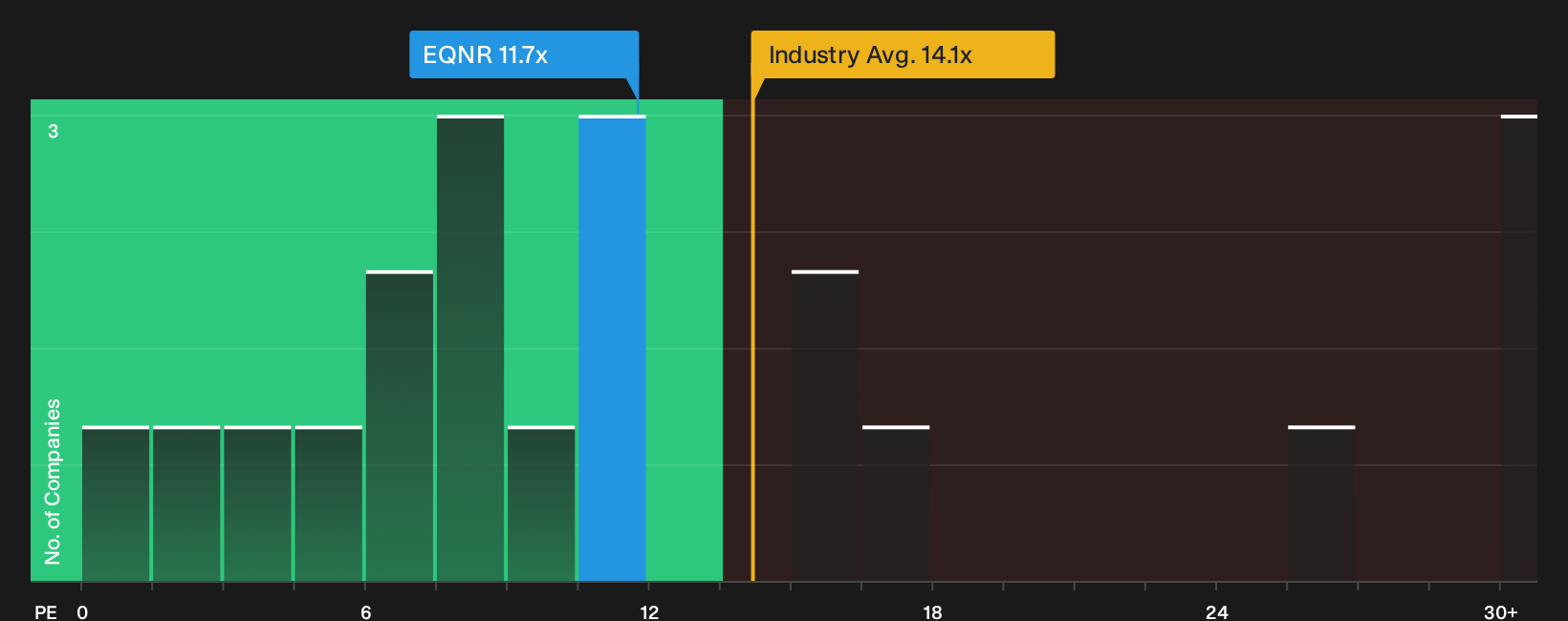
P/E is a useful check for Equinor because earnings still come largely from oil and gas, where profit cycles tend to drive how investors frame valuation. On this lens, Equinor trades on about 11.7x earnings, which is below both the Oil and Gas industry average of roughly 13.3x and a broader peer group around 16.0x.
The fair P/E that best fits Equinor, given its size, risk profile and sector, is around 12.1x. That is only slightly above where the shares currently change hands, so the discount to peers looks more like a modest cushion than a strong signal of mispricing. The lithium joint ventures and US battery storage projects may help explain why the P/E has not compressed further, since they add potential beyond the traditional hydrocarbon portfolio.
On this earnings multiple, Equinor looks priced broadly in line with what its fundamentals currently support.
See what the numbers say about this price — find out in our valuation breakdown.
The Equinor Narrative: What Would Justify Today's Price?
Equinor's valuation story so far raises a simple question for you as a shareholder or potential buyer: what kind of future would actually need to play out for today’s price to make sense? Simply Wall St Narratives on Equinor pick up from that question by spelling out the specific paths for growth, margins and earnings that would need to unfold for the shares to be worth materially more or materially less than where they trade now. Instead of a single ratio or model output, you see the underlying future it rests on and can watch whether that path is still intact over time. These scenario threads sit on Simply Wall St’s Community page and turn the valuation puzzle into a set of concrete business outcomes that can be checked against real world progress.
Community narratives on Equinor sit far apart, with one camp leaning into cash returns and gas exposure while the other worries about transition risks and payout durability.
Bull case: 5% undervalued
"Equinor's expansion in natural gas, illustrated by multi-decade contracts supplying key European markets and integration into power infrastructure aligned with data center activity in the U.S., is described by some investors as positioning the company for higher volumes and margins if global demand for gas remains strong, which they believe could support revenue and earnings."
Read the full Bull Case to see why Equinor could be undervalued
Bear case: 19% overvalued
"Skeptical investors argue that current valuations imply that shareholder returns (dividends and buybacks) will remain elevated, but they see a risk that high capital distribution could become harder to sustain if energy prices weaken, FX movements turn adverse, or capex needs for transition projects rise, which they believe could pressure future EPS and total shareholder yield."
Read the full Bear Case to see why Equinor could be overvalued
Do you think there's more to the story for Equinor? Head over to our Community to see what others are saying!
The Bottom Line
Equinor now appears roughly fairly valued, with the Discounted Cash Flow (DCF) work indicating only a modest 9.5% upside and the P/E sitting close to a tailored fair ratio. That combination leaves less of a valuation cushion and places greater emphasis on whether new lithium and storage projects can offset the inherent swings in oil and gas cash generation. For investors, the crux is straightforward: the assessment depends on whether Equinor can convert its transition spending into durable, less volatile cash flow without eroding the returns that have supported the current price.
This article by Simply Wall St is general in nature. We provide commentary based on historical data and analyst forecasts only using an unbiased methodology and our articles are not intended to be financial advice. It does not constitute a recommendation to buy or sell any stock, and does not take account of your objectives, or your financial situation. We aim to bring you long-term focused analysis driven by fundamental data. Note that our analysis may not factor in the latest price-sensitive company announcements or qualitative material. Simply Wall St has no position in any stocks mentioned.
Have feedback on this article? Concerned about the content? Get in touch with us directly. Alternatively, email editorial-team@simplywallst.com