
Royal Caribbean (RCL) Stock May Be Undervalued As Earnings Power Holds
Royal Caribbean Cruises stock has delivered a very strong 5 year run, yet recent share price weakness and an underscored undervalued signal from the broader checks pull in a different direction on what investors are really paying for today.
- The share price has gained about 219.3% over 5 years, which puts long term holders in a strong position and raises the bar for what future returns might look like from here.
- The business can see its valuation supported if it continues to turn demand into solid cash generation. However, any hit to travel appetite or higher operating costs could quickly pressure what investors are willing to pay.
- On a composite view of the main valuation tests, Royal Caribbean Cruises screens as cheap overall, with a value score of 6 pointing to a broad set of indicators that lean in favor of undervaluation.
The issue now is whether the current price already reflects the cruise operator’s recent gains or still leaves room for further upside based on these valuation checks.
Look beyond Royal Caribbean Cruises and consider its recent pullback alongside carefully selected opportunities in our 32 high quality undervalued stocks.
Is Royal Caribbean Cruises a Bargain on Earnings?
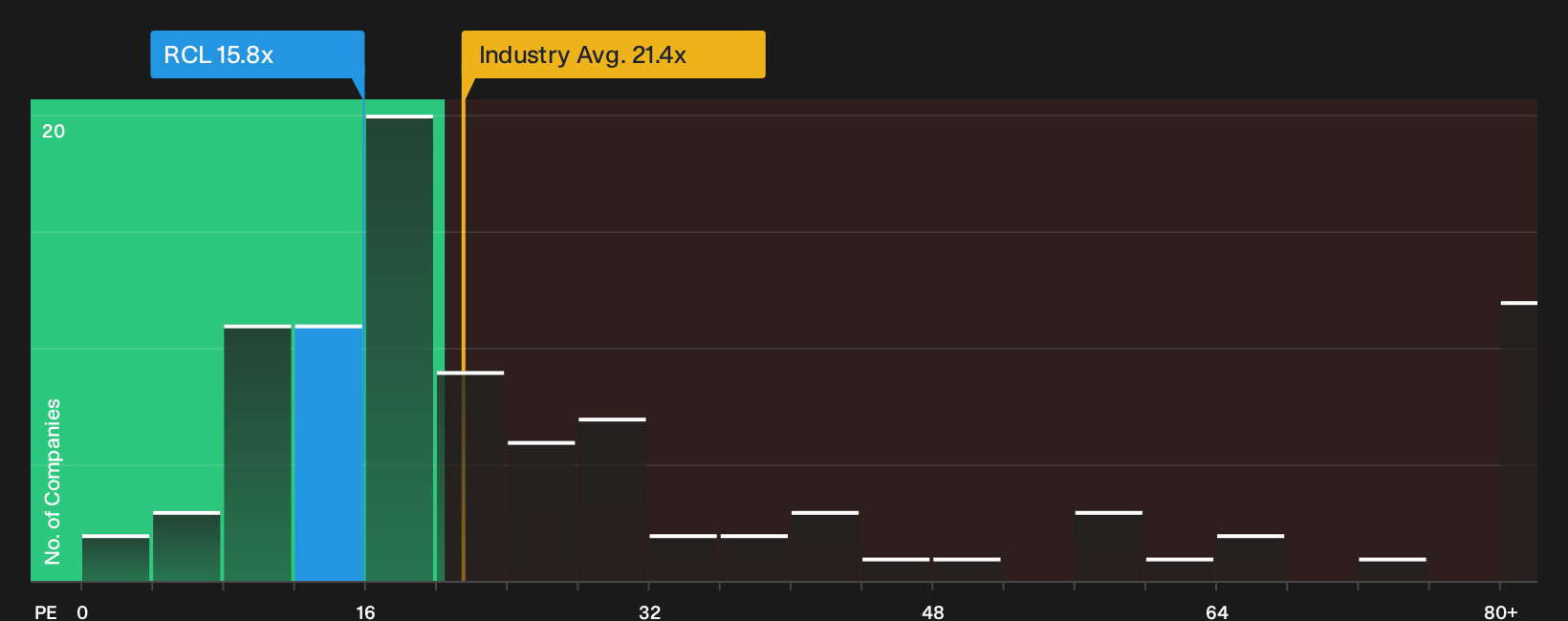
The P/E multiple suits Royal Caribbean Cruises because investors often focus on earnings power when judging a travel operator that is already producing profits. On this measure, the stock trades at about 15.8x earnings, which is below both the broader hospitality industry average of roughly 21.4x and a peer group sitting near 33.2x. That means the market is assigning a lower price tag to each dollar of Royal Caribbean Cruises earnings than to many comparable operators.
The tailored fair P/E ratio for Royal Caribbean Cruises is estimated at about 27.5x, which is well above the current 15.8x level. This gap indicates that the current share price may not fully reflect what the model implies for the company once its growth profile, profitability, size and risk factors are taken into account.
On the P/E test alone, Royal Caribbean Cruises stock appears undervalued compared with both its fair multiple and sector benchmarks.
See what the numbers say about this price — find out in our valuation breakdown.
The Royal Caribbean Cruises Narrative: What Would Justify Today's Price?
Simply Wall St Narratives for Royal Caribbean Cruises pick up where the valuation puzzle leaves off. They set out which future paths for growth, profitability and earnings would need to hold for the stock to be worth materially more or less than today’s price. Each scenario links a fair value to a clear story about Royal Caribbean Cruises' potential catalysts and pressure points, so you can track which version gradually aligns with reality over time on the Community page.
One of the top community narratives on Royal Caribbean Cruises: 25% undervalued
"Enhanced guest experiences, investments in private destinations, and new ships are driving higher onboard spending and pre-cruise purchases, which should support revenue growth by increasing per-passenger spend…"
Read one of the top narratives on Royal Caribbean Cruises
Do you think there's more to the story for Royal Caribbean Cruises? Head over to our Community to see what others are saying!
The Bottom Line
Royal Caribbean Cruises screens as undervalued on earnings, with the current P/E sitting well below both peers and its own tailored fair multiple. That discount only pays off if the operator keeps translating demand into resilient cash generation without a material squeeze from higher costs or softer travel appetite. The real swing factor from here is whether the market maintains confidence in that earnings power and is willing to lift the multiple closer to the implied fair level, rather than keeping a safety discount in place.
This article by Simply Wall St is general in nature. We provide commentary based on historical data and analyst forecasts only using an unbiased methodology and our articles are not intended to be financial advice. It does not constitute a recommendation to buy or sell any stock, and does not take account of your objectives, or your financial situation. We aim to bring you long-term focused analysis driven by fundamental data. Note that our analysis may not factor in the latest price-sensitive company announcements or qualitative material. Simply Wall St has no position in any stocks mentioned.
Have feedback on this article? Concerned about the content? Get in touch with us directly. Alternatively, email editorial-team@simplywallst.com