
Ford (F) Stock Could Be 16% Above Fair Value Following Kentucky Plant Investment
Ford Motor stock enters the spotlight with a split verdict on value, as the Discounted Cash Flow (DCF) intrinsic value estimate points to a premium while market multiples suggest the shares may be on the cheap side.
- Over the past 5 years, Ford Motor has returned about 40.6%, which gives investors a solid gain to measure against today’s valuation signals.
- Large commitments to U.S. production, including the recent US$1b plan to upgrade the Kentucky Truck Plant, can support long term cash generation, while political scrutiny of Chinese partnerships may weigh on how dependable those future cash flows look.
- A value score of 3 out of 6 points to a mixed picture rather than a clear bargain or obvious overvaluation for Ford Motor on the broader checks.
For investors, the debate is whether Ford Motor’s current share price already reflects these cross currents in its intrinsic value and market-based valuation signals, or still leaves meaningful room on either side.
Capture both sides of the Ford Motor valuation debate and line it up against 32 high quality undervalued stocks that our data flags as potential mispricings across the market.Has Ford Motor Run Too Far on Cash Flow?
The Discounted Cash Flow (DCF) approach estimates what Ford Motor might be worth today based on the cash it is expected to generate in the future. Ford’s latest twelve month free cash flow sits around $7.9b, and the model assumes those dollars continue at a broadly steady, mature pace rather than surging or collapsing. On that stream of cash, the 2 Stage Free Cash Flow to Equity model lands on an intrinsic value of about $12.01 per share.
That figure compares to a current share price that screens roughly 16.3% above the DCF estimate, so on this method the stock screens as overvalued rather than cheap. The planned US$1b upgrade to the Kentucky Truck Plant may help explain why the market is willing to pay a premium to today’s cash flow profile, even though the model itself only credits moderate growth. The DCF workup therefore suggests Ford Motor looks overvalued at today’s price on a pure cash flow basis.
Our Discounted Cash Flow (DCF) analysis suggests Ford Motor may be overvalued by 16.3%. Discover 32 high quality undervalued stocks or create your own screener to find better value opportunities.

Does Ford Motor Look Undervalued on Sales?
P/S works well for Ford Motor because you are effectively comparing the value of its trucks and SUVs on the market to each dollar of revenue those vehicles bring in.
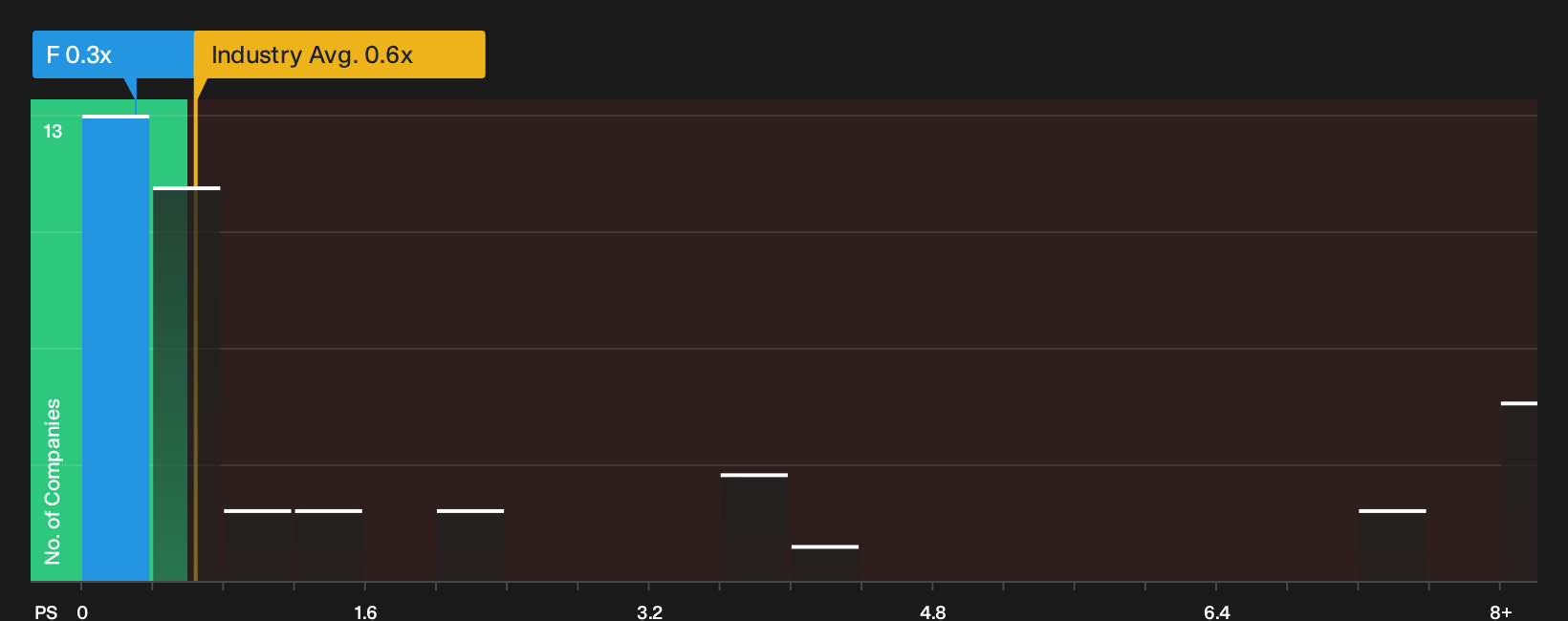
On this metric, Ford Motor trades on a P/S of about 0.3x. The broader auto industry sits nearer 0.6x, and peers cluster higher again around 1.4x. The fair P/S ratio that adjusts for Ford Motor’s size, margins and risk profile is about 0.5x, which is still well above where the shares change hands today.
That spread suggests investors are paying a much lower price for each dollar of Ford Motor sales than both simple industry benchmarks and the tailored fair ratio imply. The result lines up with the idea that current concerns around Chinese partnerships and policy risk have cooled sentiment more than the revenue multiple alone might justify.
On a pure P/S comparison, Ford Motor appears undervalued relative to what its revenue base would typically support.
See what the numbers say about this price — find out in our valuation breakdown.
The Ford Motor Narrative: What Would Justify Today's Price?
Simply Wall St Narratives pick up where the Ford Motor valuation puzzle leaves off. They set out clear paths for how Ford Motor’s future earnings power, profit margins and business risks would need to move for today’s quote to look meaningfully high or low. Each narrative links its number to a specific view on how growth, profitability and uncertainty might evolve, giving you something concrete to test as fresh information comes through the Community page over time.
Community narratives around Ford Motor are miles apart, with one camp leaning into recurring software and energy storage while the other fixates on capital strain and execution risk.
Bull case: 11% undervalued
"The focus on connected vehicle data, OTA software updates, and advancements in autonomous driving (BlueCruise, upcoming Level 3 capabilities) sets the stage for new, high-margin revenue streams from digital services and vehicle fleet management..."
Read the full Bull Case to see why Ford Motor could be undervalued
Bear case: 23% overvalued
"The costly transition from internal combustion to electric drivetrains, coupled with tightening global emissions standards, will likely continue to pressure Ford's margins and necessitate sustained high capital expenditures..."
Read the full Bear Case to see why Ford Motor could be overvalued
Do you think there's more to the story for Ford Motor? Head over to our Community to see what others are saying!
The Bottom Line
Ford Motor throws off one clear message. The Discounted Cash Flow (DCF) view leans toward overvalued, while the sales multiple points to undervalued on revenue alone. That gap mostly reflects a clash between heavy capital needs and cash timing on one side, and low market expectations and cooler sentiment on the other. The real hinge from here is whether Ford Motor can convert its spending and software ambitions into steadier, higher quality cash flows rather than just more volume at thin margins.
This article by Simply Wall St is general in nature. We provide commentary based on historical data and analyst forecasts only using an unbiased methodology and our articles are not intended to be financial advice. It does not constitute a recommendation to buy or sell any stock, and does not take account of your objectives, or your financial situation. We aim to bring you long-term focused analysis driven by fundamental data. Note that our analysis may not factor in the latest price-sensitive company announcements or qualitative material. Simply Wall St has no position in any stocks mentioned.
Have feedback on this article? Concerned about the content? Get in touch with us directly. Alternatively, email editorial-team@simplywallst.com