
There is still room for imagination in the AI super bull market, but Wall Street is quietly preparing “two types of insurance”: to prevent a negative fall from eroding profits, and also to prevent the impact of a sharp decline
Although the market raised the price of interest rate hikes to close to 90% at the Federal Reserve's next FOMC monetary policy meeting (September policy meeting held this week), the S&P 500 index and the Nasdaq Composite Index closed up 0.86% and 0.96% respectively with strong resilience last Friday. Among them, the decline in oil prices driven by news of the easing of geopolitical conflicts in the Middle East provided important support.
On Friday September 11th, the overall US CPI rose 0.4% month-on-month and the core CPI rose 0.3% month-on-month in August, all faster than in July, but the overall year-on-year increase remained flat at 3.4%, and the core year-on-year increase fell to 2.4%. Therefore, the more accurate judgment is that short-term price pressure has rebounded, not all inflation indicators have deteriorated across the board.
The Zhitong Finance App notes that according to some senior Wall Street analysts, there is no contradiction between the resilience of the stock market and the need for capital hedging risks in the context of surging long-term US bond yields and rising interest rate hikes due to rising inflation, and the need for capital hedging risks: some senior Wall Street traders and investors still want to preserve the benefits of rising stocks, but there is disagreement about whether the risk will be released by “slowly compressing valuations” or “suddenly closing positions on a large scale with leverage.” The former promotes conditional protection against falling, while the latter promotes instruments with strong convex returns, such as VIX call options. This reflects the fragmentation of risk management methods; it is not that the market is already betting unanimously on the end of the bull market in US stocks or even global stock markets.
The AI bull market has entered a profit test, and global capital has begun to buy insurance for two falling methods
After the release of CPI data that slightly exceeded expectations, Wall Street financial giant Goldman Sachs moved from predicting that the Federal Reserve's September monetary policy meeting will stand still to bet that the Fed will choose to raise interest rates by 25 basis points this week. Goldman Sachs's position is relatively cautious about the path after September. However, in a research report released by Goldman Sachs last weekend, the “profit overrides everything” bullish logic that the long-term bull market in the US stock market will continue strongly since ChatGPT became popular around the world in 2022 — earnings per share of the S&P 500 are expected to reach 340 US dollars in 2026, which means that it is expected to increase sharply by 24% year over year on a high base; in 2027, it is expected to further reach 385 US dollars, an increase of 13% year over year.
At the same time, the forward price-earnings ratio fell from 22 times at the beginning of the year to 19 times, indicating that interest rate headwinds have been reflected through valuation compression. Its historical sample shows that three months after the start of the seven-rate hike cycle, the S&P 500 fell by an average of 2%, but increased by an average of 9% after 12 months. This data does not yet support “the end of the bull market trajectory after the Federal Reserve starts raising interest rates,” but it cannot be 100% used to prove that future investment returns will necessarily replicate history; Goldman Sachs emphasized in the research report that the real key is whether the profit cashing trend can offset the further decline in valuation factors.
As far as the current stock bull market is concerned, the Federal Reserve's single rate hike itself is not a cause for concern. At least historical data shows that the real threat to bulls is a complete cycle of interest rate hikes rather than a single action.
The chart below compiled by the agency details and accurately sorts out the 12 bear markets where the S&P 500 index fell 20% or more since 1945, as well as four other declines of 18% to 20%, close to the bear market. Among them, six bear markets occurred after a cycle of interest rate hikes, and the economy then fell directly into recession; three occurred after interest rate hikes but were not accompanied by an economic recession; once occurred at the same time as the economic recession during the COVID-19 pandemic; and only two did not raise interest rates or recession. In this comparison, an interest rate hike cycle is defined as a minimum of two rate hikes with a cumulative margin of 100 basis points or more.

Goldman Sachs analysts agree that AI can provide a source of continuous and strong profit growth, and the bullish logic of “AI overrides everything” is still strong — that is, the strong bullish logic that “AI themes completely overwhelm all negative factors, including inflation, geopolitical crisis, and surging US bond yields.”
From the perspective of actual AI applications and data center engineering, if the future takes on more long-range tasks, multiple rounds of reasoning, and nearly endless high-performance tool calls, it will continue to blowout a series of AI data center infrastructure resource-related requirements such as core computing, DRAM/HBM memory, data center NAND storage systems and server CPUs, high-performance network equipment, and data center high-speed optical interconnection; from an investment perspective, these workloads must be converted into paid orders, actual delivery, data center level equipment utilization and cash Payback.
The share prices of Dell and HPE in the US stock market both rose sharply by about 12% last Friday, showing that the market is still willing to pursue computing power growth opportunities supported by corporate performance. However, Goldman Sachs also warned that capital expenditure also brings depreciation, financing, electricity, and maintenance costs, and that the increase in demand for computing power and the increase in shareholder returns is still a test of profit margin and return on invested capital.
Goldman Sachs also said that the reason and speed of interest rate increases is more important than a single interest rate point: if rising interest rates mainly reflect growth and productivity improvements, corporate profits may provide a buffer; if it mainly comes from energy supply shocks, inflation risk premiums, or financial financing pressure, it may simultaneously raise the discount rate, squeeze profits, and weaken consumption. Its judgment on long-term fixed-rate debt of large enterprises means that the cost transmission of existing debt is slow, but it cannot eliminate the pressure of additional AI project financing and future refinancing. The global AI industry chain can share demand expansion, yet it will still be clearly differentiated due to differences in financing structures, energy costs, and customer concentration.
The US stock options market is warning — even if long-term profit judgments do not change, positions may experience two completely different downward paths. VIX of about 15.5 does not automatically mean that protection is cheap. If actual market fluctuations are lower, the volatility premium paid may still be too high; short-term put options may lose time value due to insufficient or too slow decline. Betting on double binary options where “the stock index falls and the VIX also falls” requires that the conditions stipulated in the contract be met at the same time and is not a substitute for collapse insurance.
Meanwhile, the bulk purchases of VIX's call options in October and November, which have exceeded 275,000 lots in the past few weeks, reflect the need for another group of Wall Street professional traders and investors to protect against sudden shocks. As for the AI super bull market, which is still sweeping the global stock market, there is a more grounded view that the unexpected and strong profit growth trajectory surrounding AI may still support a long-term upward trend, but Wall Street institutional investors are pricing valuation compression and liquidity shocks separately. Whether the bull market can continue depends on the growth delivery trajectory, not whether risks are ignored.
Preventing a sharp fall or preventing a downturn? Traders seeking a hedge against the stock market rally disagree on whether to prevent a sharp decline or a slow downturn
As rising interest rates and oil prices brought stock market gains to a standstill, investors seeking hedging were divided: whether to prevent a quick sell-off or a slow decline.
Recently, several factors have been unfavorable to stock market hedgers. The S&P 500 index has mostly remained range-bound since the end of May, and there are several stages this year. The actual fluctuation during the period of rise was greater than the period of decline. As a result, the phenomenon of “rising prices and rising volatility” in market terms has occurred.
Smaller fluctuations — particularly declines — make some traders more reluctant to buy short-term put options directly at a higher price as protection, as option premiums may be lost over time if there is not a large enough drop. As a result, while some traders and investors are buying call options on the Chicago Board Options Exchange Volatility Index or S&P 500 put options, other traders and investors are using more creative methods when planning for falling markets.
Antoine Porcheret, head of institutional structural products at Citigroup, another Wall Street financial giant based in the UK, Europe, the Middle East and Africa, said: “As the pattern of 'rising prices and rising volatility' is reversed, we have seen some transactions begin to bet on 'falling prices and falling volatility' — for example, by betting on double binary options where the S&P 500 index falls and VIX falls, the layout is slowly declining.”
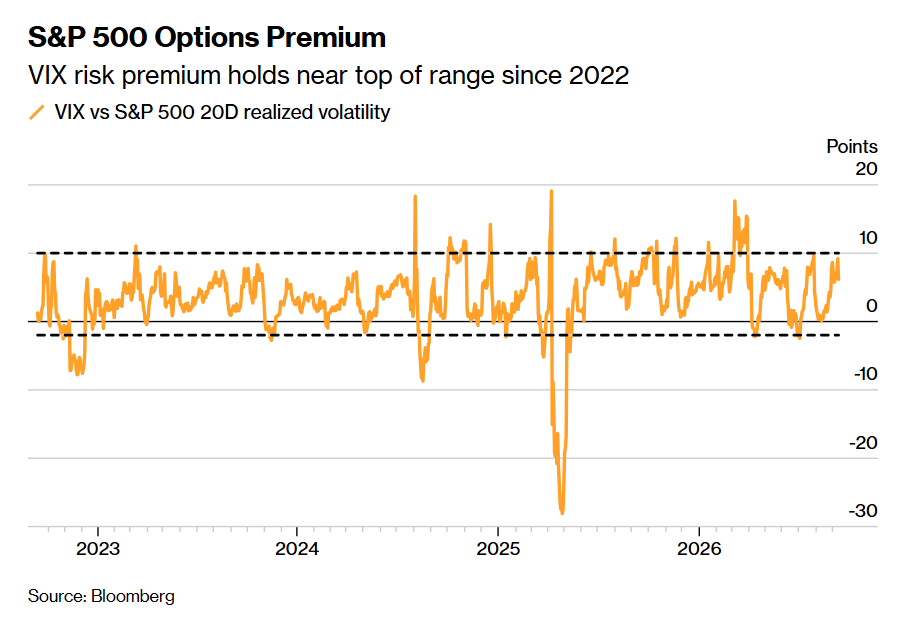
As shown in the chart above, the S&P 500 options premium — the VIX risk premium — has remained near the top of the range since 2022.
Over the past few years, “slow decline” has been a popular saying and a popular trading idea, because some professional traders and investors believe that a moderate sell-off rather than a sudden collapse is a scenario worth hedging and speculative layout.
These double binary options transactions, which bet that the stock market's volatility is declining at the same time, reflect that the current AI theme and geopolitical risks are generally not shocking or unexpected, making the reasons for holding long volatile positions less clear. Even though VIX is currently around 15.5, which is lower than the average of the past four years, it is still near the upper end of the range relative to the actual volatility of the market.
Incidents such as the US non-farm payrolls report often caused large market fluctuations, but now, if the results are not shocking, the market may calm down quickly.
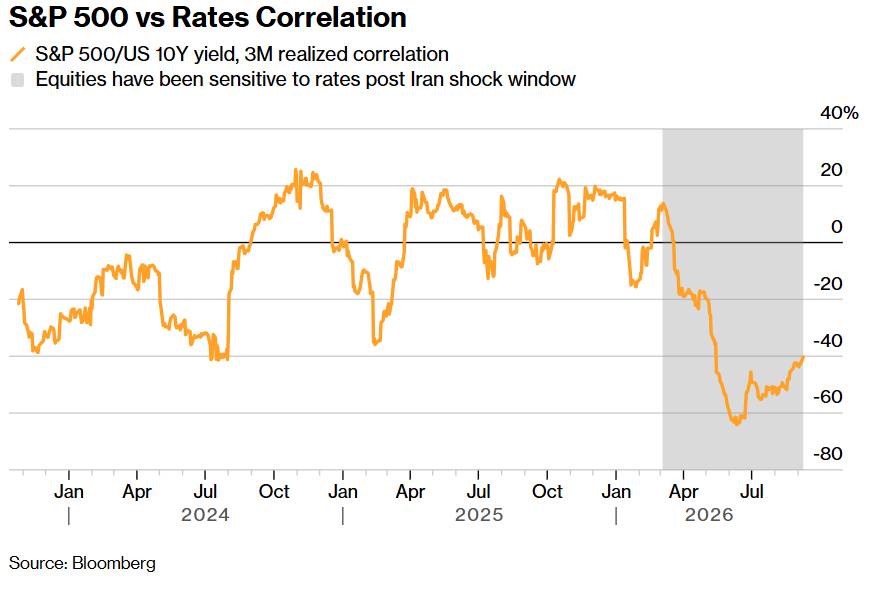
However, although the risks posed by economic news have abated, the stock market still appears to be highly sensitive to interest rates. Therefore, all eyes will be on the Federal Reserve's interest rate decision this week. Currently, the market anticipates that the Bank of America will raise interest rates. The chart above is a compilation and summary of the correlation between the S&P 500 index and interest rate trends.
As US long-term treasury yields rose to multi-year highs, a stagflating scenario option income structure betting on falling stock markets and rising interest rates attracted capital inflows earlier this year. J.P. Morgan strategists recently promoted dual binary options, and the leveraged layout continues until the end of the year.
Of course, there are still signs that traders and investors are establishing bets with more positive returns. It is expected that at a time when stock market gains face multiple threats, volatility may soar. In addition to rising interest rates, these threats include high oil prices in the context of the ongoing US-Iran war, and trends supporting the strengthening of the yen — the latter may trigger the liquidation of arbitrage transactions, similar to what happened when the stock market plummeted and volatility soared in August 2024.
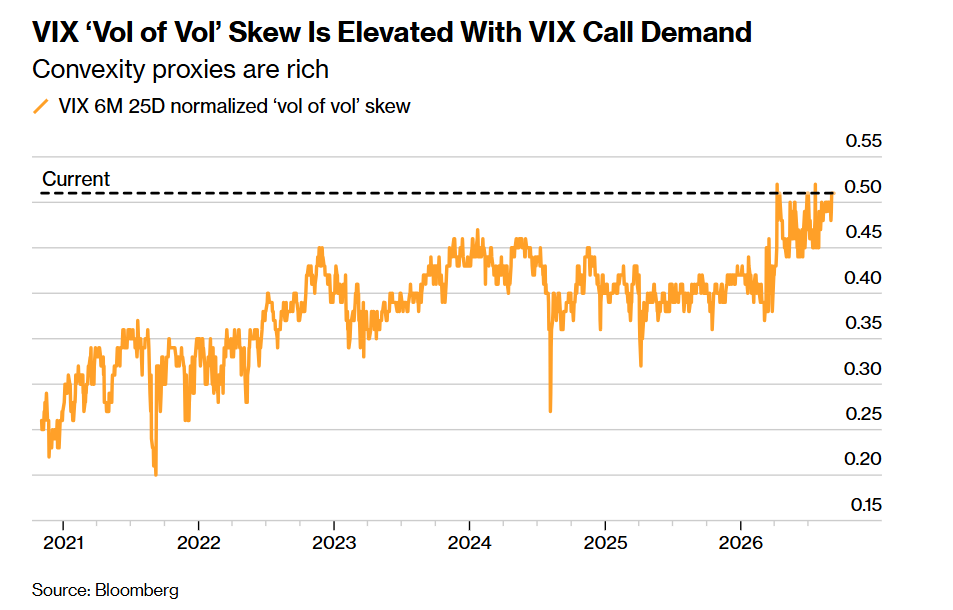
As shown in the chart above, US stock VIX bullish options are in high demand, and the “volatility of volatility” bias is high, and indicators for measuring convex pricing are expensive.
This prompted some traders and investors to firmly choose to hedge by directly buying VIX call options, and the market's general buying demand for “volatile volatility” can be seen from the index's bias in bullish options. Over the past few weeks, the total number of October and November VIX call options bought through bulk transactions has exceeded 275,000 lots.
Porcheré said, “The most important theme in capital flows has always been hedging activities. Direct long-term volatility trades are more cautious, such as buying knock-in forward variance contracts. Under this structure, you only have exposure to volatility when the market rises.”
Moreover, although some leveraged bets are still expensive, there are veteran Wall Street traders and investors who are willing to stand on the other side of the deal and seek premium.
Adrian Gellio, CEO of Premialab, said: “In fact, we see demand on both sides: traders and investors are increasingly interested in systematic protection and convexity, while continuing to deploy sell-out volatility strategies to obtain return on positions and enhance returns. The key difference is increasingly reflected in portfolio goals and implementation methods, rather than the overall market shifting from shorting volatility to going long.”