
AI drives MLCC and ABF dual explosions! Goldman Sachs is bullish on Samsung Electric's target price target of 2.25 million won
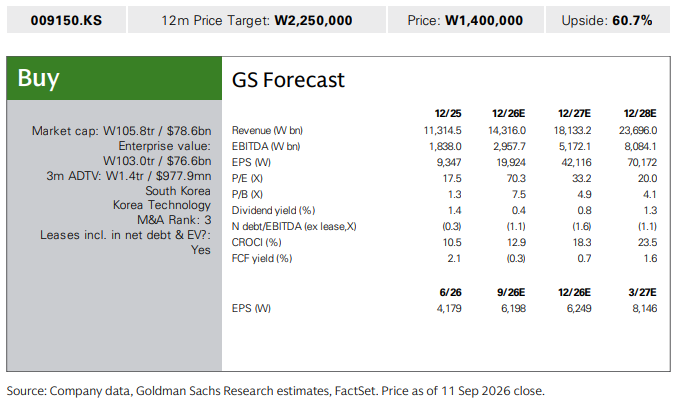
The Zhitong Finance App learned that Goldman Sachs held a non-transactional roadshow (NDR) for Samsung Electric (SEMCO) in the US and summarized 8 key points in a recently released research report. Goldman Sachs said artificial intelligence (AI) has brought strong benefits to MLCC (multilayer ceramic capacitors) and ABF substrates. The bank expects that steady MLCC demand from AI servers and automobiles, and strong FC-BGA business growth driven by AI customer expansion will result in a steady year-on-year increase in operating profit. As a result, Samsung Electric was given a “buy” rating for stocks listed on the Korea Exchange. The target price for 12 months was 2.25 million won, with 60.7% upside compared to last Friday's closing price of 1.4 million won.
Here are 8 key highlights from Samsung Electric's non-trade roadshow listed by Goldman Sachs in the research report.
1. Maintaining the results guidance for the third quarter of 2026 means that the core fundamental outlook has actually improved.
Despite the unfavorable exchange rate environment so far in the quarter — the cumulative appreciation of the won against the US dollar during the quarter — Samsung Electric maintained its revenue/operating profit guidance for the quarter, which Goldman Sachs believes means that the outlook for its core fundamentals has actually improved. The company believes that the strength of its core fundamentals comes from the MLCC and the base board business. Among them, the former expects revenue growth of about 10 to 20 percentage points month-on-month in the third quarter of 2026, with an operating profit margin of about 20%; the latter expects revenue to increase 20% month-on-month, and the operating profit margin is also about 20%.
2. Tight supply brings favorable MLCC price trends.
Due to tight market supply, Samsung Electric has raised the price of MLCC sales to distributors twice this year. This channel accounts for about 10% of its MLCC revenue. For the rest of the revenue from direct customers, the company is currently discussing potential price adjustments, and the results may be determined soon.
3. A significant portion of MLCC revenue will be covered by long-term agreements (LTAs).
Customer concerns about MLCC supply are deepening, and some mobile phone customers are even beginning to worry that there may be a shortage of supply in the next 2 to 3 years. As a result, customers are locking in production capacity ahead of schedule, and the number of long-term agreements (LTAs) signed is increasing. Samsung Electric expects that about 60% of MLCC revenue next year will be covered by LTA. The typical period is one year, and some customers require a longer period. Under these LTAs, quantities will be guaranteed, and prices will be based on reference prices and adjusted according to market conditions.
4. By 2028, AI data center MLCCs may account for 40% of revenue.
As MLCC usage for AI servers increases dramatically and the price premium is significantly higher, Samsung Electric believes that the AI data center MLCC market may grow 70% to 80% this year. At the same time, it is expected that its own AI MLCC revenue growth rate will exceed the market, increasing by about 100% year on year, and the growth rate is expected to accelerate next year. As a result, the company expects AI to account for close to 20% of its MLCC revenue this year, rise to more than 30% next year, and may reach about 40% in two years.
5. A higher proportion of AI will bring significant benefits to MLCC profit margins.
Although Samsung Electric's overall MLCC operating margin is currently about 20%, the company mentioned that its AI data center MLCC operating margin is about 30%, while the profit margin for specific high-end products is even close to 40%. Therefore, the higher share of AI MLCCs is likely to bring significant benefits to Samsung Electric's overall MLCC profit margin.
6. Silicon capacitors are another potential long-term growth driver.
Samsung Electric emphasizes that silicon capacitors are not a replacement for MLCC, but rather a complement to the product—their smaller, thinner shape allows them to be closer to the chip and provides better noise filtering effects. The company is receiving great attention from customers, as can be seen from the approximately $1 billion silicon capacitor contract signed with a single major technology customer announced in May. Significant revenue will be recognized starting next year, and a significant portion of this will be recognized in 2028.
Goldman Sachs believes that Samsung Electric is in an advantageous position in the silicon capacitor market because it has the ability to develop high-capacitance silicon capacitors, and the Samsung Group has its own wafer foundry business, which helps in the production of such capacitors. In the long run, the bank emphasized that Samsung Electric has a unique positioning — it can provide a one-stop (turn-key) solution for silicon capacitor embedded packaging substrates, which is likely to attract strong customer interest.
7. AI is also a strong tailwind for ABF substrates.
Samsung Electric's ABF substrate business is also gaining strong momentum from AI data centers. Data centers (servers/networks) currently account for about 60% of ABF revenue, and may rise to 70% in two years. Due to the tight supply of ABF, the company has been adjusting prices since the first quarter of 2026. Coupled with the improvement of the product structure to AI data centers, the profit margin of its ABF business continues to increase. Samsung Electric plans to expand new production capacity in Vietnam and South Korea from 2028. It is expected that its ABF production capacity will double by 2030 compared to last year, while its ABF revenue is expected to more than double this year by 2030.
8. ABF's tension may be more serious than MLCC, and a longer-term LTA is being signed.
Samsung Electric believes that ABF supply may be more tight than MLCC because it is a customized product, and ABF used in AI data centers is larger and has more layers, so it may be difficult to achieve high yield. In view of ABF's tight supply, the company is discussing LTA with the customer, which is consistent with the customer's chip roadmap, and the period can even be as long as 2032. Customers are paying prepayments to lock in capacity in advance, and annual capacity utilization will be guaranteed to a certain extent.