
Pressure on energy and food prices may increase or trigger a rebound in inflation! It may be difficult for the Bank of England to “calm down” and bets on market interest rate hikes have soared
The Zhitong Finance App learned that after the interest rate decision in July, Bank of England Governor Andrew Bailey conveyed an unusually candid message to reporters: “Please don't leave this room with the idea that the Bank of England is trending to raise interest rates.” However, with the Bank of England's latest interest rate decision this Thursday, it may be difficult for him to be so adamant.
The upward pressure on energy prices due to the unresolved war in the Middle East is coming menacingly — the price of Brent crude oil has stabilized at $100 per barrel, and the cost of natural gas is even more of a challenge for the UK. Bailey recently told lawmakers that energy prices “may be even higher.”
New risks are also looming, and could keep inflation above the Bank of England's 2% target for most of next year. Food cost risks are also emerging after widespread droughts in the UK and the imminent impact of the extreme El Niño phenomenon. Other parts of the consumer basket are also less optimistic, such as ticket prices. Rapid economic growth, on the other hand, suggests that demand is stronger than expected.
Hertar Mehta, chief economist at St James's Place, said: “Energy prices have to some extent given the baton to food prices. The broader El Niño effect is likely to make next year's inflation more stubborn. Even if energy price inflation associated with the Middle East actually falls, you will be compounded by another wave of rising food prices — this is exactly what makes the overall data unable to drop significantly.”
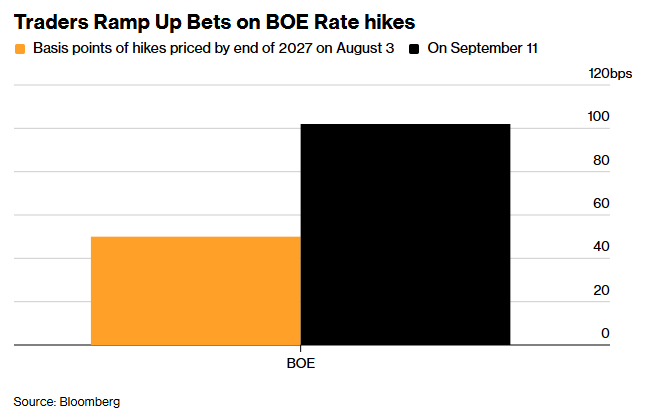
Traders are betting more on the Bank of England's interest rate hike
In the face of increased risk of inflation, the market has adjusted accordingly. In the few days following Bailey's July press conference, traders had priced the Bank of England's interest rate hike before the end of the year at less than 25 basis points; as of September 11, they had set the Bank of England's rate hike of 46 basis points before the end of the year, and are betting on raising interest rates up to four times before next summer.
Most Bank of England officials believe that the weak labor market and the expected slowdown in growth in the second half of this year will help contain price pressure caused by the Middle East war. Although the July GDP data suggests that the economy may be resilient, the overall evidence supports the view that the second-round effects are still within manageable limits.
There are currently few signs that inflation is becoming entrenched. According to the August inflation forecast survey released by the Bank of England on Friday, the inflation forecast for the next year fell to 3.2% from 4% in May; the forecast for the next 12 months fell to 2.9% from 3.5% in May. The Bank of England's agent survey of companies across the country found that the 2027 salary agreement was “roughly the same as or lower than 2026” — an average increase of 3.6% in 2026.
One of the key unknowns in the UK is whether the UK's strong economic growth will continue in the first half of this year, and whether it will even push companies to start hiring again. Although forecasting agencies expect rising inflationary pressure to drag down consumer and economic activity, surveys show that consumer and business confidence have rebounded since Andy Burnham became prime minister in July, which may increase demand in the economy.
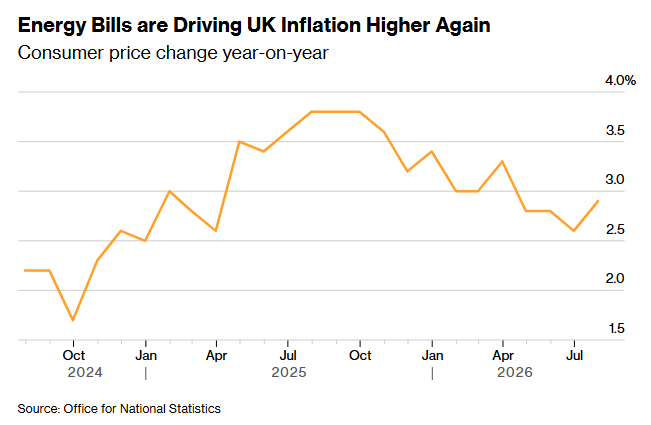
Energy bills are once again driving up UK inflation
However, the Bank of England may have to change its strategy at some point. The Oxford Institute of Economics estimates that UK inflation — currently 2.9% — could rise to close to 4% by the end of the year. This would be double the Bank of England's target, and higher than the level where the central bank believes households are beginning to notice an accelerated rise in prices.
One of the key drivers will be the UK energy price cap, which limits the unit energy bill that suppliers charge consumers. The UK regulator, the Office of Gas and Electricity Markets (Ofgem), has announced that the cap will hit a three-year high in October. Experts say it may rise further in early 2027.
Andrew Goodwin, chief British economist at the Oxford Institute of Economics, said: “We believe the effects of the Middle East conflict are still accumulating. We think the price cap could rise another 13% in January. The current wholesale price is much higher than the level of the previous observation window.”
The food industry is also warning that the combination of rising energy costs, the impact of hot weather in the UK on harvests, and the El Niño phenomenon will drive up spending on groceries for most of next year. The British Food and Drink Federation (FDF) expects food inflation to jump to nearly 4% before Christmas and peak at 6.4% in July 2027.
FDF chief economist Liliana Danila said, “The biggest risk is actually what will happen to commodities, and what impact will El Niño have.” She pointed out that crops such as cocoa, coffee, palm oil, rice, and sugar may be affected, and “we may see worse than expected... although until now, we haven't seen a real impact on a real level.”
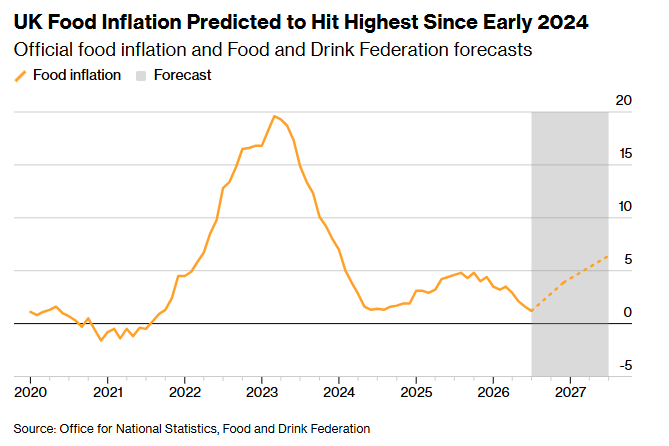
UK food inflation is expected to hit its highest since the beginning of 2024
Most economists expect the Bank of England's Monetary Policy Committee (MPC) to once again keep interest rates unchanged at 3.75% with a 6-3 vote on Thursday. ITEM Club's chief economic adviser Matt Swannell said the committee is likely to “strongly demonstrate its preparations to fight inflation in order to avoid any unnecessary relaxation in financial conditions.”
Furthermore, outsiders generally expect that the Bank of England's Monetary Policy Committee will slow down the reduction of its treasury bond portfolio to take into account the fragile state of the bond market. Since quantitative austerity began in 2022, the Bank of England's treasury bond portfolio has shrunk from £875 billion to £489 billion. The market expects the Bank of England to slow down the pace of contraction from £70 billion in the previous 12 months to £50 billion in the next 12 months from October.