
Data center boom reshapes US commercial real estate bond market investors face risk pricing problems
The Zhitong Finance App learned that commercial real estate mortgage-backed securities (CMBS) have long been an important pillar of financing US office buildings, apartments, and shopping malls. Today, this market is being reshaped by surging data center deals, and investors are having to face a whole new set of risks.
From power supply and grid capacity constraints to rapidly changing cooling and computational density requirements, CMBS buyers are being pushed into risk assessment areas that have little to do with commercial real estate in the past. Even traditional issues such as tenant demand and operational stability are quietly evolving — data centers are highly dependent on a few hyperscalers (hyperscalers), and their future needs are difficult to determine. Once these tenants are evacuated after their leases expire in the next few years, the cost of remodeling such highly specialized buildings can be extremely high.
The wave of data center debt issuance has hit, and risk assessment has become a problem
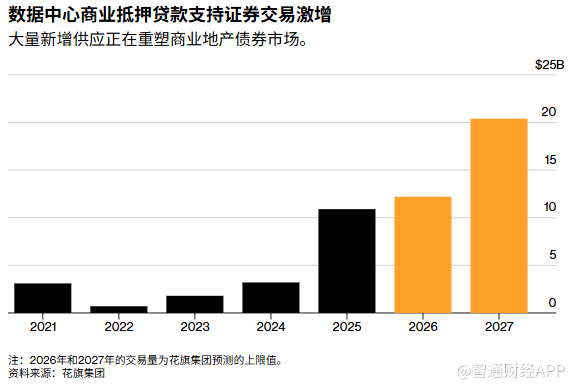
Since the beginning of 2025, the data center CMBS distribution scale has reached about 17 billion US dollars, which is more than three times the total amount issued in the previous two years. During this period, data centers have accounted for about 8% of the new commercial real estate bonds. Industry veterans are rapidly revising the risk assessment manual to avoid mineblasting projects, considering that there are still several billion dollar projects lined up to enter the market.
“Real data centers are measured in units of computing power and megawatts — a completely unfamiliar world for real estate investors.” Alex Killick, senior managing director of CWCapital Asset Management, said, “These metrics are difficult to apply to the analytical framework we are used to. It's very difficult to re-evaluate these data centers after a few years. We are re-evaluating our office or hotel CMBS every day. But after two years, how can I re-credit a data center?”
Killick revealed that CWCapital is developing a new stress testing model for this field to try to answer these questions.
Axonic Capital faces the same dilemma. Its portfolio manager, Steven Jury, chose a relatively cautious strategy: keeping the share of data center assets in the company's portfolio low and emphasizing diversification in terms of tenant types, application scenarios, and geographical distribution. Most data center CMBS use a single asset, single borrower (SASB) transaction structure, that is, a large mortgage loan (usually corresponding to a single facility or park) as a bond guarantee.
“How much these assets will actually be worth in 5, 10, or 20 years, and who will need them is the hardest question to answer.” View Jury. “Technology, tenant demand, and supply patterns are all likely to change significantly during this time.”
Old Risk, New Logic: Changes in Tenancy Agreements, Site Selection, and Tenant Concentration
Many of the risks that CMBS buyers will have to weigh in the long term remain, but as far as data centers are concerned, the factors driving these risks are quite different.
Take a leasing agreement as an example. Clauses on electricity costs, minimum capacity commitments, and downtime liability determine who is responsible for unexpected expenses, which in turn affects the cash flow of debt repayment. Reviewing these terms is also more difficult because tenants often insist that their identity and other rental details be kept private.
Ben Hunsaker, portfolio manager at Beach Point Capital Management, said, “Traditional commercial real estate investors know how to evaluate office buildings, apartments, warehouses, and retail properties because leasing contracts are often relatively standardized and tenant information is more transparent. Data centers, on the other hand, are far less transparent.”
The site selection logic has also been rewritten. In the past, property values were judged by convenience of transportation, living facilities, or whether they are close to the core area of the city; today, the criteria for judging value are whether cheap electricity and sufficient transmission capacity can be obtained. These advantages will determine how competitive and how much a data center facility will remain when the loan is due.
Tenant concentration and lease expiration risk have also changed. For an office building or apartment, the risk of re-leasing is nothing more than finding a different home; but for data centers, the more critical question is: Can customized power supply and cooling systems fit other companies? If not, how much would the final cost of the refurbishment be?
For CMBS investors, this means higher capital expenditure expectations, longer idle periods without income, and weaker recovery rates once borrowers are in trouble.
“These minuscule risks are really, really hard for me to fully digest.” Stephen Buschbom, head of applied research and analysis at data research firm Trepp, said bluntly, “These projects look more like infrastructure and complex technology projects than traditional real estate projects.”
The elimination cycle has plummeted: from “decades” to “a few years”
Additionally, there are a few considerations that are almost unheard of for CMBS buyers.
The rapid iteration of artificial intelligence chips may lead to a sharp rise in demand for electricity and cooling. A facility designed and built around a certain generation of hardware may become obsolete in just a few years, shrinking asset values, and making debt refinancing more difficult.
“The decommissioning cycle of traditional real estate can be modeled in units of several decades. But the data center situation is completely different,” Killick said. “The chip you installed six months ago may soon be replaced by another unknown chip. That alone made due diligence extremely difficult.”
At the same time, data centers have become an important political issue from local to national levels, and the industry is facing rare resistance from public opinion in the commercial real estate sector. Market observers pointed out that concerns about utility costs and pressure on local infrastructure have already provoked calls for restrictions on new construction projects in some communities, making the future regulatory environment particularly difficult to predict.
Oversupply concerns: interest spreads have quietly widened
Some of the cliché concerns remain, particularly oversupply. Major tech companies have issued more than 429 billion US dollars in bonds globally this year to build artificial intelligence. Although these financings span multiple fixed income markets outside of CMBS, investors' fatigue over the financing boom has also spread to the real estate bond sector.
Just last week, a $356 million bond supported by a 30-megawatt facility near Elk Grove Village (Elk Grove Village) in Illinois had a pricing spread that was significantly wider than initial guidance. This is the third such case in recent months. Barclays Bank data shows that since the beginning of the year, the risk premium for AAA-level data center transactions has expanded. Currently, the average is 1.65 percentage points higher than its floating interest rate benchmark. In contrast, the risk premiums for office buildings, retail and industrial real estate are 0.93 percentage points, 1.05 percentage points, and 1.25 percentage points, respectively.
As a large number of projects will soon require financing, Citigroup expects data center CMBS circulation to jump by about 50% to reach $18 billion to $20 billion next year.
“We expect supply to increase next year, which will present the risk of a longer-term revaluation of market capitalization, especially as demand becomes more vulnerable.” Jeffrey Berenbaum, director of global market research at Citibank, wrote in a report this month.
However, demand for computing power still far exceeds available supply, which helps support investors' confidence in the industry.
He said, “Right now, it looks like you probably have AA rated tenants and the rental period is about 15 to 30 years, but if all of these tenants move out, all you have left is just the biggest pick stadium in the world.”