
Concerns about “AI deceleration” triggered a sell-off in global chip stocks. Bernstein calms the market: the basic logic of computing power spending has not changed
The Zhitong Finance App learned that a rare “AI security consensus” over the weekend overturned global chip stocks on Monday (September 14). Anthropic CEO Dario Amodei (Dario Amodei) published a long article entitled “We must slow down the pace of advancing cutting-edge AI”, calling on the industry to take the initiative to slow down the pace of improving model capabilities, and received open solidarity from OpenAI CEO Ultraman and Musk; Ultraman also announced that OpenAI will not go public in 2026. In response, Stacy Rasgon (Stacy Rasgon), head of the semiconductor team at Bernstein Research Institute and a senior analyst, released a report with the title: “Can the AI Genie be put back in the bottle?” His answer is no, and there is no need: “slowing down the narrative” is not equal to “slowing spending,” and the fundamentals of AI semiconductor demand have not wavered.
Event: Big Three rarely agreed, Amodei proposed a three-step plan
According to the Bernstein Report, sentiment in the semiconductor sector had continued to improve in previous weeks — although it was still about 19% lower than the June high, it had rebounded about 13% from the July low, up 67% during the year. Optimism surrounding AI spending once overshadowed doubts about sustainability. However, “putting on the brakes” from within the industry is causing the latter type of concern to return to the front desk.
Amoudi proposed a three-step “rhythmic framework” in the long article: first, embedding an independent third-party evaluation agency with the authority to verify and report on the implementation of industry safety practice commitments (Anthropic has unilaterally promised to open “permanent employee-level” system access to third-party evaluation agencies); second, “democratic coordination,” that is, US regulation of all US AI companies, regardless of whether the company is voluntary; and third, “simultaneous global slowing down”, that is, reaching some form of cooperation and coordination with China. According to the report, the main background of this statement is the public resignation of safety and alignment personnel from several leading basic model laboratories, and the laboratory itself also acknowledged that AI has a “non-zero probability” of threatening humans — Ultraman's statement is “the risk of human extinction is unacceptable.”
Bernstein's Six Interpretations: From Expected Management to “Skynet”
The Rasgon team listed six possible interpretations of this appeal (from best to worst): shifting public hostility toward AI and data center construction; cracking down on and limiting China's “distillation” behavior; admitting that it can no longer get all the computing power needed to maintain the speed of previous iterations; trying to slow down the competitive ecosystem (such as the open source camp); realising that the return rate of training new models is declining and that excuses to slow down (that is, “next level”); and the worst case scenario — the lab actually sees something that scares them, such as recursive self-improvement outside of human control ( RSI), also commonly known as the “Skynet” scenario.
In particular, the report indicates that the “China factor” may account for quite a bit of weight. Amoudi correctly suggested that US restrictions should not be at the cost of China's overtaking, and proposed maintaining the ban on the sale of advanced AI chips and semiconductor equipment to China, cracking down on unauthorized distillation, and preventing model weights from being stolen — the report mentioned recent news that Chinese laboratories secretly used unauthorized Claude distillation to train models, and Amoudi also reiterated these views on the weekend TV program.” Although this proposal uses RSI and security concerns as a hammer, we doubt that China is the main driving force behind it.” The report reads.
Core judgment: Slowing down is not the same as slowing down spending money
The market's biggest concern is: will the “slowdown” impact AI capital expenditure? Bernstein's response was “We don't think so”. The report provides three layers of logic: First, the pace Amoudi talks about is from “extremely fast” slowing down to “still quite fast” — measured by the current scaling speed, this level is “still more than enough in our opinion”, and he hasn't said he wants to stop training; second, AI semiconductor demand is increasingly driven by inference (inference), especially with the rise of agentic (agentic) use cases, and the current computing power is far from sufficient to meet the reasoning needs of the current model, let alone the next three models; this is not the first time that AI standards and regulations have appeared. Demis Hassabis (Demis Hassabis), the director of the song DeepMind, proposed a similar plan in July. As a result, Bernstein judged that the AI revenue targets recently given by various companies “should have reflected expenditure plans”, and the possibility of substantial changes in these plans is very low.
The report also provides a longer-term defense: “Safer AI is AI that is easier to adopt.” Safety mechanisms such as third-party assessments help ease political and social anxiety about AI (and reduce the probability of the end, no matter how small), thereby favoring the long-term penetration of the industry.” We suspect it's too late to put the AI sprite back in the bottle, so why not find a safer way to release it.”
Market reaction: Asian chip stocks fell sharply, US chip stocks plummeted before the market
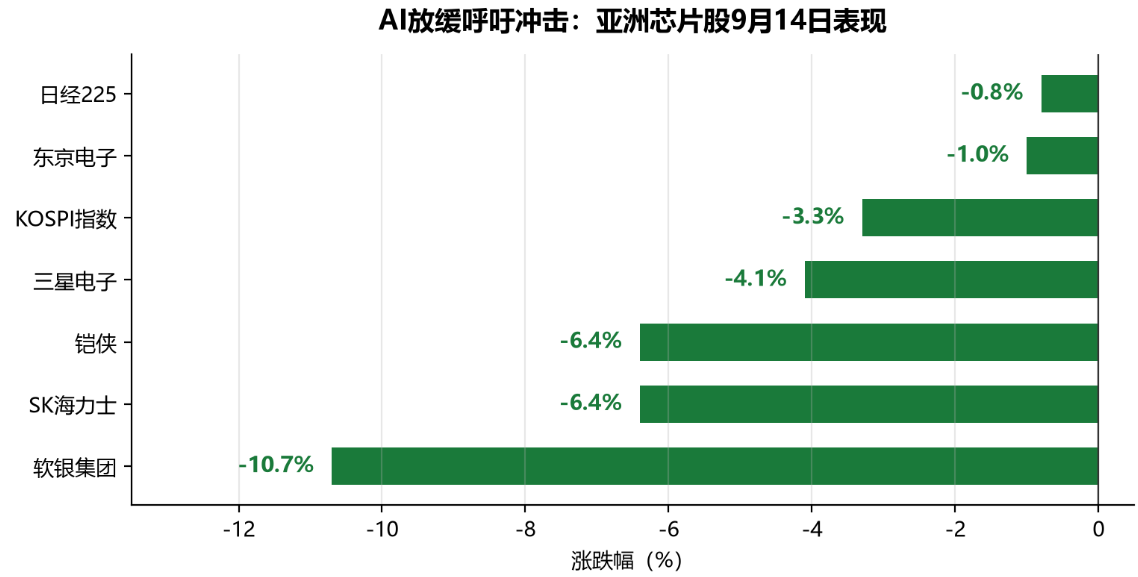
The Asian market has already given its first reaction. SoftBank Group closed down 10.7%, one of the largest Asian technology stocks with the biggest decline of the day; Kioxia closed down 6.4%, and the Nikkei 225 index fell 0.8%; SK Hynix closed down 6.4%, Samsung Electronics closed down 4.1%, and the KOSPI index fell about 3.3% — according to rough estimates of market capitalization, SoftBank, Kioxia, Tokyo Electronics, SK Hynix, Samsung, and TSMC alone evaporated to the trillion yuan level.
As of the press release on Monday evening Beijing time, US stocks have yet to open. Pre-market data shows that Nvidia once fell more than 2.47%; chip stocks such as AMD, Intel, and Micron once fell by around 5%; NASDAQ futures fell more than 1%; software stocks (Adobe, ServiceNow, etc.) were relatively strong.
Undercurrents in the Capital Market: IPO Variables, Profit Narratives, and Antitrust Questions
This “deceleration agreement” comes at a time when Anthropic is sprinting to an IPO with a valuation of about $2 trillion, causing a sharp increase in its listing prospects. The media quoted people familiar with the matter as saying that Anthropic has confirmed to some shareholders that the adjusted operating profit for the third quarter will be positive for the second consecutive quarter, with gross margin exceeding 80% before including distribution shares and training costs. By the end of July, annualized revenue had reached 65 billion US dollars (only 9 billion US dollars at the end of last year). However, according to reports, the market speculates that Anthropic needs to at least revise the S-1 documents that have been secretly submitted to the SEC, and that underwriters may even downgrade valuations or delay listing; professional media comments are even more sharp, saying that Amoudi's initiative is “far from enough,” and if they really agree with the risk, they should directly stop cutting-edge research such as RSI.
There is also more than one questioning the “deceleration motive.” D.A. Davidson analyst Luria believes that Anthropic and OpenAI's approach is “increasingly like pulling a ladder” and is suspected of monopoly; OpenAI has sought opinions from members of Congress on whether the industry-wide coordination deceleration violates antitrust laws; Gartner analyst Chandra Sekaran points out that if smaller rivals cannot afford to invest in cutting-edge security and assessment, this set of standards actually benefits Anthropic and OpenAI. Many institutional figures focus on “where does the money go after slowing down”: Saxo Markets' Chanana cautioned that AI and chip stock valuations are also based on strong demand and continued rapid technological progress, “even a possible delay is enough to trigger a profit settlement”; GlobalX's Billy Leung and Allspring's Gary Tan both believe that shouting slowly does not mean that the entire industry is slowing down at the same time. Instead, the lengthening development cycle may cause the industry to shift from “spending money to build” to using existing assets Profit; T. Rowe Price's Mallet clarifies the problem — investors' focus has shifted from “how much computing power AI requires” to “how much computing power can ultimately be earned”.
Bernstein's target preferences
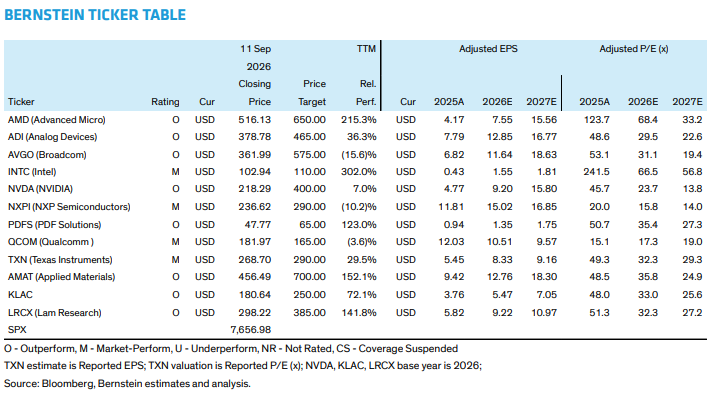
The report reaffirms optimism about the future of AI construction. Nvidia (NVDA.US), Broadcom (AVGO.US), and semiconductor equipment stocks are still the team's first choice in the sector. According to the report, Bernstein gave Nvidia a target price of $400 (“outperforming the market” rating, implying an upward margin of about 83%); for Applied Materials (AMAT.US), $700 (implied about 53%), Broadcom $575 (implied about 59%), KLAC.US (implied about 38%), Fanlin Group (LRCX.US) $385 (implied about 29%); AMD (AMD.US) (target price of 650 dollars, implied about 26%) AI requirements drive both CPU and GPU “Story” was rated “outperforming the market”; Intel (INTC.US), Qualcomm (QCOM.US), Texas Instruments (TXN.US), and NXP (NXPI.US) had simultaneous market ratings. Among them, Qualcomm was the only target with a target price lower than the current price ($165, implying about -9%).
Taken together, this sell-off caused by “one's own people” changed expectations rather than orders. If Bernstein's judgment holds true — it is the acceleration of cutting-edge training rather than computing power spending — then Monday's decline is closer to a concentrated vent of emotion; the hard indicators that are really worth tracking are whether AI companies' capital expenditure guidelines have been substantially revised, and the final pricing of the Anthropic IPO.