
Don't be afraid of oil prices, long-term debt, or interest rate hikes! Many Wall Street institutions are still bullish on US stocks, and Yardeni downplays concerns about AI slowing down
The Zhitong Finance App learned that despite the escalation of the Middle East conflict driving up oil prices, rising long-term US bond yields, and rising expectations of the Federal Reserve's interest rate hike, most Wall Street strategists still believe that as long as the pace of interest rate hikes is moderate, corporate profits are strong, and inflation remains unanchored, the US stock bull market is expected to continue.
Macro headwinds are at its peak, why is Wall Street still bullish?
The Middle East conflict recently escalated, and oil prices once soared to close to $109 per barrel last week, while US long-term Treasury yields hit a decades-high. The probability that the Federal Reserve will raise interest rates in September also soared sharply.
US stocks have continued to fluctuate since reaching record highs in mid-August, and investors worry that rising oil prices will increase inflationary pressure. The 10-year US Treasury yield was once close to 5%. This level is often seen as a risk sign that the stock market is rising. Swap traders currently price the probability that the Federal Reserve will raise interest rates on Wednesday is about 87%. This will be the first rate hike in three years. Nasdaq 100 futures, mainly technology stocks, fell 1.6% on Monday. However, the S&P 500 index fell less than 2% from its peak, supported by strong corporate profits.
Wall Street institutions, including Morgan Stanley, J.P. Morgan Chase, and Goldman Sachs, predict that any decline caused by expectations of the Federal Reserve's interest rate hike may be short-lived, given the company's good profitability.
Ben Snider, chief US stock strategist at Goldman Sachs, said: “The stock market usually struggles when the Federal Reserve starts raising interest rates, but we expect the bull market to continue. The market has already set prices to raise interest rates more than three times in the next year, and the company's profit and balance sheet are very stable.”
Morgan Stanley strategist Michael Wilson admits that if the impact of inflation is stronger than expected, there is a risk of a pullback in the stock market — that is, a 10% drop from the recent high. The geopolitical tension in the Middle East continues, and the rise in oil prices has resumed. However, Wilson added that the economic outlook is critical. “If strong nominal economic growth is the main driver, then the stock market can tolerate high back-end yields,” he said. “In other words, the stock market is still an effective hedge against inflation in the medium to long term.”
J.P. Morgan strategists said that short-term oil market trends may determine risk appetite. They pointed out that seasonal trends indicate that the stock market usually performs weakly in September, but it should not be assumed that this fluctuation will continue. The team led by Mislav Matejka wrote in the report: “As long as the Fed raises interest rates moderately and in a context of strong profit growth and unanchored inflation, the stock market should be able to withstand it.”
An analysis shows that the real threat to the bull market is not a single rate hike, but a full cycle of interest rate hikes. Since 1945, the S&P 500 has experienced 12 bear markets with declines of more than 20%, and 4 close bear markets with declines of 18% to 20%. Of these, 6 have directly entered recession following a cycle of interest rate hikes. Only two retracements were not due to the triggers mentioned above.
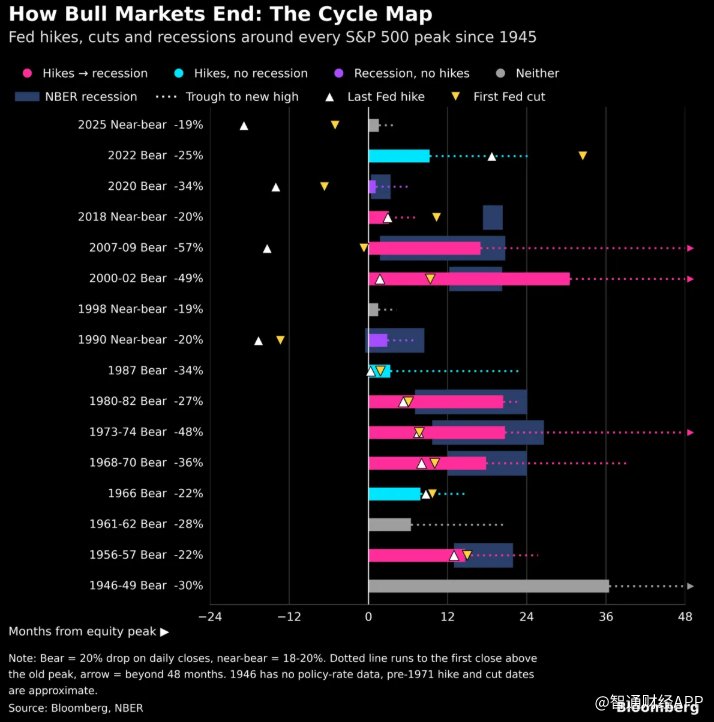
S&P 500 target price increase and disagreement: bulls persist, Bank of America and Citibank warn of short-term risks
Yardeni Research said in the report that despite rising oil prices, bond yields, and expectations of the Federal Reserve's interest rate hike, the S&P 500 did not respond sharply to macro headwinds. The agency reiterated the S&P 500 target of 8,400 points by the end of the year.
However, according to Yardeni Research, market dynamics have changed. “In recent weeks, the forward price-earnings ratio of major market indices has declined because the expected growth rate of forward earnings per share exceeds the increase in stock prices.” The agency said that since the beginning of the year, S&P 500 forward profits have risen by 28.1%, and the forward price-earnings ratio has declined by 12.9%, indicating that investors are unwilling to pay higher valuations for the company as in January. Yardeni Research raised its 2027 earnings forecast per share from $415 to $425 and lowered its forward price-earnings ratio forecast from 20.2 times to 19.7 times.
At the same time, several institutions have also reaffirmed or raised their S&P 500 targets in the past week.
Last week, HSBC raised the S&P 500 target from 7,650 points to 8,100 points due to stronger company profits, continued investment in AI, and the resilience of the US economy. HSBC expects the profit growth rate of the S&P 500 index to be close to 40% in the first half of 2026, and at least 25% in the second half of the year.
HSBC said that although technology stocks are still the main driving force, the resilience of consumer spending and the strong performance of healthcare, industrial and consumer goods companies supported overall profit growth. However, HSBC also warned that seasonal weakness in the fall, economic data, regulatory changes, and geopolitical tension may cause short-term fluctuations, but at the same time emphasized that strong corporate fundamentals should support the further rise of the S&P 500.
Barclays also raised its 2026 S&P 500 target from 7,800 points to 7,950 points, citing that second-quarter earnings were better than expected, while raising the earnings forecast per share from $337 to $365. According to the bank, more than 86% of the company's earnings exceeded expectations, and core earnings per share increased by more than 50% year over year. Barclays expects AI-driven investments to continue, and predicts capital expenditure for hyperscale enterprises to exceed $1.1 trillion in 2027, an increase of 67%. Despite high bond yields increasing the cost of profits falling short of expectations, the bank maintained its 2027 index target at 8,800 points.
Bank of America has also joined the ranks of raising the target price, but it is more cautious. Bank of America stock and quantitative strategist Savita Subramanian raised the S&P 500 target from 7,100 points to 7,400 points, but the new target still means about 3% downside from current levels, highlighting the bank's caution about short-term trends. Subramanian said that the stock market is entering a “period of seasonal weakness,” and a correction is probably long overdue. She pointed out that the S&P 500 only experienced a 5% correction this year, and according to Bank of America statistics, the average was about three times in previous years; at least a 10% correction usually occurs once a year, but the last such decline dates back to the spring of 2025.
Here are a few major Wall Street agencies' targets for the 2026 S&P 500:
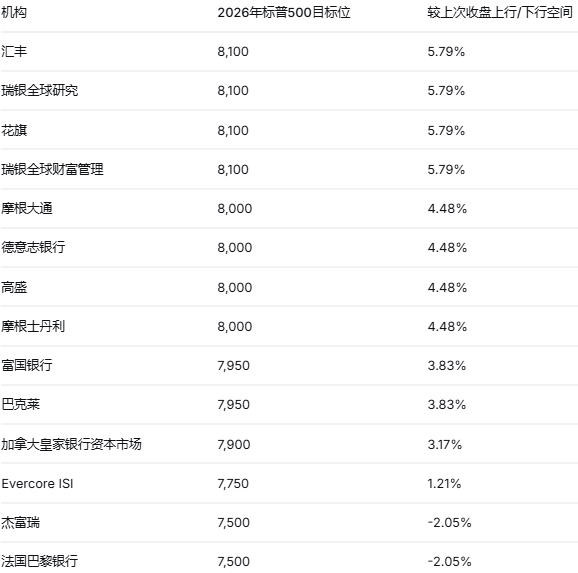
Notably, not all agencies are equally optimistic. Citi warned on Friday that its target for the end of the year S&P 500 may be too high, as rising oil prices and rising bond yields cast a shadow over the outlook for the US stock market. Strategist Scott Chronert said that Citi's current target of 8,100 points for the S&P 500 by the end of 2026 seems “aggressive” because macro factors have changed in the past few weeks. Chronert still believes that earnings should be strong in the third quarter, but in order for the index to reach its target, under the current uncertainty, it will have to rely more on a rebound at the end of the year.
The analyst also pointed out that despite the complex and changing economic situation, “the Fed's next rate hike is not a foregone conclusion,” he also reiterated that continuing concerns about inflation may mean that interest rate hikes can ease uncertainty, and if the Fed actually raises interest rates, it may raise interest rates twice instead of once this year.
AI alone supports the rise, Yardeni: Calls for a slowdown are difficult to stop the capital expenditure cycle
Most of the increase in the S&P 500 this year was due to the AI boom. Shares of companies such as Micron Technology, Intel, and AMD will achieve three-digit growth in 2026. Meanwhile, the Global X Artificial Intelligence and Technology ETF (AIQ) also outperformed the S&P 500 this year.
The Kobeissi Letter said on the X platform that against the backdrop of such weak performance in the bond market, the S&P 500 is only one step away from a record high, which is amazing. The agency also stated, “Without AI, the S&P 500 would now be at least 50% lower. Without a spike in oil prices, the S&P 500 would be above 9,000 points. AI alone is supporting the global economy.”
However, differences within the industry over the speed of AI development are beginning to suppress investor sentiment. Anthropic CEO Dario Amodei proposed over the weekend to slow down the pace of AI development to allow more time to address security issues. OpenAI's Sam Altman and SpaceX's Elon Musk expressed support for increased regulation. In contrast, the CEOs of Microsoft and Meta are against slowing development. Altman also said OpenAI won't go public this year. Meanwhile, US President Trump downplayed concerns, believing that AI risks can be managed through guardrails.
Ed Yardeni, president of Yardeni Research, tried to tone down concerns about AI slowing down on Monday. He said that the market is worried that tech companies may slow down AI development, but this is unlikely to disrupt broader infrastructure construction. “The reality is that there are already restrictions on the construction of data centers, etc. I don't think infrastructure construction will slow down.” He maintained the S&P 500 target of 8,400 points by the end of the year.
Yardeni believes that the weekend calls to slow down AI are probably more about establishing security than reducing capital expenses. He said that as technology becomes more powerful, stronger guardrails may become necessary, but this will not necessarily weaken the investment cycle. He also pointed out that productivity data supports the AI-driven growth narrative and believes that the economy is still in a “productivity-driven technological boom.” Yardeni also proposed the possibility of strengthening cooperation between the US and China in AI regulation, saying that the two countries face similar challenges in advancing technology and may be motivated to establish rules around its development.
As far as the market is concerned, Yardeni's view is that AI concerns may cause short-term fluctuations, but are unlikely to stop the infrastructure investment needed to support the technology's continued expansion.