
The EV Bubble Has Burst. How to Play Rivian Stock Now.
Electric vehicle (EV) stocks are having a dismal run, to say the least. Many have simply gone bankrupt as the euphoria that we saw between 2020 and 2021 has faded away. Some have survived but remain a pale shadow of their past, Lucid Group (LCID) and Rivian (RIVN), for instance. The former almost became a $100 billion company in 2021 but now has a market cap below $2 billion and is a penny stock despite a 1-for-10 reverse stock split last year.
The EV Bubble Has Burst
Rivian’s market cap soared past $150 billion following its 2021 IPO, which, for context, was even higher than Ford Motor Company (F) and General Motors (GM) and was among the biggest signs of an underlying bubble in the industry. Along with the euphoria over vehicle electrification—remember those reports calling for massive EV adoption rates over the coming years—an abundance of cheap money helped EV stocks rise to astronomical levels in 2021.
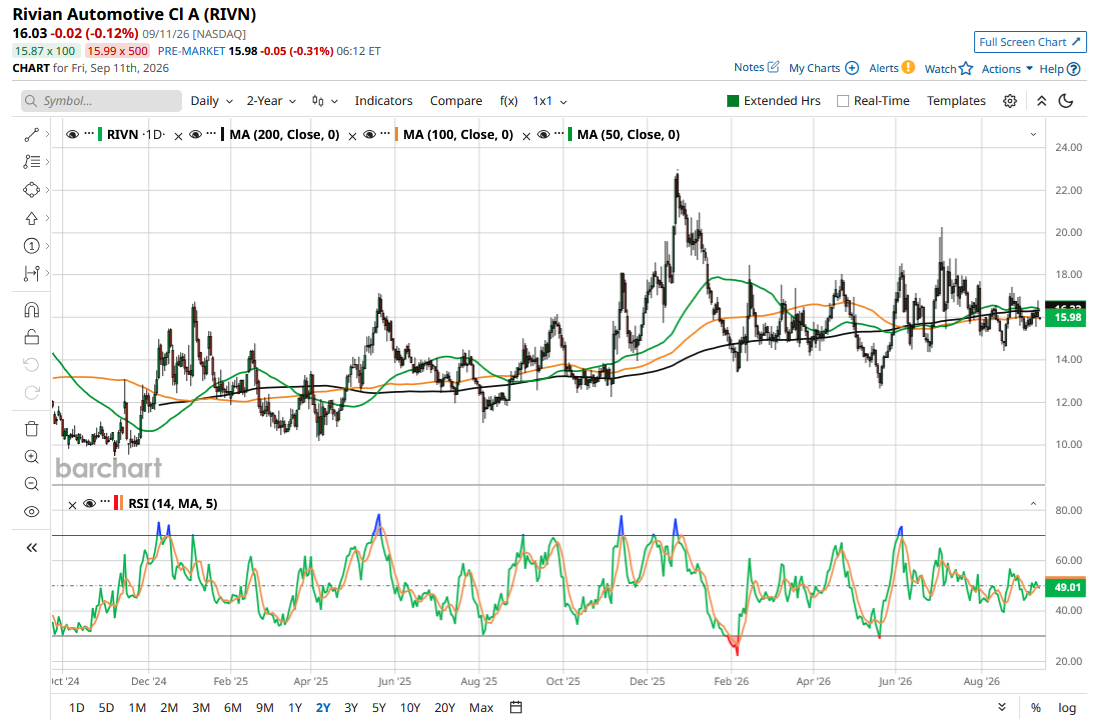
However, U.S. EV adoption rates have been much slower, and Detroit's Big 3 had to book billions of dollars in losses as they wrote down the value of their EV assets. Along with low demand, the auto tariffs and the easing of fuel economy standards are taking a toll on industry profitability. For startup EV players like Rivian, this is adding to losses and making the path to sustainable profitability even more difficult.
Cut to 2026, and Rivian’s market cap is under $25 billion. Tesla (TSLA) is an exception here, and the stock rose to a new all-time high last December. The price action had little to do with its EV business, which has reported degrowth for two consecutive years, but rather with optimism about its robotaxi and physical artificial intelligence (AI) business.
Lucid Group Has Survived the Slump Due to Saudi Cash Infusion
As I have noted for the last few years, Rivian and Lucid are perhaps the only two names worth talking about in the startup EV ecosystem. Both companies offer quality products that have received rave reviews from credible third parties. Both have relatively strong balance sheets, and importantly, investors have been backing them with cash even though Lucid has been hooked on capital raises to fund its cash burn.
In fact, if I were to only bet on survival, I would pick Lucid. Not only has Saudi Arabia’s Public Investment Fund (PIF) poured billions of dollars into the company, but The Kingdom went a step further with Saudi billionaire Prince Alwaleed bin Talal Al Saud disclosing a 5% personal stake in July. However, Lucid has been found wanting on execution, and Saudi backing cannot be the sole reason for owning that stock, at least at these levels.
Uber and Volkswagen Have Invested in Uber
Rivian has been raising cash as it is also battling cash burn. However, its capital raises have been a lot more diversified and not dependent on one firm. In 2024, Volkswagen (VWAGY) announced it would invest up to $5.8 billion in Rivian and is now the company’s biggest shareholder, a position that was previously with Amazon (AMZN).
Earlier this year, Uber (UBER) announced that it would invest up to $1.25 billion in Rivian and buy up to 50,000 of its upcoming R2 vehicles for its robotaxi fleet. The deal was much larger than the triparty robotaxi deal between Uber, Lucid, and Nuro.
Apart from Uber and Volkswagen, Rivian also secured a loan from the U.S. Department of Energy, which it renegotiated to $4.5 billion in April, down from the prior commitment of $6.57 billion.
RIVN Began R2 Deliveries
In June, Rivian began deliveries of its R2 vehicles, which would help it expand its target market. Notably, the midsize SUV segment that R2 would cater to is the largest subsegment in the U.S. auto market. On a related note, Tesla’s Model Y midsize SUV has been the best-selling model across both EVs and internal combustion engine (ICE) cars for the last two years. Rivian is also progressing in vehicle autonomy, and its software would power the robotaxis in the deal with Uber.
Looking at earnings, Rivian has turned positive at the gross profit level but withdrew its guidance of positive adjusted earnings before interest, tax, depreciation, and amortization (EBITDA) in 2027.
However, while Rivian is among the rare quality names in the U.S. startup EV space, we also need to look at the valuations. RIVN trades at a forward price-to-sales (P/S) multiple of 2.35x, which I don’t find tempting enough to buy the stock here, as there isn’t much margin of safety at these levels. I sold much of my Rivian stock amid last year’s rally and haven’t added to positions since, as while the stock has come off those highs, the risk-reward hasn’t been attractive.
On the date of publication, Mohit Oberoi had a position in: RIVN , F , GM , TSLA , AMZN . All information and data in this article is solely for informational purposes. For more information please view the Barchart Disclosure Policy here.