
How Cloud Infrastructure Strategy Can Keep Taking Oracle Stock Even Higher
Oracle Corporation (ORCL) is turning heads on Wall Street, and its latest earnings report gives investors plenty of reason to pay attention. The software giant delivered one of its strongest quarters on record, with cloud infrastructure revenue surging triple digits year-over-year (YoY) as its infrastructure-as-a-service (IaaS) strategy gained serious momentum. The company's growth came in stronger than almost anyone on the Street expected, yet Oracle shares still slipped following the earnings announcement. Wall Street analysts, however, were far more impressed.
J.P. Morgan reiterated its “Outperform” rating and $200 price target, while Jefferies maintained its “Buy” rating with a $290 target, highlighting Oracle’s significant backlog. Citi also reaffirmed its “Buy” rating, setting a hefty $330 price target. Despite the lukewarm reaction to Oracle’s strong Q1 earnings report, multiple analysts continue to make a bullish case for the company, pointing to its cloud growth and massive backlog as key reasons for optimism. With the stock facing a post-earnings pullback while analysts stand by their bullish outlooks, ORCL may be worth a closer look.
About Oracle Stock
Headquartered in Austin, Texas, Oracle is a global technology powerhouse that helps businesses manage their data, run critical operations, and embrace the digital age. Its key offerings span database software, Oracle Cloud Infrastructure (OCI), and enterprise applications such as Fusion ERP for finance, human resources, and supply chain management, along with NetSuite for growing businesses and Oracle Health for healthcare organizations.
Together, these solutions help companies store information securely, automate everyday tasks, and make smarter business decisions. Oracle earns revenue primarily by selling cloud services and subscriptions, providing ongoing support for its software, and licensing database and other technology products. Its cloud business includes infrastructure that companies rent to power applications and AI workloads, while its enterprise applications generate recurring subscription revenue.
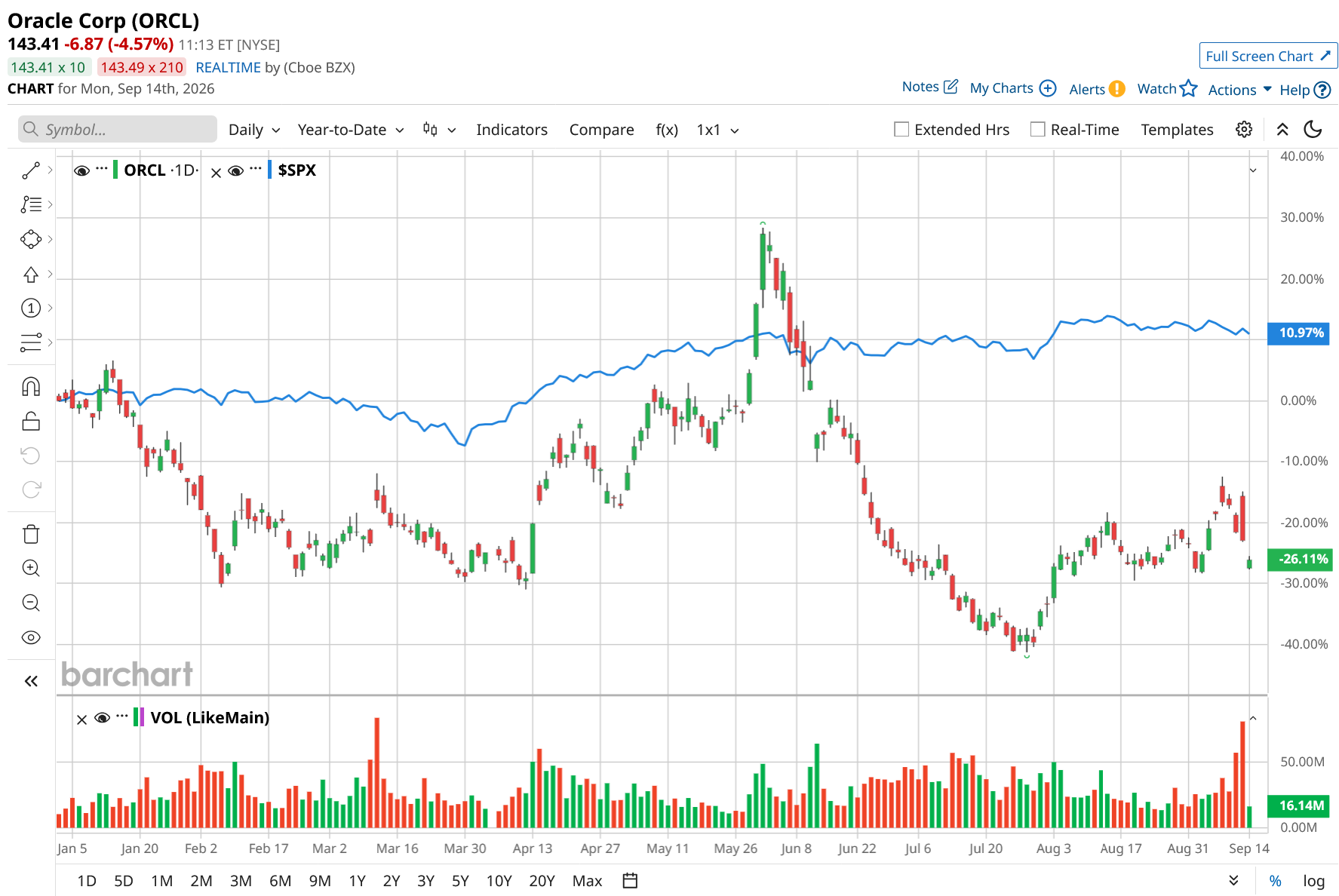
Today, Oracle is betting big on artificial intelligence and cloud computing, investing in AI-ready data centers and infrastructure to meet surging demand for AI services. Oracle’s AI ambitions may be grabbing headlines, but its stock is facing a tough reality check. Currently commanding a massive market capitalization of about $432.88 billion, Oracle shares are down roughly 27% this year as investors grow increasingly concerned about the enormous debt and capital spending needed to build out its artificial intelligence data centers.
The heavy investment has pushed free cash flow deep into negative territory while increasing the company’s reliance on credit markets. Over the longer term, the stock has fallen 51%, raising questions about whether Oracle’s AI growth story can overcome its mounting financial pressures. The performance looks even more disappointing when compared with the broader market. While the S&P 500 Index ($SPX) has gained about 15.3% over the past 52 weeks and 11% so far in 2026, ORCL stock has struggled to keep pace, heavily lagging the benchmark.
Inside Oracle’s Q1 Earnings Report
Oracle’s fiscal 2027 first-quarter earnings report, published on Sept. 10, delivered a blockbuster performance, fueled by an unprecedented acceleration in enterprise cloud demand that sent both revenue and earnings soaring past Wall Street’s expectations. The software giant posted record Q1 total revenue of $19.35 billion, up 30% YoY and ahead of analysts’ estimate of $19.13 billion.
Total cloud revenue jumped 62% to a record $11.61 billion, but the real star was Oracle Cloud Infrastructure (OCI), where revenue skyrocketed 121% to $7.4 billion. And Oracle wasn’t just riding the AI wave. It was rapidly expanding to meet it, bringing 850 megawatts of new data center power online during the quarter, nearly triple the pace of the previous quarter.
Meanwhile, Cloud Applications (SaaS) revenue climbed 10% to $4.2 billion, software revenue fell 3% to $5.5 billion as customers continued migrating from on-premises software to the cloud, services revenue rose 5% to $1.4 billion, and hardware revenue increased 15% to $0.8 billion. Oracle’s AI ambitions are also reflected in its eye-popping $664 billion Remaining Performance Obligations (RPO), boosted by a massive intake of artificial intelligence contracts. Non-GAAP EPS surged 30% YoY to $1.92, comfortably beating Wall Street’s estimate of $1.74.
But beneath the impressive growth lies a growing financial challenge. Oracle is pouring billions into data centers to capture a bigger share of the AI boom, yet its weaker cash position and lower credit rating compared with hyperscaler competitors have investors concerned. The company now carries $125 billion in debt, while negative free cash flow widened sharply to $5.4 billion from negative $362 million a year earlier.
Capital expenditures also exploded to $28.50 billion in Q1 from $8.50 billion last year. Despite these concerns, Oracle is guiding for another strong quarter, with Q2 fiscal 2027 total revenue expected to grow between 30% and 34% and cloud revenue projected to surge about 65% to 71%. Moreover, non-GAAP EPS is forecast at $1.85 to $1.93, representing 21% to 25% growth.
How Do Analysts View ORCL Stock?
Wall Street remains bullish on ORCL stock following its strong Q1 results, with J.P. Morgan, Jefferies, and Citi reiterating their positive ratings and price targets of $200, $290, and $330, respectively. J.P. Morgan highlighted Oracle’s 30% revenue growth, $26 billion sequential RPO increase, and 850 MW of new data center capacity. The company also secured more than $30 billion in new AI contracts, while operating margins held steady at around 42%, showcasing strong operational discipline.
Jefferies emphasized Oracle’s massive $664 billion backlog, up 46% YoY, driven by more than $30 billion in new AI cloud contracts. Citi, meanwhile, pointed to Oracle’s delivery of over 300,000 GPUs, a 20% premium on renewed and resold older GPUs, and the potential for faster RPO-to-revenue conversion. Multicloud database revenue surged 353% YoY, while multicloud customers grew 180%. With AI demand accelerating and cloud infrastructure expanding, analysts see further growth potential for Oracle.
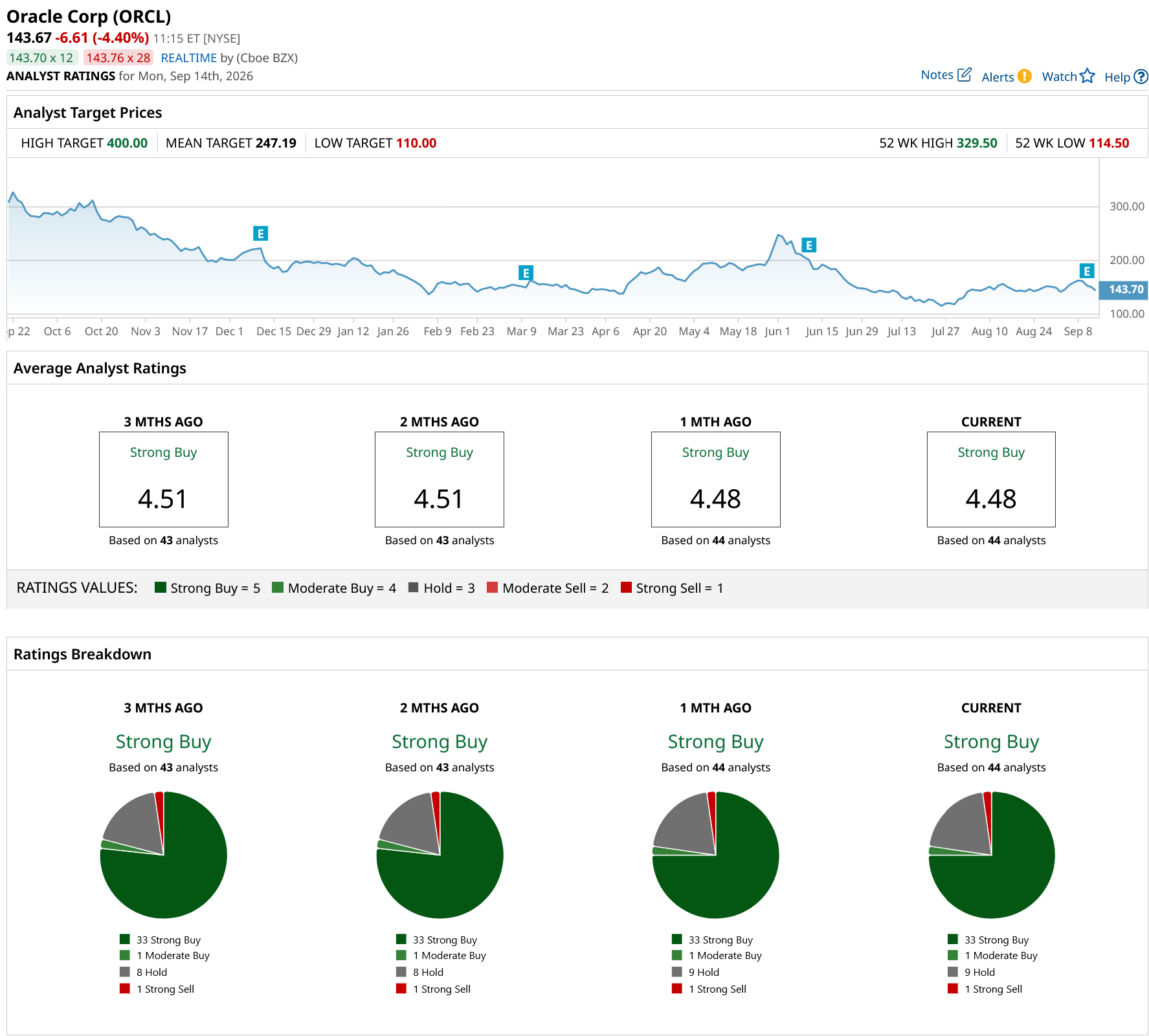
Overall, Wall Street is bullish about ORCL stock, with it earning a consensus “Strong Buy” rating. Of the 44 analysts offering recommendations, 33 suggest “Strong Buy,” one gives “Moderate Buy,” nine sit on the sidelines with “Hold,” and only one gives a “Strong Sell” rating. Oracle’s upside potential is turning heads, with the average price target of $247.19 suggesting a 72% rally, while the Street-high target of $400 points to a staggering 178% upside from current levels.
On the date of publication, Anushka Mukherji did not have (either directly or indirectly) positions in any of the securities mentioned in this article. All information and data in this article is solely for informational purposes. For more information please view the Barchart Disclosure Policy here.