
Bloom Energy Is Up Big This Year. Is It Too Late to Buy?
Key Points
AI data centers need power, and the electrical grid cannot supply it alone.
Few companies can match Bloom's installation time for its power servers.
Bloom Energy (NYSE: BE) has been on a tear in 2026 -- and for good reason, too. Imagine, for a second, an extraordinarily intelligent machine, one that can process mountains and oceans of information within seconds, resolve age-old math problems, and write computer code faster than you can spell your first and last names.
Now imagine that powerful machine sitting there, in a dark warehouse of servers, doing absolutely nothing, because there's no power to serve it. If you can imagine that, then you can understand, at least figuratively, the massive opportunity that still remains before Bloom.
Missed Nvidia in 2009? This Rare Signal Is Flashing Again. In 2009, a "Double Down" signal flashed for a little-known chipmaker called Nvidia. For the first time in years, that same "Total Conviction" signal is flashing for a company 1/100th the size of Nvidia. Continue »
If 2026 has shown only the first phase of artificial intelligence (AI), then successive phases will need far more power than even today's data centers consume. Bloom's fuel-cell systems could become even more highly sought as the preferred power source for these data-crunching, power-thirsty machines.
BYOP: The new standard for AI data centers
In February, President Donald Trump told tech companies that they have to start building their own power plants. In his words:
We're telling the major tech companies that they have the obligation to provide for their own power needs ... We have an old grid. It could never handle the kind of numbers, the amount of electricity that's needed. So I'm telling them, they can build their own plant. They're going to produce their own electricity.
Trump is right, in a sense: The U.S. grid was mostly built in the 1960s and 1970s. It is already strained in many areas, and expanding it fast enough to meet data centers' growing needs is a major challenge to utilities. Besides, tech companies don't want to rely on the grid. It takes too long to connect to established grid networks, considering the pace at which AI is moving.
Bloom's solid-oxide fuel cell servers, which are basically compact power plants, can be operational in as little as 90 days. Once installed, they let data centers generate electricity on-site, thereby bypassing the long wait for a utility to deliver the power they need. The servers use fuel, like natural gas, to generate electricity around the clock, which gives them an advantage over weather-dependent power sources like wind and solar.
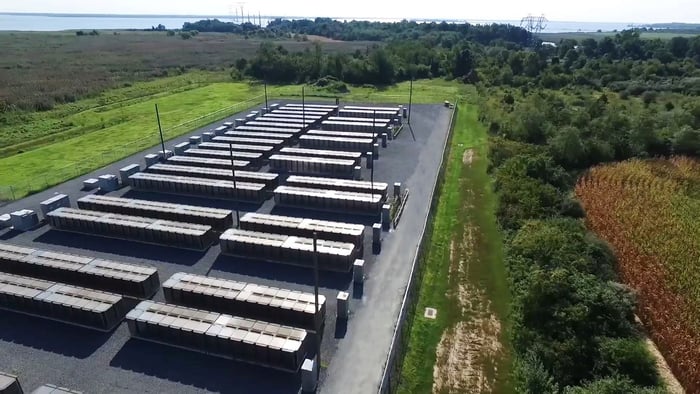
Image source: Bloom Energy.
Bloom's product revenue has, unsurprisingly, soared. Total revenue last quarter more than doubled year over year, and full-year guidance is now up to $4.2 billion, roughly double last year's sales.
That's enormous growth for an energy tech company like Bloom, but I think it's only the beginning. Few companies can match Bloom's time-to-power speed, and for data center operators facing long grid delays, getting power in three months or less is a compelling pitch. One day, this could change -- nuclear reactors, for instance, could give customers more options -- but Bloom has a chance right now to win that business while competing projects are still working through regulatory approvals and permits.
An investment in Bloom, in short, is a belief that AI technology will need more power than today's consumption. If you believe that, then Bloom could be a way to play the energy side of that future.
Steven Porrello has positions in Bloom Energy. The Motley Fool has positions in and recommends Bloom Energy. The Motley Fool has a disclosure policy.