
The AI reasoning era ignites the ASIC demand frenzy! Google's demand for TPU has exploded, and a $300 billion super blue ocean has surfaced
The Zhitong Finance App learned that Bernstein, one of the largest investment banks on Wall Street, released a research report saying that the strong expansion trend of Google's TPU computing power system on AI applications around the world is opening up new growth space for MediaTek Inc (MediaTek Inc) far exceeding the traditional mobile phone chip business. MediaTek's target price was raised sharply from NT$4,380 to NT$5,500 to maintain the “outperform the market” rating and its preferred position within the scope of coverage. The core basis is the expansion of the customized AI computing accelerator (TPU/AI ASIC/XPU) market and the increase in Google's project volume and operating leverage. Google TPU is the most typical AI ASIC/XPU chip technology route for major cloud computing companies to develop their own.
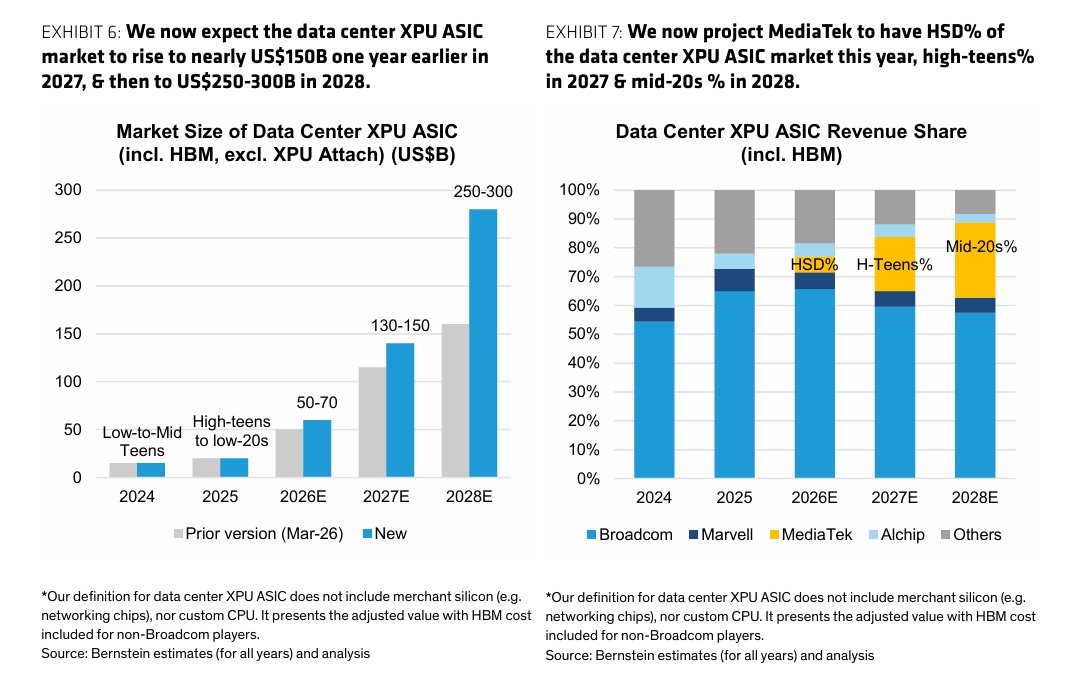
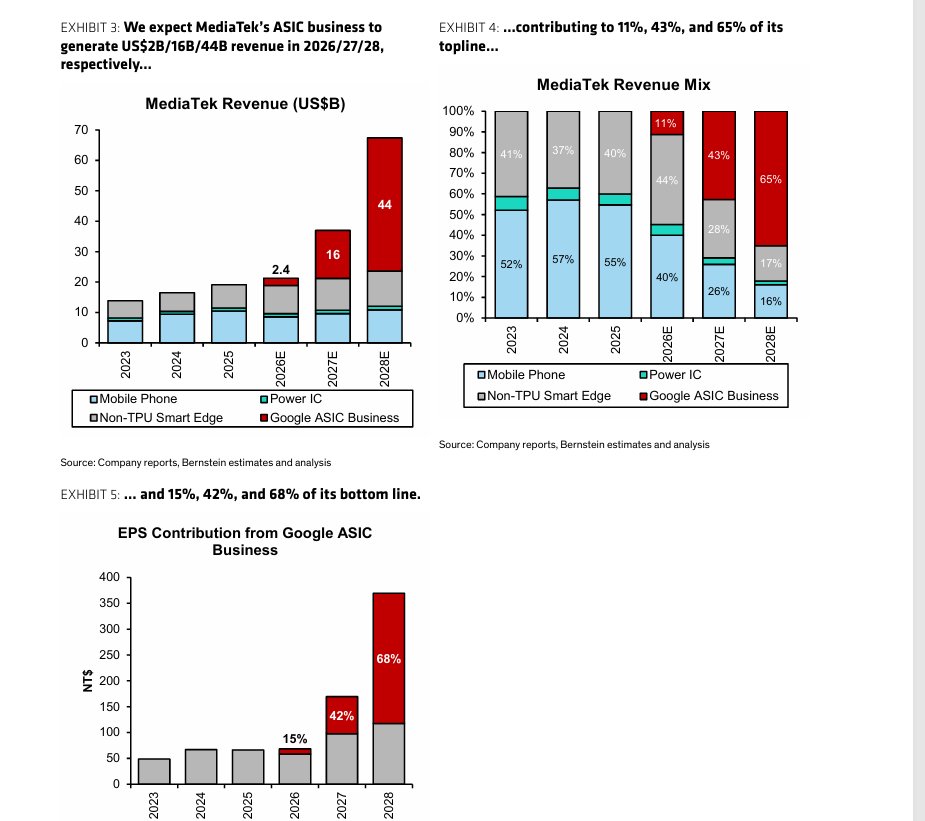
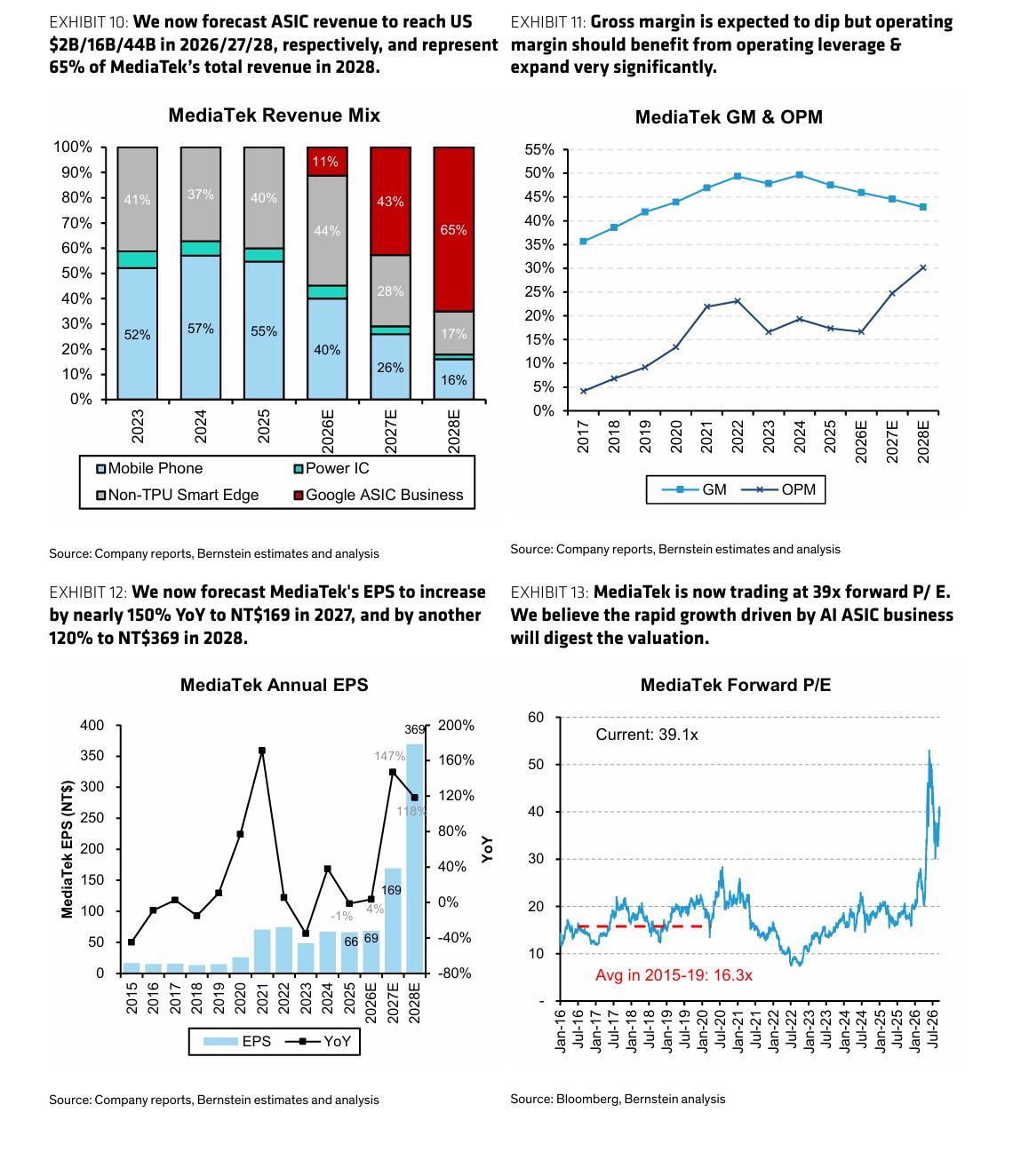
The Bernstein analyst team predicted MediaTek's 2026-2028 ASIC revenue of $2.4 billion, $16 billion, and $44 billion, respectively. The report predicts that ASIC's share of the company's revenue will rise from 11% in 2026 to 43% in 2027 and up to about 65% in 2028, with contributions to earnings per share reaching 15%, 42%, and 68%, respectively. Meanwhile, Bernstein raised the 2028 global data center XPU ASIC market forecast from 140 billion to 160 billion US dollars to 250 billion to 300 billion US dollars. The forecasts for 2026 and 2027 are 50 billion to 70 billion US dollars and 130 billion to 150 billion US dollars, respectively.
These latest predictions mean that stock market investors' investment logic in MediaTek is simultaneously benefiting from the expansion of the industry and a significant increase in the company's own AI ASIC market share — the report expects its share to reach about a quarter in 2028.
For mature models, open source models, and AI agent workloads that have a relatively stable model structure, huge call volume, and can maintain high utilization rates for a long time, special AI chips such as TPU (Google TPU is the most typical AI ASIC technology route developed by major cloud computing companies) can be deeply optimized around low-precision matrix computation, memory access, and chip interconnection, thereby improving the cost per token, throughput per watt, and overall cost of ownership; at the same time, Google's TPU computing power clusters can also undertake large-scale training tasks, so the more accurate trend is GPU and ASIC /TPU forms a heterogeneous division of computing power.
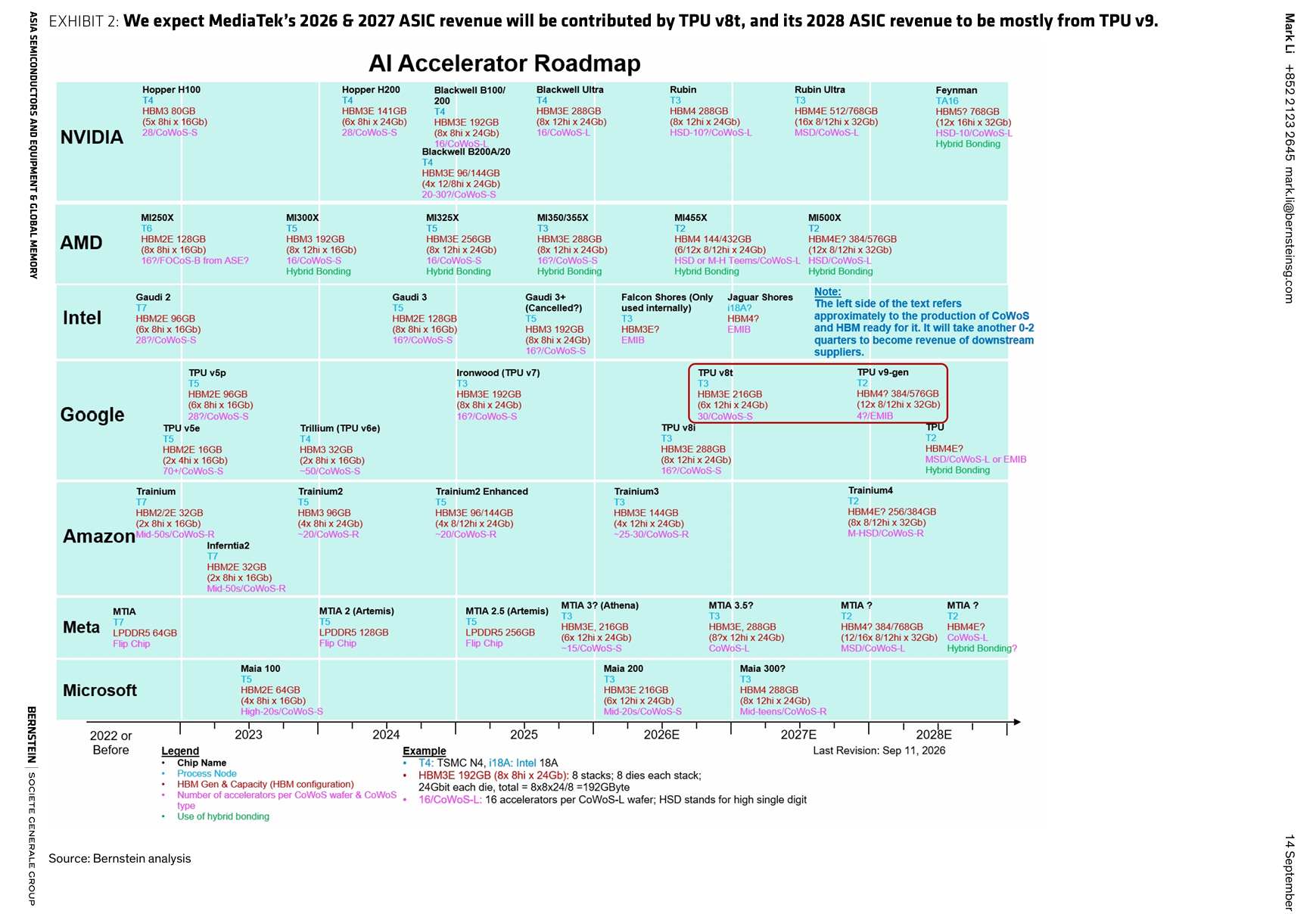
In other words, AI training operator processes and cutting-edge AI workloads with the most complex architectures and the fastest changing rate still require AI GPU clusters — cutting-edge model pre-training, reinforcement learning, and rapidly changing new operators still rely more on GPU programmability, CUDA ecology, and NVLink/NVSwitch cluster capabilities, while large-scale AI inference workloads around mature and open source AI models, Copilots, and AI Agents (AI agents) are increasingly suitable for dedicated self-developed AI chips. Specifically, Google divided the eighth-generation TPU into a training-type TPU 8t and an inference TPU 8i:8i that optimizes KV Cache and low-latency inference through larger on-chip SRAM, 288GB HBM, and a dedicated pooled communication engine. Officially, its inference cost is up to 80% higher than Ironwood.
According to institutions such as Morgan Stanley and Wedbush Securities that continue to be optimistic about the investment prospects of the AI computing power industry chain, the almost endless cutting-edge computing power in the AI reasoning era and the computing power demand surrounding AI agents enabled AI ASIC to grow into an important component of the second trillion-level computing power ecosystem without destroying GPU demand — instead further strengthening the AI computing power industry chain investment logic that “the AI semiconductor supercycle is not a single GPU cycle, but an exponential increase in the silicon content of the entire data center.”
TPU volume rewrites profit landscape: MediaTek is at the forefront of ASIC expansion
The key to whether Bernstein's expectations for MediaTek's strong growth curve can be fulfilled is the mass production capacity of Google's TPU computing power system for two consecutive generations. According to the Bernstein analyst team led by senior analyst Mark Li, the first project, TPU v8t, has entered mass production, and the test results are satisfactory; MediaTek's strong revenue in August may have contributed to ASIC.
The forecast of $16 billion for 2027 is based on guaranteed production capacity: MediaTek can allocate wafer production capacity from other products. The real tension is mainly TSMC CoOS advanced packaging. Bernstein believes it has achieved sufficient production capacity with Google's help. In 2028, it is mainly driven by TPU v9, the second large-scale AI computing power project. Mass production is expected to begin at the end of 2027, using the EMIB-T package; higher chip complexity and average sales price, combined with an increase in package supply, will jointly support the $44 billion revenue forecast. It should be added that Bernstein's industry size and share tests use a uniform caliber that includes the value of HBM, while MediaTek's own ASIC revenue does not include HBM.
Substrates have become an important constraint for this generation of products, and Ibiden, Shinko, and Xinxing have been mobilized to prepare for supply, but each company's experience and yield progress are different. It can be seen from this that the transmission of TPU demand to supply chain profits requires simultaneous cooperation of wafers, HBM, packaging, and substrates; what determines the pace of delivery is often the link with the tightest supply and the slowest yield rise.
Bernstein is bullish on MediaTek, mainly betting on profit fulfillment. At the same time, subsequent competition has been included in the valuation. According to the forecast model compiled by Bernstein, EPS for 2027 and 2028 was NT$169.35 and NT$369.45 respectively, which is about 22% and 38% higher than the market consensus; the 2028 forecast was 65.5% higher than before, but the 2027 forecast was slightly reduced by 0.7%, so the focus of this upgrade is on a longer term. The company's gross margin in the model fell from 45.9% in 2026 to 42.9% in 2028, but the operating margin rose from 16.6% to 30.1%, reflecting operating leverage formed by revenue growth faster than cost growth.
Considering that the 2029 Google project, tentatively called “v10,” may introduce more suppliers, Bernstein reduced the valuation ratio from 22 times to 18 times; potential competitors include Broadcom, Shixin, Creative, and possibly participating AMD and Marvell; MediaTek's defense capabilities come from scale, IP portfolio, cost, procurement and project history, and expanding other AI customers is still a potential increase. The partnership promoted with Nvidia through NVLink Fusion could lead to more ASIC projects, higher profit margins, and rack and subsystem revenue. The report has not included these benefits in the model.
Bernstein said that Nvidia and Google's participation in convertible bond financing will also help deepen cooperation. Google's potential shareholding limit is only 0.2%, which does not mean that the two sides have formed an exclusive relationship. Traditional businesses also need to be included in the judgment: Bernstein narrowed the forecast for the decline in global mobile phone shipments in 2026 from 15% to 13.5%, and still expects MediaTek's mobile phone business revenue to drop 18%, partially buffered by about 20% Smart Edge growth, and progress in transferring high storage costs to customers is also better than expected.
From the length of computing power to the cost per token, ASIC demand is sweeping the world
Strong AI computing power demand support linked to the AI computing power industry chain level has been clearly reflected in the strong performance of industry chain leaders, South Korea's continued record semiconductor exports, and long-term capacity agreement arrangements. However, the stock market's pricing for this computing power growth curve is still being adjusted repeatedly.
According to official data from South Korea, semiconductor exports reached 46.65 billion US dollars in August 2026, up 209% year on year; from September 1 to 10, semiconductor exports increased 270.1% year on year. Nvidia announced on August 26 that revenue for the second quarter of fiscal year 2027 was US$96.2 billion, up 106% year on year, of which data center revenue was US$89 billion, up 117% year on year, further reflecting the expansion of AI infrastructure procurement. At the market level, the South Korean stock market recovered after a sharp decline at the end of July. The Philadelphia Semiconductor Index rebounded more than 20% from the July 29 low on August 13; however, by the close of trading on September 14, the Fee Half Index fell 5.86% in a single day.
Anthropic, which is preparing for a record IPO in the US stock market, is also expanding the supply of computing power through long-term agreements. It announced in April of this year that it will invest more than 100 billion US dollars in AWS-related technology over the next ten years to obtain up to 5 gigawatts (GW) of new capacity to train and operate Claude; another agreement signed with Google and Broadcom involves several gigawatts of next-generation tensor processing unit (TPU) capacity, which is expected to be launched one after another starting in 2027.
Facebook's parent company Meta is also expanding various computing platforms: in February, it announced a partnership with AMD to deploy Instinct GPUs of up to 6 GW, and signed an expansion agreement with CoreWeave in April to obtain AI cloud capacity that will continue until the end of 2032, focusing on inference workloads. These agreements support Bernstein's judgment on total market expansion: demand sources such as Google, Anthropic, OpenAI, and Amazon have increased, giving multiple vendors related to key AI chips the opportunity to grow simultaneously.
Together, the above data shows that infrastructure demand at the AI computing power level has already generated large-scale actual procurement and supplier revenue. These long-term commitments have increased the visibility of future chip, computer room, and electricity demand, while also making supplier delivery capacity, financing costs, and actual customer usage become key variables in AI investment returns. As far as MediaTek's fundamentals themselves are concerned, MediaTek will mainly benefit from TPU v8t from 2026 to 2027, and TPU v9 in 2028. The directly trackable growth path is still the Google project listed in the report; other companies' computing power promises first represent industry demand, and whether they can be converted into MediaTek revenue also depends on specific supplier choices, chip plans, and delivery arrangements.
Token economics in the AI inference era is completely different from AI training workloads. Training includes forward propagation, backward propagation, gradient synchronization, and frequently changing research-based operators, which place more emphasis on versatility, software maturity, and cluster expansion capabilities; inference can be split into computationally intensive prefills (prefills) and memory bandwidth, KV caching, and latency-sensitive decoding. ASIC/XPU can remove unnecessary general-purpose circuits and harden FP8/FP4 low-precision matrix operations, attention mechanisms, mixed expert models (MoE), KV cache, and data movement paths, thereby improving the number of tokens per watt, number of tokens per dollar, and the certainty of service level agreements (SLAs).
It should be emphasized that although the model call mode of AI agents is more suitable for ASICs than GPUs, their planning, tool call, search enhanced generation (RAG), and state management still require collaboration between CPU, memory, network, and storage, so the intelligent era will further strengthen the “heterogeneous computing system.”
According to a Microsoft research report, the company's customized AI ASIC — the MAIA 200 — has achieved a 30% increase in performance per dollar compared to the latest generation hardware in its fleet, and its self-developed MAI model has improved performance per watt by about 40% when running on the MaiA 200. This is the most dangerous competitiveness of ASIC/XPU in the age of reasoning: when billions of similar token generation tasks can be highly standardized, the flexibility premium of Nvidia-led “universal GPUs” may not necessarily be worth paying for every inference request.