
3 U.S. Defense Stocks With Direct Exposure to Missile and Radar Replenishment
Wartime spending is back in the headlines, with US$33.4b already committed and hundreds of millions in damage to US facilities reminding investors how quickly defense budgets can shift. That kind of real world stress test tends to expose where supply chains are stretched and which contractors are positioned to respond. This article walks through 3 U.S. Defense and Aerospace Stocks screener picks that appear particularly exposed to today’s news flow, and outlines what that could mean for your portfolio decisions.
The stocks highlighted below are just a starter pack, with the full screen surfacing 34 more U.S. defense and aerospace companies that show similarly compelling narratives not covered here. If you want to get straight to work, use the U.S. Defense and Aerospace Stocks screener to identify, filter and analyze the ideas that best fit your own conviction.
Park Aerospace (PKE)
Overview: Park Aerospace develops advanced composite materials and parts for aircraft and missile structures, supplying adhesives, lightning protection and ablative solutions worldwide.
Operations: Park Aerospace generates about US$76 million from Aerospace & Defense, with roughly US$73 million of that tied to North America customers.
Market Cap: US$691 million
Park Aerospace illustrates the role materials suppliers can play in a defense upcycle, since its composites are used in aircraft, engines and missile systems that may need to be replaced and upgraded as wartime wear and tear builds.
"The push to replenish and then expand missile defense stockpiles after recent conflicts, combined with the call to roughly quadruple production of high end weapon systems, points to sustained demand for Park’s ablative materials for solid rocket motors, which directly supports revenue and can improve capacity utilization driven margins."
What happens to Park Aerospace’s earnings power if a single key assumption about long term missile procurement intensity quietly shifts direction?
That kind of shift is exactly what sits at the center of the full narrative for Park Aerospace, where missile demand, capacity constraints and capital returns all collide.

Ducommun (DCO)
Overview: Ducommun provides engineering and manufacturing services for mission critical electronic systems and aerostructures used across military aircraft, weapon systems and space programs.
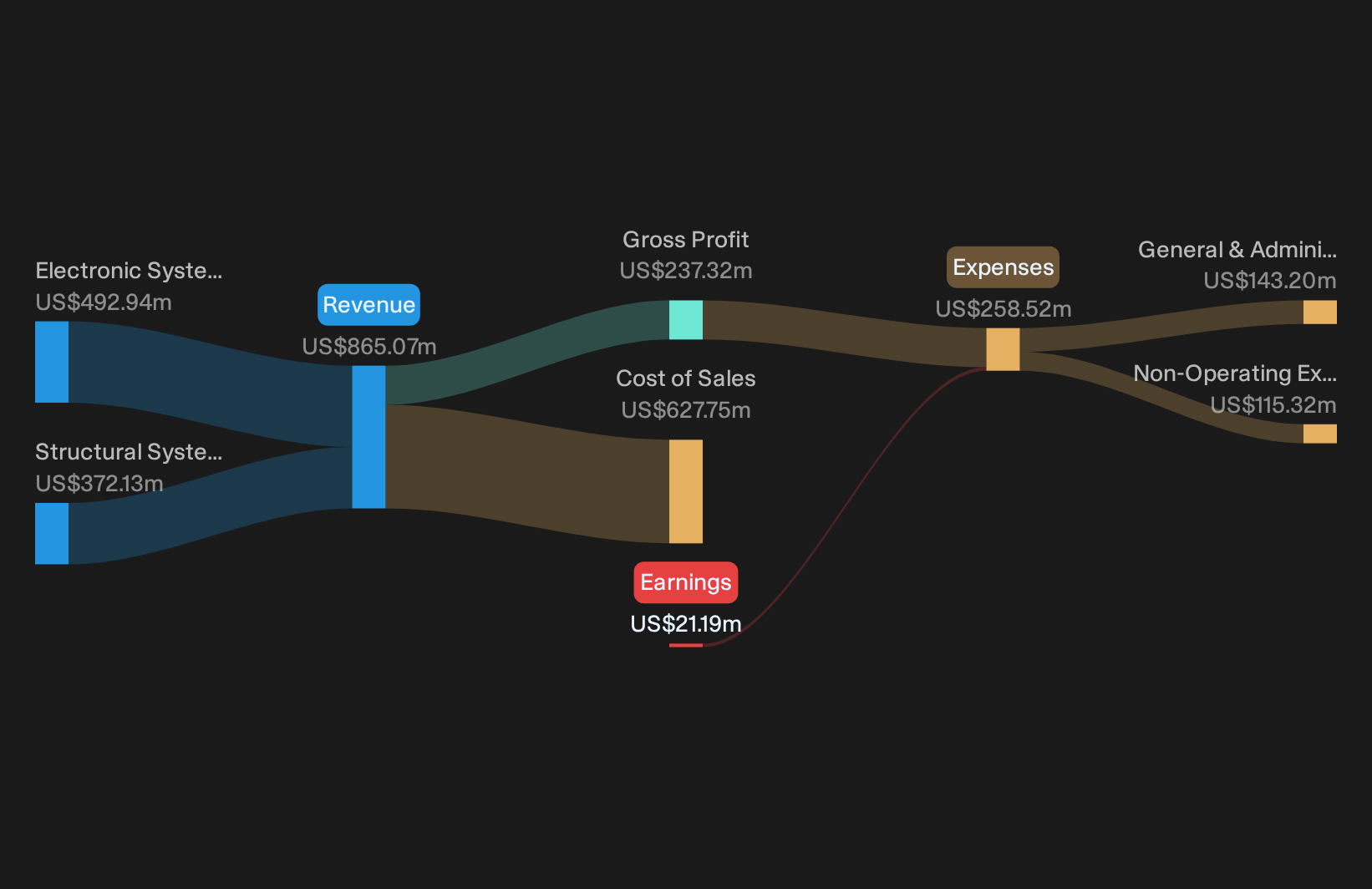
Operations: Ducommun generates about US$493 million from Electronic Systems and roughly US$372 million from Structural Systems, both tightly linked to aerospace and defense platforms.
Market Cap: US$2.6 billion
Ducommun sits squarely in the U.S. Defense and Aerospace Stocks screener because its electronic systems, cabling and complex aerostructures are built directly into frontline missiles, radar, fighters and rotorcraft that are central to today’s wartime resupply push.
"Elevated global defense spending and the replenishment of missile and radar inventories, highlighted by strong double-digit growth in both segments and a 30% increase in missile backlog, positions Ducommun to sustain and expand revenue as defense modernization accelerates over the next several years."
The real swing factor for Ducommun investors is what happens if one assumption about how defense primes outsource future high margin electronics work suddenly shifts.
That hinge point is exactly what the full narrative for Ducommun unpacks, distinguishing short-term backlog optics from the underlying trends in Ducommun’s positioning and earnings potential.
Mercury Systems (MRCY)
Overview: Mercury Systems supplies mission critical aerospace and defense electronics, building processing, sensor and electronic warfare subsystems for frontline military platforms.
Operations: Mercury Systems generates about US$984 million from Aerospace & Defense customers, with roughly US$966 million coming from the United States and additional sales in Europe.
Market Cap: US$4.8 billion
Mercury Systems plugs straight into the U.S. Defense and Aerospace Stocks theme, because its electronics content rides on the very missiles, radars and aircraft that today’s conflict driven spending priorities are trying to replenish and upgrade.
"The company announced an AI focused partnership with Palantir to support material planning and factory optimization, which management aims to use to improve backlog conversion and operational efficiency."
What happens to Mercury Systems’ earnings power if a single assumption about how quickly that record defense electronics backlog turns into higher margin shipments breaks?
That backlog question is exactly where the full narrative for Mercury Systems picks up, tracing how Mercury Systems could turn AI driven execution into accelerating cash flow and rerated expectations.

Seeking Alternatives Before Others Catch On
Fresh ideas move first. By the time momentum headlines hit, the early entry window can be gone. Scan these under the radar lists now to review ideas sooner.
- Spot resilient operators before headlines catch up by scanning the list of solid balance sheet and fundamentals (23 results) that keeps financial stress and weak cash generation off your shortlist.
- Explore potential income opportunities while yields still look appealing by reviewing the curated 6 dividend fortresses that screens for hefty payouts with staying power.
- Review the curated 35 elite gold producer stocks to evaluate metal producers that may still be flying mostly under the radar.
This article by Simply Wall St is general in nature. We provide commentary based on historical data and analyst forecasts only using an unbiased methodology and our articles are not intended to be financial advice. It does not constitute a recommendation to buy or sell any stock, and does not take account of your objectives, or your financial situation. We aim to bring you long-term focused analysis driven by fundamental data. Note that our analysis may not factor in the latest price-sensitive company announcements or qualitative material. Simply Wall St has no position in any stocks mentioned.
Have feedback on this article? Concerned about the content? Get in touch with us directly. Alternatively, email editorial-team@simplywallst.com