
Obviously, renting a house has entered the no-deposit era, and an unrefundable deposit is still the “number one sinkhole”
The Zhitong Finance App learned that on September 15, Black Cat Complaints and China Quality Report issued the “2026 Housing Rental Consumption Guidelines to Avoid Pitfalls” (hereinafter referred to as the “Guidelines”). Coinciding with the first anniversary of the implementation of the Housing Rental Regulations, the “Guidelines” are based on 12003 housing rental complaints received by the platform during the same period and a survey of 11096 tenants by the Shell Research Institute, to sort out the “ten major pitfalls” through the “pre-rent - during - after rent” process, and give prevention and suggestions item by item.
Top Ten Rental Pits: Deposits are at the top, and “lanterns determine losses” are typical
On the day he checked out, Beijing tenant Manzi disposed of the last bag of garbage early in the morning, and the room was restored to the way it was a year ago. The landlord didn't look at the wall or the floor. He pulled out a highlighter from his pocket, squatted down, and looked at a few cat hairs in the sofa slits. Before signing the contract, the landlord had verbally confirmed that “you can keep pets,” but the landlord said that if you can keep them, it doesn't mean you can destroy the house; all of the 5,200 yuan deposit must be deducted. Manzi had no choice but to call the police and posted the scene online. In the end, she had to get all of her deposit back.
The problem that Manzi has encountered is the use of “lanterns to determine loss” and is also the biggest “pit” revealed in the “Guide” this time. In terms of the proportion of complaints, the top three of the “Big Ten Pits” are directly related to “money”: non-refundable deposits and malicious deductions topped the list. On average, every three rental complaints involved a deposit. The amount involved was about 9.39 million yuan. Of these, delays in non-return complaints increased by 51%, and “lantern loss determination” became a typical portrayal of malicious deductions; contract fraud and overbearing clauses accounted for 14%, of which complaints about failed verbal promises reached 71%, and the “short rental and long visa” fraud routine was repeatedly prohibited and prohibited; Expense disputes accounted for 12.4%, and complaints about disguised charges outside of contracts increased by 34% in the past year.
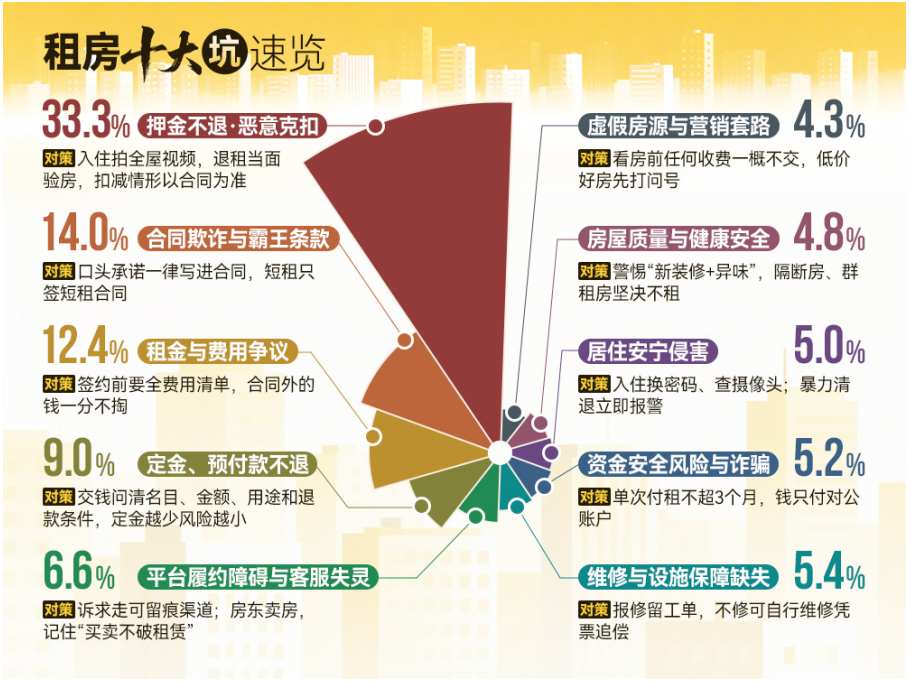
The three “main pits” problems are significant, accounting for more than 10%. The remaining “secondary pits” are also common, in order: non-refundable deposit payments, failure to comply with the platform and customer service failure, lack of maintenance guarantees, financial security and fraud (complaints related to eviction of privacy, violent evictions, etc.), infringement of residential peace (involving privacy infringement, violent evictions, etc.), housing quality and safety issues (involving formaldehyde, partition, noise, gas and electricity safety, etc.), false housing - “photography” complaints did not drop but rise. Notably, some areas have now converged — formaldehyde pollution complaints dropped by 28% after the regulations were issued, while complaints about mold, odor, and pest continued to increase by 46%.
According to the “Guidelines”, in the year since the regulations were implemented, there has been a marked increase in tenants' awareness of the rules. The Black Cat Complaints Platform had 12003 complaints relating to housing rental, an increase of 11% over the previous year's 10,767, an average of about 1,000 per month; in March 2026, the number of complaints returned to the city for rent reached 1,636 in a single month, a record high of nearly two years.
Half of the respondents said their awareness of rights protection had increased, with 47.6% more inclined to defend their rights through official channels; the proportion of “rational invocation of rules” complaints rose from 4.0% to 10.6%. 955 complaints referred to the Civil Code, and 118 directly referred to the Housing Rental Regulations.
Reminder! Do your homework before signing
For the top ten holes, the “Guide” provides countermeasures before, during, and after renting.
Video inspection before renting, no fees for viewing the house; the deposit clarifies the name, amount, use, and refund conditions, and is paid at the lowest possible ratio; all oral promises are written down as contract terms, and a full list of expenses is included before signing the contract, and no money other than the contract is spent. Leave traces of communication during leasing, keep work orders for repairs, be wary of the “new decoration+smell” combination, and never rent partition houses or group rental houses. Keep your funds after renting. Try not to pay a single rent for more than 3 months; pay only the right account; shoot a video of the whole house on the first day of stay, return the rent and inspect the house in person, and be officially reminded if the deposit is overdue.
The “Guide” also condenses the main points of rights protection into a “self-inspection checklist before payment”: whether the property has been verified, whether the name of the money is clear, whether the oral promise is included in the contract, whether the list of expenses is complete, whether the payee paid the rent for more than 3 months -- if you can't answer one of the six questions, don't pay first.
However, not all issues and disputes can be “prevented in advance,” and they are extremely complicated to manage. For example, the house is leaking water. After a torrential rain in the summer, Hangzhou tenant Xiao Zeng's ceiling began to drip, and repairs were reported to the second landlord, but they were slow to deal with it — the previous few home appliance repairs had not been properly resolved. The leak was serious day by day, affecting his residence. Xiao Zeng was only able to return his rent and move away. The second landlord did not make repairs and did not refund the deposit. At the same time in Wuhan, a tenant heard a clear sound of water in the bathroom ceiling, but the upper floor was clearly vacant for a long time. After confirmation on the spot, the seashell housekeeper communicated with the owner, neighbors, and the water company; closing the main water valve affected other residents, and the housekeeper bought a bottled water door himself and apologized. Finally, it was discovered that the dilapidated water valves and pipes in the upstairs bathroom had burst.
In reality, many complaints will also be “reversed.” There was a complaint in Ningbo: the tenant tested that the formaldehyde exceeded the standard and asked to change the house to cancel the contract and move; however, when the staff came to the door, they saw a mountain of express cartons piled up in the room — cartons would precipitate formaldehyde at room temperature. After removing the carton, the third party's inspection certificate did not exceed the standard, and the Shell platform covered 680 yuan in inspection fees and moving expenses. But this “tuition fee” was not in vain: in addition to the well-known new decoration and new furniture, the causes of excessive formaldehyde may also be cabbage, takeout cooler bags, stocked courier boxes, and figurines.
Who will translate the pit into the rule?
The common root cause of the ten major pitfalls is “information asymmetry, lack of service, and no one is responsible” in the decentralized rental market. This means that the real effective solution is not to turn every tenant into a legal expert and forensic expert, but rather to turn “verbal promises” into “system rules” to fill in uncertainties at the institutional and rule levels ahead of time.
Taking the public practice of Heart Rent in Shell Province as an observation sample, it can be seen that in response to persistent deposit problems, reducing dependence on cash deposits: in 12 cities including Beijing, Shanghai, and Chengdu, tenants who meet credit conditions can pay 0 deposits and rent monthly - “0 guarantees” are not exempt from liability. Arrears, breaches, and human damage are still covered by the contract, but the deposit changed from a sum of money placed in the landlord's account to a credit-related promise; in Chengdu, the check-out deposit was promised to arrive within 3 days, and deferred payment of 100 yuan per order Compared to “refund as soon as possible”, time limits and responsibilities have been specified.
Similarly, in response to the public's concerns about formaldehyde rooms and “string houses”, Shell's smart rental management was put ahead before occupancy: risks were identified through listing information and handheld screening, and special attention was paid to newly renovated houses and newly added furniture, then confirmed through professional inspection, treatment, and re-inspection; in the first half of 2026, Shell Huiju tested a total of 14,880 apartments nationwide and identified 1,278 “formaldehyde rooms”, with a total of 4,488 units treated.
However, leaking water in a rental house not only requires preliminary investigation, but also requires someone to cover up after the problem has occurred. In the first half of 2026, Shell Smart Rent inspected more than 450,000 homes. The average number of leaking soft furniture units was 2.4 per month, a decrease of 67% over the previous year. For repairs such as waterproof layers and concealed pipes, which have complex causes and overlapping responsibilities, it bears the cost of 1.61 million yuan and pays 5.3 million yuan for water leaks, covering all parties such as owners, tenants, neighbors, and properties.
Indeed, the order of the disposal process is the most critical. Generally, the trusteeship agency's disposal process is: stop the loss first, guarantee the tenant's residence, then clarify the responsibility, and then recover from the actual responsible party — tenants don't have to face increasing water stains on the ceiling alone during torrential rain, let alone be caught between the owners, neighbors, and the property to push back each other.
Huang Hui, a senior rental analyst at Shell Research Institute, said, “Shell is translating every 'pit' into a system rule: 0 monthly deposits correspond to persistent problems; time-limited maintenance corresponds to no way to repair; third party account fund storage and face recognition correspond to the second landlord's account to run away; and gas and electrical fire inspections correspond to rental safety.”
Indeed, the market needs more regulated housing leases. From “lantern loss determination” to “zero monthly payment”, from “no way to repair” to “limited-time maintenance,” these changes all point in the same direction: avoiding pitfalls in the rental market in the future is not about tenants becoming more savvy, but by compressing unreasonable space even less. When rules run ahead of disputes, when the costs of default and evasion are higher than benefits, the “pit” can only be truly filled, and only when living in peace and peace of mind can it become a part of everyday rental life.