
Did the “White House stock god” lose his hand in stock trading? 17 “Trump concept stocks” and 14 overturned
The Zhitong Finance App learned that US President Trump often touted his administration's investment in Intel (INTC.US) — especially the huge increase in the chip maker's stock price since the deal was announced. However, the fate of more than a dozen other listed companies in the US government's expanding portfolio tells a far less glorious story. The analysis shows that stocks of other companies that have reached deals with the Trump administration tend to go in the opposite direction: a common trajectory is a significant rise before and after the official announcement, then fluctuate sharply, and then the increase often evaporates almost as fast.
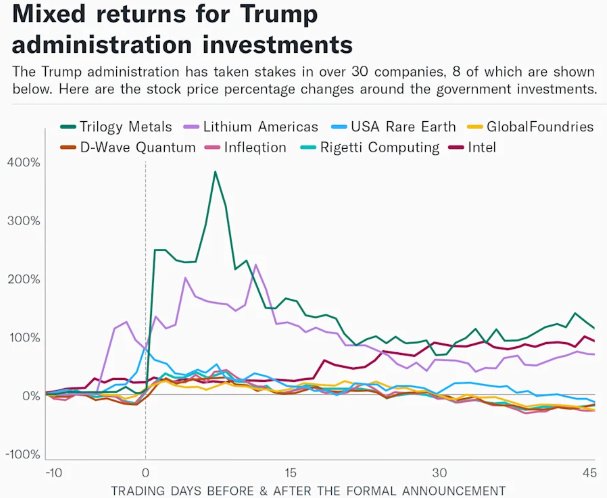
A complete picture of the “sugar high” market
Take the United States Rare Earth Corporation (USAR.US) as an example: The data shows that in the five trading days before and after the announcement of the government cooperation agreement in January of this year, the stock soared by more than 80%. But within a few weeks, those gains (and more) all came back — closing at $15.71 per share on Monday, far below the high above $30 after the deal.
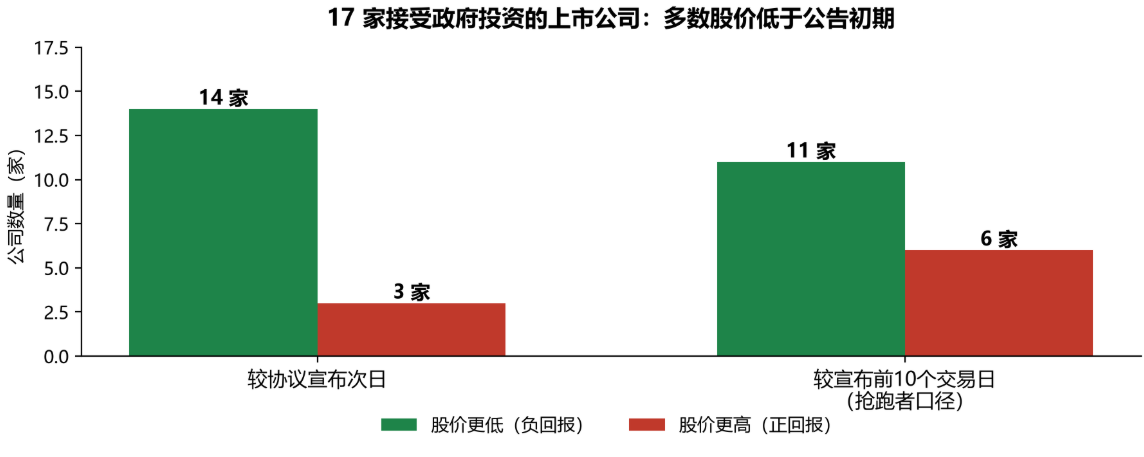
This is not an exception. The analysis showed that of the 17 listed companies receiving government investment, the closing price of 14 last week was lower than the level of the day after the agreement was announced. Even those investors who successfully ambush government investments are often losing money: 11 out of 17 companies currently have negative returns compared to the 10 trading days before the official announcement.
“This certainly seems like a 'sugar high' (sugar high),” notes Tad DeHaven (Tad DeHaven), a policy analyst at the Cato Institute (Cato Institute) who has studied government holdings and is critical of the Trump administration's practices. “It looks like there are short-term benefits... but in the long run, it's still fundamentals.”
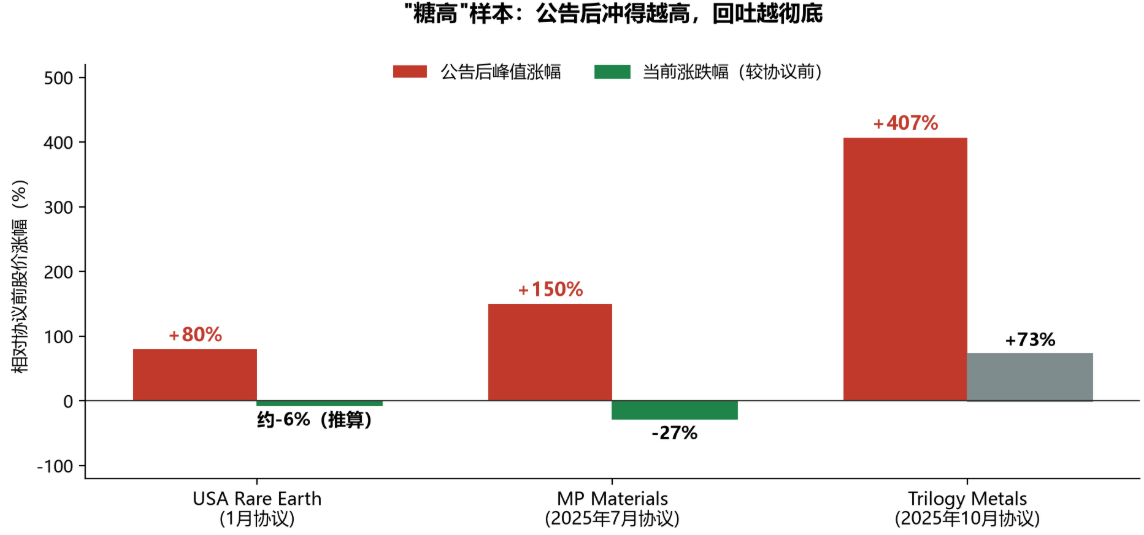
The panorama at the individual stock level is more intuitive. Trilogy Metals (TMQ.US)'s American Depositary Shares surged from a high of $2.09 to a high of $10.60 within a few days after the announcement of the government's October shareholding agreement, then quickly rebounded and now reported $3.62; MP Materials (MP.US) surged more than 150% within the five weeks after the government took the shares, but fell nearly 27% in the following year; even Intel, which is regarded as a “model case”, retracted 37% after the news of Apple's chip partnership in June peaked The fifth worst performance among the 500 constituent stocks.
Three survivors, and an exaggeration of “tens of billions”
Currently, only 3 of the 17 companies have higher stock prices than the date the agreement was announced: Intel, Nippon Steel (Nippon Steel, which issued “gold shares” with super voting rights to the government but are not equity investments), and MP Materials, a rare earth magnetic materials company that reached an agreement with the government in July 2025. However, even with MP Materials, if investors bought and held it immediately after the announcement of the agreement and had positive returns, the stock peaked in October last year, and the price is currently far below the 52-week high amid sharp fluctuations.
Intel, on the other hand, is the subject of repeated government preaching. Trump recently posted an image of himself as a stock trader in an oval office on Truth Social and wrote, “I have earned hundreds of billions of dollars for America — not for myself — from stocks and many other types of positions.” “Hundreds of billions” is an exaggeration, but the value of Intel's shares held by the government has indeed increased from the estimated $8.9 billion when the deal was concluded to over $50 billion today. Intel's stock price closed at $97.19 on Monday, down more than 5% on the same day, but is still more than four times the price before the August 2025 agreement was announced.
Investors' attention: The 32nd investment, and a combination spanning six major fields
Intel is an early example that the Trump team is trying hard to replicate. The government recently completed its 32nd corporate investment: a privately held oil drilling company called North American Blue Energy Partners — which has obtained a 100-year lease on a plot of land in Venezuela with an estimated reserves of 65 billion barrels of oil. The government's investment portfolio now spans quantum computing, semiconductors, oil drilling, steel, nuclear energy, and rare earth mining companies.
The Trump team often describes these investments as “passive,” but it still raises concerns that the government's dual role as an investor and regulator will cause political forces to distort the entire market. What is particularly alarming for retail investors is that many of these companies have already outperformed their respective industry indices — the evidence of the open market itself is a wake-up call for investors who want to take a “free ride” of government holdings.
Economic research is also on the side of the skeptics. According to the original article, an economist survey in 2025 shows that the vast majority of economists interviewed believe that government investment often harms both the company's performance and the level of corporate governance.
Legal and political mines are being laid before November
The cracks in this “government concept stock” feast are not limited to stock prices. According to reports, a shareholder lawsuit is challenging the legality of the government's investment in Intel — the lawsuit argues that the “Chip Act” does not authorize the Ministry of Commerce to use equity as a condition for issuing subsidies, and if the court supports it, the legal basis of the entire government's shareholding portfolio will be shaken.
Political risk is also imminent: Polls suggest that the Democratic Party is expected to take back at least one house of Congress in the midterm elections, when Elizabeth Warren, who may be chairman of the Senate Banking Committee, has questioned Commerce Secretary Lutnick about Intel's investment. Henrietta Treyz (Henrietta Treyz), co-founder of research firm Veda Partners, warned that the Democrat-led commission summoning business executives and government officials to attend the hearing “is one of the risks investors need to pay most attention to right now” — and the midterm elections are less than two months away.
The explanation at the institutional level is equally calm. According to AInvest's analysis, the government's stated new investment of more than 4 trillion dollars (Apple 600 billion, Meta 600 billion, Stargate and Nvidia's about 500 billion dollars each) is essentially “a promise shared over many years, and the market completed pricing in one afternoon” — the announcement would instantly reassess the price-earnings ratio, but only real cash and orders can keep the increase there.
De Haven of the Cato Institute saw this more thoroughly: the Trump team was “putting together temporary pieces while walking”; they “did not put forward a serious legal analysis of anything, and all of this points to the impromptu nature of the entire operation.”