
US Treasury yields surged 5%! Bezent faces a big test tonight, and the “growth and debt-relief” logic is being questioned by the market
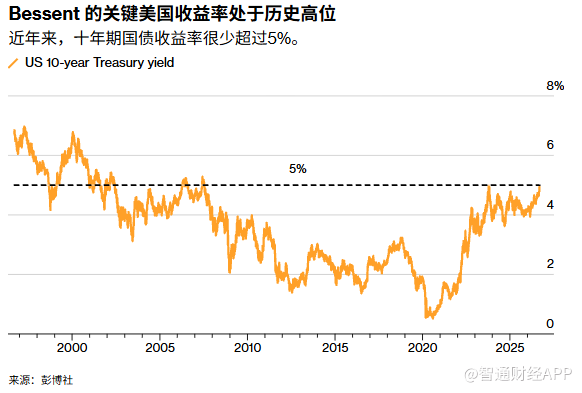
The Zhitong Finance App learned that the US 10-year Treasury yield hit 5.04% on Tuesday, a record high since 2007. As US bond yields continue to rise and US fiscal sustainability is once again receiving market attention, US Treasury Secretary Bezent will attend the US House Financial Services Committee hearing at 22:00 Beijing time tonight. The market will focus on whether he sends new signals about fiscal policy, treasury bond issuance and repurchase plans, debt management, and the outlook for the dollar and interest rates. At the same time, the strategy of “getting rid of debt through economic growth”, which Bezent has always emphasized, is facing increasing practical questions.
Bezent's “Growth and Debt Relief” Theory: Ideal Fullness, Reality is Boring
“Global growth is the solution to this mountain of debt,” Bezent said in August. At an event in Texas last week, he once again reiterated that as long as US federal spending is restrained, plus “3% growth, we can rely on growth to get out of debt.”
However, actual data does not support this optimistic idea.
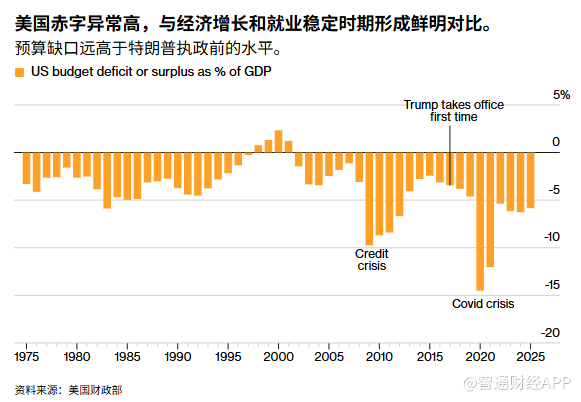
Even in 2023 and 2024, America's inflation-adjusted economic growth rate was close to 3%. However, in these two years, the US debt held by the public rose by about 10% and 7%, respectively, with annual deficits exceeding 1.6 trillion US dollars, and the share of debt in economic output is also rising.
Looking back at the end of the 1990s, the US gross domestic product (GDP) continued to grow by more than 4%, when the fiscal situation changed dramatically — from deficit to surplus. But that scene was accompanied by tax increases and a slowdown in defense spending after the Cold War.
Today, things are quite different. After many rounds of Republican-led tax cuts, the tax rate has been drastically reduced. In recent years, lawmakers from both parties have generally voted to increase rather than cut federal spending. An aging population is driving up spending on large-scale welfare programs such as social security and medical care. Meanwhile, in the context of geopolitical tension, US President Donald Trump wants Congress to approve $1.5 trillion in defense spending, an increase of up to 44%.
“You can't solve this problem through development,” said Douglas Holtz-Egin, chairman of the American Action Forum, a right-leaning think tank and former director of the Congressional Budget Office. “This is numerically unreasonable.”
The 10-year US Treasury yield broke 5%, and Bezent faced torture during the hearing
The recent rapid rise in US Treasury yields has heightened concerns about the sustainability of America's long-term debt. Benzent's own benchmark — the 10-year Treasury yield has surpassed 5%, an extremely rare level since the early 2000s. On Tuesday morning local time, Bessent may face questions about his strategy during the House Financial Services Committee hearing.
Bezent predicts that the artificial intelligence boom will help accelerate the US economy, but the mainstream consensus is that 3% GDP growth will come soon. Media surveys of economists and the latest predictions from the International Monetary Fund (IMF) show that the US economic growth rate in 2027 and 2028 is only slightly above 2%.
Joe Lavornia, a former adviser to Bezent, said that growth is an important part of reducing the deficit and overall debt burden, and Bezent was right to emphasize this. But he also believes that growth alone may not be able to complete this task.
“Looking at the 3% growth potential, this is a pretty good figure and will go a long way in improving the deficit situation,” he said. But “you probably need more than growth.”
Aging intensifies pressure on welfare spending, and interest costs on debt are rising
One of the keys to the problem is the steady increase in the number of American retirees, which in turn is driving up social security and health care spending — two of the largest items in the US budget. From Trump's return to the White House until May of this year, the number of US social security retirement beneficiaries increased by 2.8 million. But the number of American workers contributing income to these benefits only increased by 593,000.
Trump has indicated that he will not change these welfare programs, and Congress is not pushing for major reforms to these programs.
Holz-Egin pointed out that if all goes well and the economy grows rapidly, fiscal revenue will grow at the rate of nominal GDP. Nominal GDP includes inflation. He said that 3% real growth plus 2% inflation means 5% nominal growth. However, social security spending increased by an average of 5.5%, and health insurance spending increased by as much as 7.5%. “So, you can't fix this.”
The third largest category of expenditure for the US government is interest payments on outstanding debt, and this portion of expenditure is growing faster. There is still one month left in this fiscal year, and total net interest has reached $1.02 trillion, up 8.9% from the same period last year.
The rise in US Treasury yields means there is a risk that these costs will rise at an accelerated pace. According to US Treasury data, as of the end of August, the average interest rate on outstanding treasury bonds was 3.48%, far lower than the current yield. The five-year benchmark interest rate, which is the closest to the current average term of unpaid treasury bonds, is about 4.77%.
Meanwhile, the US Treasury recently relied on low-cost short-term treasury notes with a term of less than a year to issue bonds. If Federal Reserve Chairman Kevin Walsh and his colleagues raise overnight policy interest rates on Wednesday, as the market generally expects, the cost of these short-term debts will also rise.
“There are no credible estimates that growth will be strong enough for the fiscal situation to magically disappear,” said Maya Magginias, chairman of the Responsible Federal Budget Committee (CRFB).
$5,000 cheques and deficit targets: fiscal consolidation challenges to be solved
At Tuesday's hearing, Bessent may be asked about one of Trump's proposals: if the Republican Party maintains control of Congress in the November midterm elections, it will issue a check of $5,000 to every American adult.
CRFB estimates that the proposal would cost as much as $1.2 trillion a year, while the current annual deficit is around $2 trillion. The organization calculated that, without offsetting measures, the deficit would reach 9% or 10% of GDP next year.
After taking office, Bezent set a goal: reduce the deficit to GDP ratio to around 3% by the end of Trump's term (January 2029). In 2023 and 2024, the ratio was over 6%, and last year it was slightly below this level, partly due to a one-time change in the accounting treatment of federal student loans.
Economists expect the ratio of deficit to GDP in 2028 to be 6.4%. The lowest predicted value was 4.5%, and the highest was 8%.
Bessent said he is working with White House Budget Director Russ Water to develop a fiscal consolidation plan to reduce the deficit. Although he hasn't detailed the details of the plan, he suggests that anti-fraud measures may be part of it.
For many budget experts, a credible fiscal plan requires reform of welfare programs. Bezent's hedge fund mentor Stanley Druckenmiller signed an appeal last month to put forward a proposal to gradually reform these projects.
Seth Carpenter, chief global economist at Morgan Stanley and Treasury official during the Obama administration, said “some kind of fiscal consolidation based on growth” is very likely. “But this depends on fiscal policy not turning expansionary; this is the real problem.”
Holz-Egin estimates that with economic growth alone, the growth rate would need to reach 6% to reach the level of deficit expected by Bezent. He said that considering America's aging population and strict immigration restrictions, even a 3% growth rate could be called a “miracle.”