
Why Did Ellington Financial (EFC) Raise Its 2030 Notes Offering To $150 Million?
- Ellington Financial (NYSE:EFC) increased its 7.375% senior unsecured notes due 2030 offering from US$100 million to US$150 million.
- The notes are fully guaranteed by Ellington Financial and its subsidiaries, with proceeds earmarked for corporate uses including asset purchases and debt repayment.
- This larger 7.375% senior unsecured notes due 2030 issue is important to weigh alongside the rest of our Ellington findings. Check out 4 warning signs (2 major) that Ellington Financial investors should know about.
Ellington Financial is far from the only lender leaning on high-yield funding, so it is worth comparing it with 6 dividend fortresses.
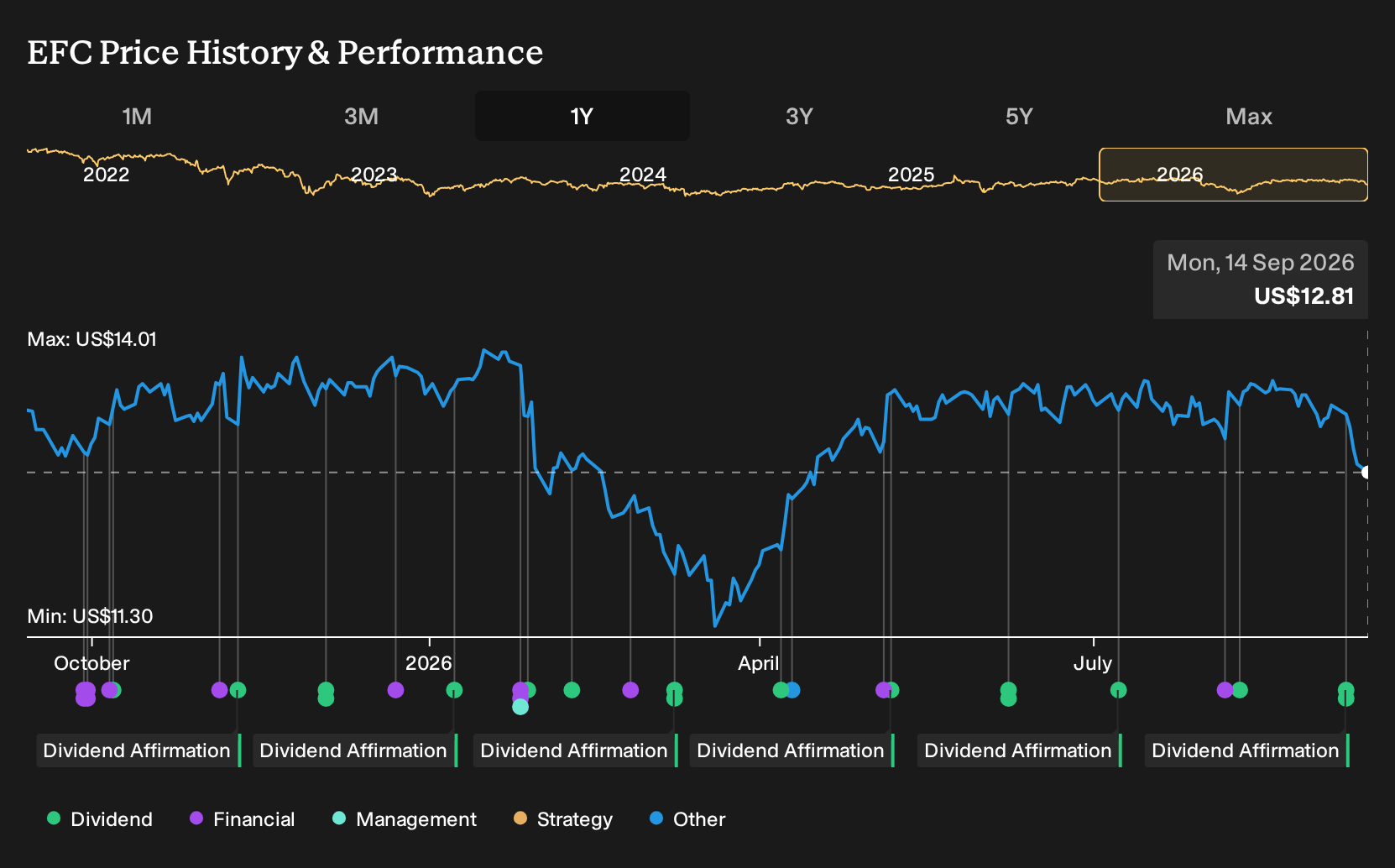
Ellington Financial is a US mortgage REIT with a US$1.7b market cap. It focuses on acquiring and managing mortgage related, consumer related, and corporate related financial assets, so a larger pool of long term funding can influence how actively it adds or reallocates those holdings across credit markets.
See how Ellington Financial's balance sheet measures up.
Upsized Ellington Financial notes issue leans into debt, but also extends dry powder
For Ellington Financial investors, the upsized 7.375% senior unsecured notes offering leans into the existing funding model rather than changing it. The extra US$50 million adds to unsecured borrowings and, in time, feeds into interest expense, which matters for a business already flagged for debt that is not well covered by operating cash flow and a dividend that is not well covered by earnings or free cash flow. On the bullish side, longer term unsecured funding can reduce reliance on shorter term repurchase lines and gives Ellington Financial room to buy more interest earning assets or refinance costlier funding. The bear case is that a higher fixed coupon becomes a heavier burden if cash generation does not keep pace.
What really determines whether this matters positively is how Ellington Financial uses the proceeds over the next few quarters. Watch the split between repurchase agreement balances and unsecured debt, any shift in overall leverage metrics, and whether cash flow coverage of both interest and the dividend improves in upcoming financial reports. If asset purchases funded by this issue do not translate into stronger cash generation relative to the added interest cost, the balance of this deal tilts toward the risk side of the ledger.
The valuation gut check most Ellington Financial buyers run before hitting “buy”
Before you treat Ellington Financial as a long term hold, it can be useful to see what a pure cash flow based estimate of the business suggests about its underlying worth versus the current share price. Find out exactly what Ellington Financial is worth today based on its cash flows.
This article by Simply Wall St is general in nature. We provide commentary based on historical data and analyst forecasts only using an unbiased methodology and our articles are not intended to be financial advice. It does not constitute a recommendation to buy or sell any stock, and does not take account of your objectives, or your financial situation. We aim to bring you long-term focused analysis driven by fundamental data. Note that our analysis may not factor in the latest price-sensitive company announcements or qualitative material. Simply Wall St has no position in any stocks mentioned.
Have feedback on this article? Concerned about the content? Get in touch with us directly. Alternatively, email editorial-team@simplywallst.com