
Jefferies warns: Super El Niño is approaching, and these six US consumer stocks are facing an impact
The Zhitong Finance App has learned that Wall Street is repricing a climate force that can be predicted months in advance. Jefferies warns that if fears about the 2026-27 Super El Niño become a reality, a number of consumer stocks will bear the brunt — and the special feature of this storm is that, unlike most climate risks, El Niño can be accurately tracked months before it lands, and investors have every chance to identify damage targets before the full economic consequences become apparent.
A super El Niño that could go down in history
Current forecasts suggest that 2026-27 El Niño may be the strongest in modern history. The World Meteorological Organization (WMO) issued a communiqué on September 3, confirming that the El Niño event has taken place and is expected to increase to a super strong El Niño within a few months; the US National Oceanic and Atmospheric Administration (NOAA) judged that the probability of reaching the “super strong” level from October to December was 81%, and the probability of reaching the “very strong” level was over 90%.
When the sea temperature abnormally exceeds 2℃ in the Niño 3.4 monitoring area of the equatorial Pacific Ocean, meteorologists call it a super El Niño — only three recorded events reached this level in 1982/83, 1997/98, and 2015/16; the one in 1997/98 was nicknamed “Godzilla” for its amazing destructive power. Meanwhile, the combined model of the European Medium-Term Weather Forecast Centre (ECMWF), NOAA, and the Australian Bureau of Meteorology is currently converging to an anomaly that could reach +3℃ — which, if realized, would match or even surpass the 1997/98 record.
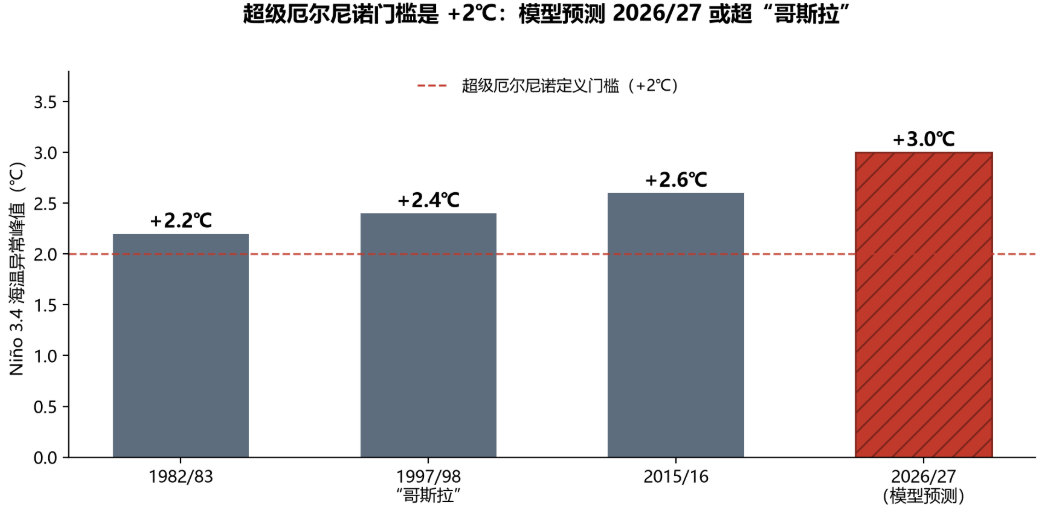
For the agricultural products market, the rules of history are simple and cruel: according to statistics, every strong El Niño in the past 55 years has been accompanied by a reduction in cocoa production.
Cocoa Chain: Hershey (HSY.US) and MDLZ.US (MDLZ.US)'s “Cocoa Price Deflation Bet”
The risk concentration is highest in West Africa. About 60% of the world's cocoa supply comes from Côte d'Ivoire and Ghana, and during the El Niño season, West Africa historically tends to be hotter and drier during the November-January harvest season — this is at the cost of chocolate companies.
Jefferies analyst Scott Marks notes that Hershey undertakes highly concentrated cocoa exposure through its core US chocolate business, and the company has based its 2027 profit margin repair plan on expectations of deflation in cocoa prices.” Notably, a super El Niño that will make West Africa's 2026/27 production season hotter and drier will shake the pillars of this restoration story,” Max wrote.
Mondelez International's transmission path is the same: about 60% of cocoa supply is concentrated in Côte d'Ivoire and Ghana, and strong events historically caused production areas to turn hot and dry before the harvest season. The risk is that Super El Niño will impact the 2026/27 production season and threaten its profit margin repair narrative.
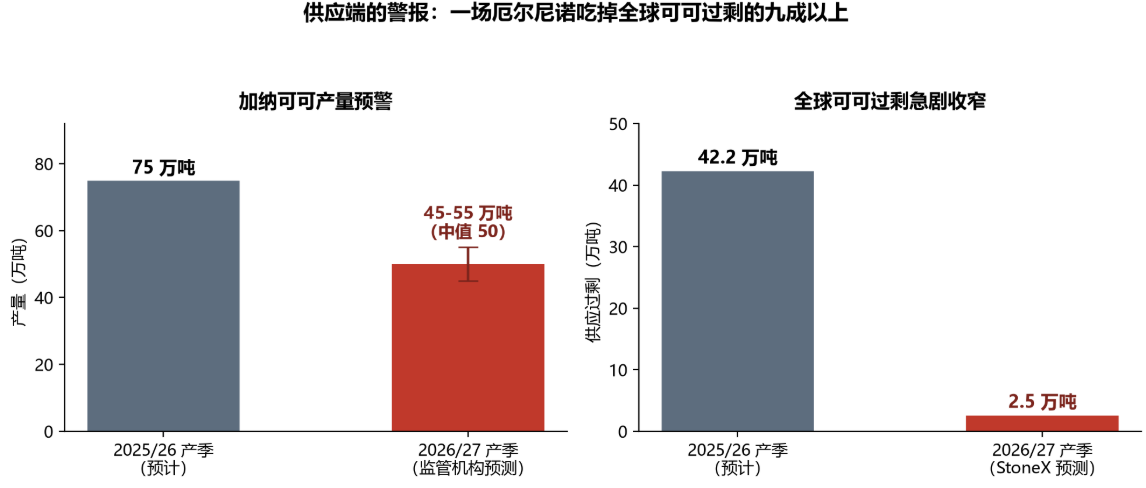
The supply-side alarm has been sounded. Ghana's national cocoa regulator predicts production for the 2026-27 season will be only 450,000 to 550,000 tons, far lower than the estimated 750,000 tons for the 2025-26 season; the country's exporters have even warned that production could drop as much as 38% year over year. Côte d'Ivoire, the world's largest producer, has slowed sales of new products for the 2026-27 main season, and has sold about 1 million tons of export contracts. StoneX predicts that the global cocoa surplus will suddenly narrow from about 422,000 tons this season to around 25,000 tons.
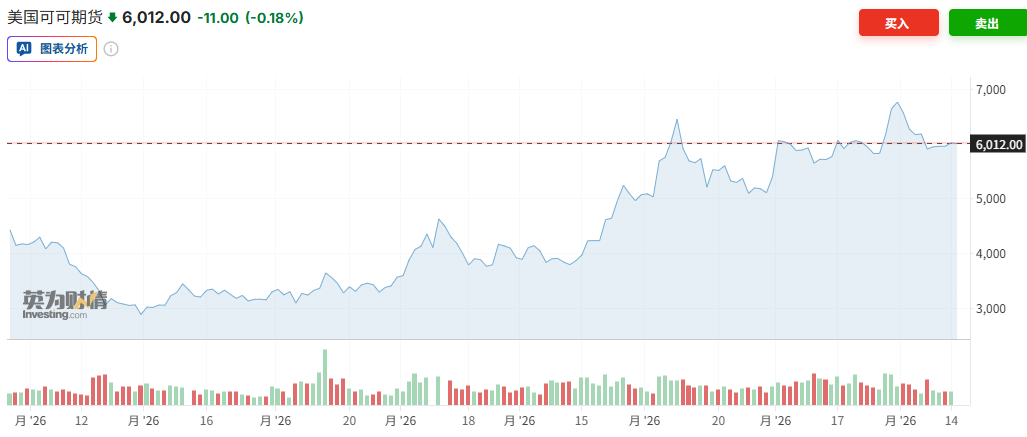
New York cocoa futures are currently around $6,000 per ton. Previously, in early July, they had surged 14.1% in a single day due to an El Niño risk reassessment.
The demand side may not be that cooperative. Darren O'Brien, chief cocoa officer of Mondelez, said during the Singapore International Cocoa Conference that after the sharp rise in cocoa prices a few years ago, chocolate companies generally reduced product specifications and increased the use of alternative ingredients — even if demand recovers, the total amount of cocoa needed may not rise but fall.” Product specifications have changed. “If the chocolate bar gets smaller, there will naturally be less cocoa available,” he said. Demand in Europe, the world's largest consumer region, is still weak. Although processing volume in Asia jumped 25% in the second quarter, this is more a sign of recovery than prosperity.
Coffee chain: SJM.US (SJM.US) double opening
Smack's exposure to El Niño was transmitted through coffee combinations — its procurement was also exposed to Brazilian Arabica, Vietnam, and Indonesian Robusta. Currently, the coffee market is in a long and short period: ICE-certified Arabica stocks are at a low level to provide support, but Brazil's record export flow and improved flowering weather caused the New York December Arabica contract to fall below 288.15 cents/pound on September 10; the November Robusta contract bucked the trend and closed at $3,458 per ton. For Shengmeijia, once the Asian production area turned to aridity after a few months, as expected by the model, Robusta's risk was only just beginning to be factored in.
Retail and Catering: Three Shocks on the Demand Side
Jefferies has a list that goes beyond the cost of goods. About 11% of PSMT.US's sales come from Colombia, and its business spans Central America, and is exposed to disrupted weather, supply chain disruptions, and weakening optional consumption in affected markets. However, analyst Pedro Baptista gave a relatively mild judgment on this list: “Although individual warehousing stores may experience temporary operational shocks, past events have shown that demand is often delayed rather than disappeared, and the membership model and steady consumer positioning will support the recovery.”
YUMC.US (YUMC.US)'s risk comes from three aspects: analyst Anne Ling points out that extreme rainfall, flooding, and bad weather may temporarily reduce in-store diner flow — particularly in affected areas — and disrupt logistics and distribution efficiency; at the same time, catering companies may face rising prices for key agricultural inputs.
Coca Cola Vanessa (KOF.US) is an open door to the sugar chain: analyst Alex Wright emphasized that if sweetener costs soar faster than price increases, profit margins will be under pressure. The October contract for raw sugar futures rose to 18.4 cents/lb last week, and demand for sugar cane ethanol driven by the sharp rise in CNPC prices is also adding fuel to sugar prices.
The climate pendulum is still swinging. Barclays warned that this extreme weather could drive up the prices of a range of commodities; while the WMO and NOAA models are still refreshing intensity expectations every month. For buyers of chocolate, coffee, and sugar, from record sea temperatures to empty shelves, there are two harvest seasons in between — Jefferies's list is an advance for investors.