
The US bond yield broke 5% or was just the beginning. Wall Street drew a “life and death line” for the financial market: 5.25%
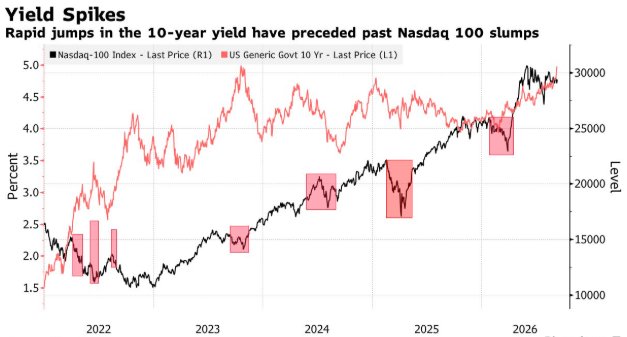
The US stock market is entering the most volatile season in history, and the bond market tore the gap first: the 10-year US Treasury yield hit 5% this Monday (September 14), for the first time since October 2023; it further rose to 5.041% on Tuesday, a new high since July 2007, and reached 5.399% for a 30-year period.
But unlike October 2023 — when the S&P 500 index was about 10% below its all-time high, and the market was already absorbing the spillover impact of global bond market sell-offs — the benchmark index is now only 2.5% short of the record high set in August. The real question in the market is: in the valuation of US stocks, there is still almost no room reserved for this round of yield increases?
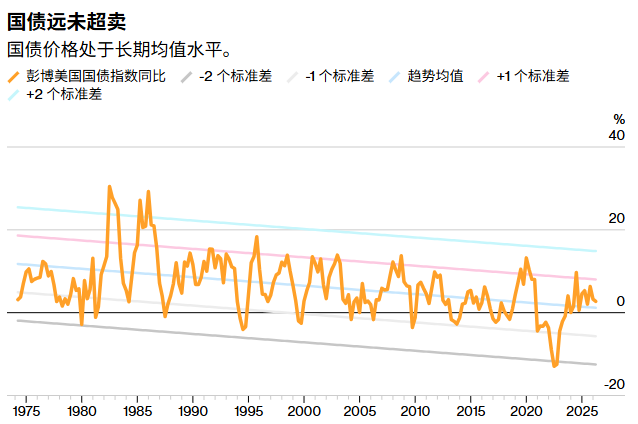
At the same time, there is one more problem. The yield on 10-year US Treasury bonds rose above 5% this week. The first question is: can the yield continue to rise? The yield appears to be too high. Today, it has climbed to the highest level since 2007, yet US Treasury bonds have not yet been oversold. If return on capital and price factors are taken into account, the yield only falls back to the long-term average when calculated at an annual growth rate.
Everyone is waiting for Walsh's answer
Strategists at various institutions, including Wells Fargo, believe that the rapid rise in yield will trigger anxiety on Wall Street, and the specific impact on the US stock market may depend on how fast yields rise in the future.
The yield threat mechanism is not new: higher bond yields lower the present value of future profits, making stocks less attractive in the face of risk-free assets, while increasing corporate financing costs and squeezing profit margins. Prior to 2023, 10-year yields were at this high level or the beginning of the global financial crisis — a crisis that eventually forced policymakers to cut interest rates to near zero and apply massive quantitative easing.
Notably, high-growth, overvalued technology stocks are generally considered more vulnerable to rising interest rates, as their valuations are mostly based on expected profits that will only be realized in the next few years. Portfolio managers, including investors who have long been optimistic about the industry, believe that interest-rate sensitive tech stocks may face new losses in the future — given that prices for goods and services remain high, there are various signs that Walsh is likely to deliver on his policy threats.
In this context, what really made traders nervous was the US Federal Reserve interest rate decision this Wednesday (September 16) and Chairman Walsh's subsequent press conference. After the August inflation report showed that prices continued to rise, traders believed that the probability of raising interest rates on Wednesday was over 90%; Morgan Stanley has also joined the hawkish camp, and the Federal Reserve is expected to raise interest rates by 25 basis points each in September and December.
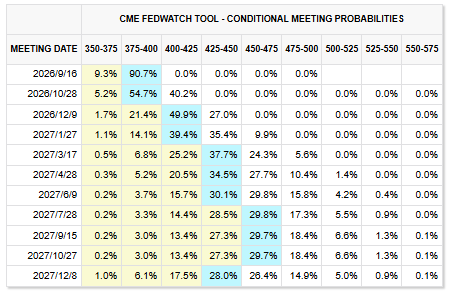
“Traders will breathe a sigh of relief if the Federal Reserve indicates that it will only raise interest rates once,” said Max Wasserman, senior vice president and portfolio manager of the Wealth Enhancement Miramar team. But if there is no guarantee how many interest rate hikes will follow, or if there is any hint that inflation will take some time to fall, then yields of 5% or more will require long-term technology stocks to fall — investors will re-evaluate those expensive valuation multiples.”
Ohsung Kwon, chief stock strategist at Wells Fargo Bank, gave a counterintuitive judgment in a phone interview: “Investors will probably welcome the 'one plus one stop' message. If they don't raise interest rates, it will be bad for the stock market” — because long-term US bond yields are likely to soar further. ING foreign exchange strategist Francisco Pesole also called the current bond market performance a “warning sign”: if the Federal Reserve remains on hold at this time, it may cause unnecessary turmoil in the market.
Point map: 5%, 5.10%, 5.25%, behind each line is a kind of market logic
Treasury bond prices have the characteristic of reversing to the mean, which means they fluctuate around the long-term average. They eventually return to near the mean, but usually fluctuate excessively afterwards. Therefore, the price of treasury bonds is likely to fall further before they are actually oversold.
Wall Street has drawn this yield breakthrough into a hierarchical map. Wasserman believes that the psychological tipping point of the S&P 500 is between 5% and 5.25%; Jackson Square Capital partner Andrew Graham said that once the yield stands at 5.10%, it will trigger a correction in US stocks; Dennis Debusscher of 22V Research believes that the yield in the 4.8% to 5% range itself will suppress economic growth.
Stephanie Rose, chief economist at Wolfe Research, put it more directly: “Bond yields must fall back before US stocks can resume their upward trend.” If interest rates or oil prices rise further, a more meaningful correction in the stock market may be ahead.”
Another analysis pointed out that the problem was raised from a “point” to a “system”: when the 10-year yield was significantly higher than 5.25%, the trend of stocks and bonds almost always turned in the same direction throughout history — stocks and bonds mutually reinforce each other's losses. In a period where yields were below 5.25%, it was astonishing that the correlation between S&P and US bonds was almost never negative. From 2022 to the end of last year, the correlation between equities and bonds was positive when the yield was below 5.25%, and has remained flat since this year — and if yields continue to rise, the correlation is likely to fall firmly back into the positive range.
When 10-year US Treasury yields far above 5.25%, the market pattern changes significantly. Thereafter, the risk of bond volatility, which in turn affects stock volatility and credit spreads, will increase significantly.
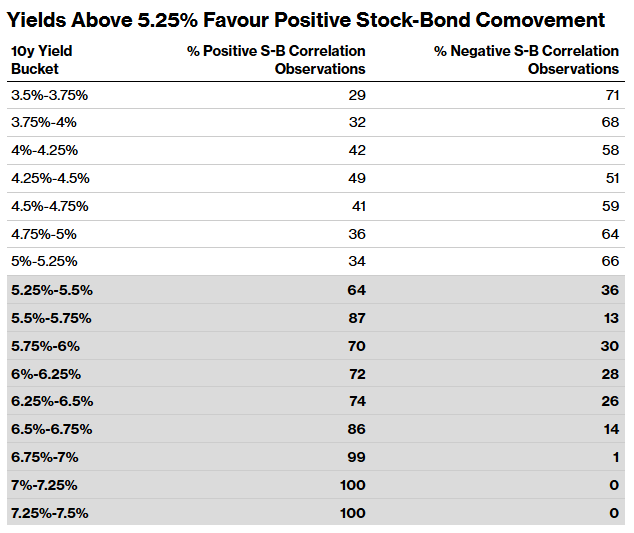
That means bonds are no longer a hedge against stocks. The transmission chain is intertwined: the appeal of US bonds as a combined hedging tool has declined, marginal buyers have become more sensitive to prices, and the market's sensitivity to capital flows has increased; investors have turned to options to hedge US bonds, and implied volatility has increased — treasury bond volatility first increased, and this is the official reason given by the US Treasury when it announced enhanced repurchases last month (maintaining treasury bond liquidity).
Next, stock index volatility cannot stand alone: stocks and bonds amplify profits and losses, making asset rebalancing capital more unstable and boosting VIX; rising demand for stock options to hedge will also support implied volatility. The third channel is particularly critical today — bond fluctuations have increased the uncertainty of cash flow discount rates, and the record-low correlation between individual stocks shows that the market hardly prices the “long-term interest rate”, the most dominant single-factor risk.
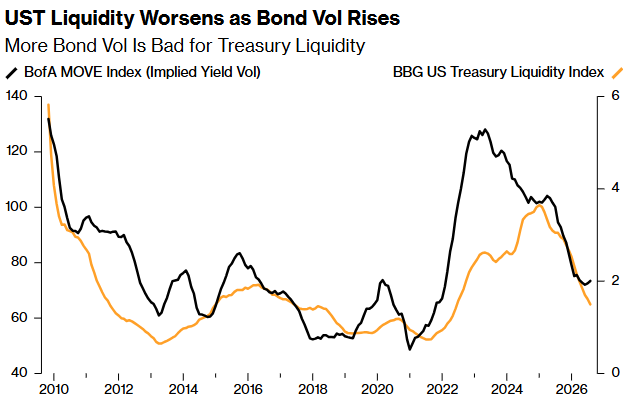
Extremely low stock correlation inhibits the transmission of individual stock fluctuations to the VIX Index. Although individual stock volatility has retreated from the high level of memory frenzy, the VIX Index will still be significantly impacted if correlation increases.
Credit spreads are also hard to escape. Low index fluctuations are a key factor in suppressing interest spreads, and high yield spreads and VIX tend to go hand in hand — the latter usually enters credit pricing through the Merton model.
Valuation Alerts and Inverse Bets
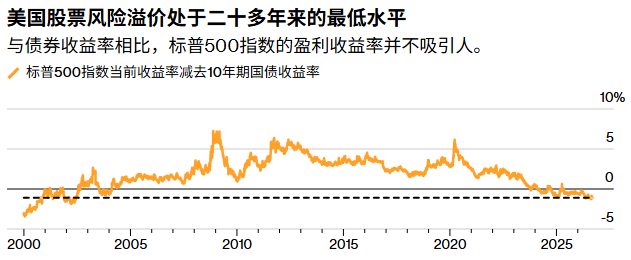
One closely watched indicator is the stock risk premium — the difference between the S&P 500 profit yield and the 10-year US Treasury yield, which is commonly used to measure the attractiveness of stocks compared to other assets — currently hovering around the lowest level since 2002, meaning stocks are more sensitive to every change in bond yields. J.P. Morgan's team of strategists led by Nicolaus Panigirzoglu predicted that the premium would narrow to 100 basis points below the historical average, in part because stocks are more sensitive to bond yields.
Of course, there are also people who are almost at the end of their sales in the gambling bond market. Raymond James Chief Investment Officer Larry Adam stated, “Investors are already extremely pessimistic about bonds. Speculative short positions on 10-year US bonds are close to record highs, and this round of sell-off seems to be expanding more and more — indicating that yields may be closer to the peak rather than the beginning of a new round of continuous upward movement.”
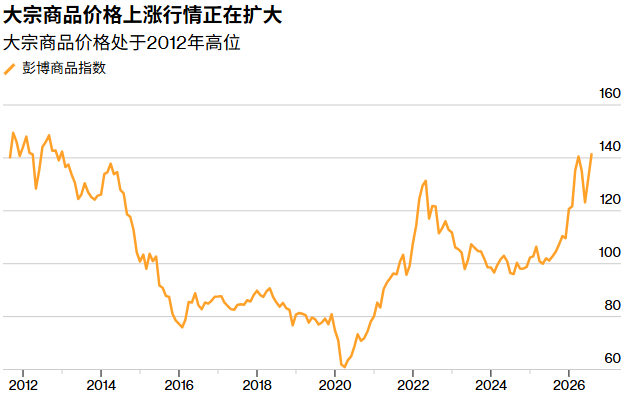
A few potential pivots for yields to stop rising: the news that AI Labs are slowing down model development is probably just a convenient excuse for capital expenditure to pull back — this is a “kick in the calf” for economic growth; but considering that unquestionable computing power contracts have been extended to next year or even further, it may not be enough to trigger a rebound in the bond market in the short term. Funds from real money buyers or hedging mortgage securities may enter the market when the yield continues to be above 5%, but this has not yet occurred, and the impact may only be temporary. However, commodity gains are still piling up, energy and food supply disturbances in the Middle East and Russia have not improved, and structural price pressure is a tailwind for yields that are difficult to dissipate.
A paradoxical possibility lies on Wednesday: interest rate hikes may instead attract buyers of US bonds — if the market assumes that the Federal Reserve is seriously suppressing inflation; in turn, staying on hold may push yields even higher. Girard's Chief Investment Officer Tim Chubb's attitude represents moderates: “As long as interest rate hikes are not aggressive, the Federal Reserve will not interrupt this bull run. However, the weakest corner of the market and the easiest to overreact is probably technology stocks with high valuations.”
At any rate, US debt is nearing an inflection point. The S&P 500 has risen 20% since its low at the end of March, its market capitalization expanded by $11 trillion, and VIX remained stable around 17 during Monday's bond sell-off — not a typical level of market pressure. How long the calm will last depends on whether the 5.25% line will actually be stepped on after Wednesday. If the 10-year yield stays above 5.25% long enough, the trading environment and asset price gameplay will be completely different from the past three years.