
Why Wall Street Could Be Pricing This GE Stock Option Spread Incorrectly
Browsing through the available strike selections for month-of-October bull call spreads, it’s impossible to ignore one glaring idea for GE Aerospace (GE). With a maximum payout of 222.58% in exchange for a net debit (cash outlay) of $310, the risk-reward profile seems unusually favorable. Of course, Wall Street isn’t in the business of giving traders a free lunch — and that’s where the problem with GE stock lies.
While the breakeven price of $333.10 represents “only” a 5% lift from the current spot price, the implied probability of this threshold (derived from the Black-Scholes family of calculations) sits at 29.6%. Again, that’s just to break even. If you want to be fully profitable, GE Aerospace stock must trigger the $340 second-leg strike price.
That target stands at around 7.1% up from current levels. A reverse-engineering of Barchart’s Expected Move calculator — which is effectively the probability distribution as presumed by the Black-Scholes framework — places the odds of GE stock triggering full profitability on expiration at only 22.28%.
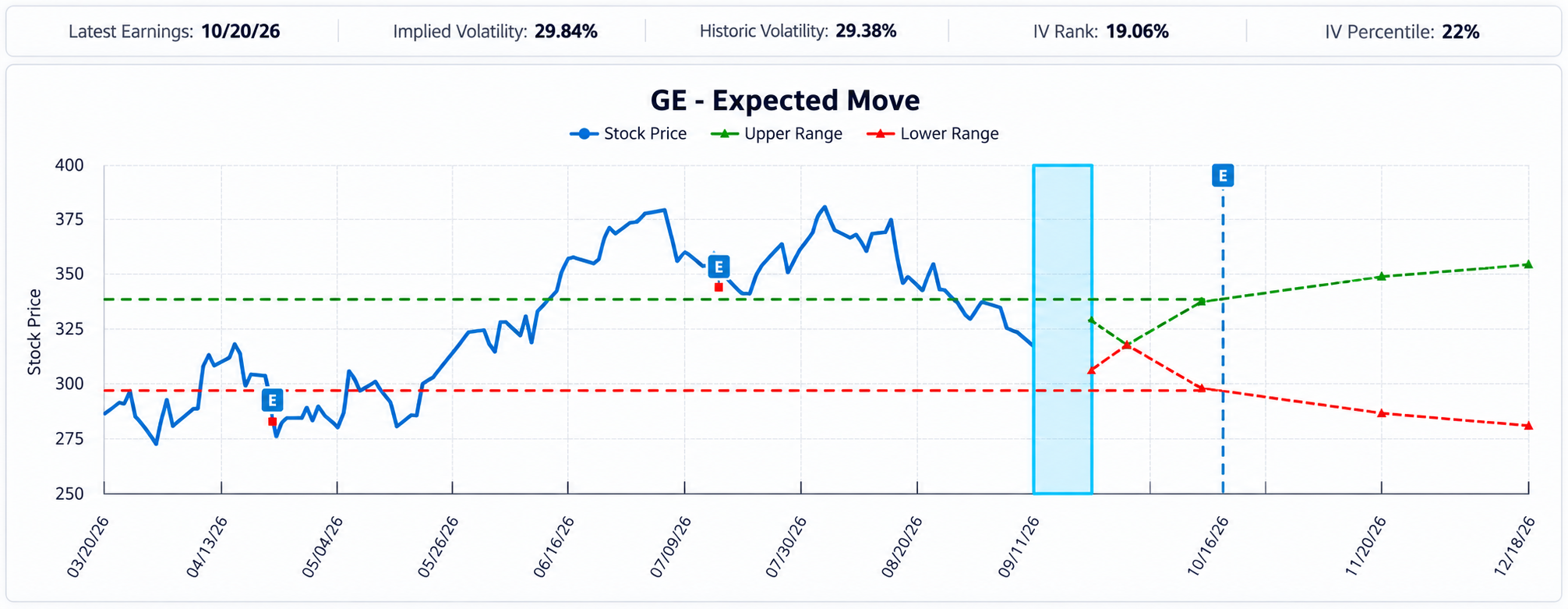
You can sense the dilemma without running a formal expected value calculation. If you were to run this exact trade across multiple parallel universes, your portfolio would quickly sink as the pace of expected losses would dwarf the pace of expected wins. Thus, any financial expert would beg you not to expose yourself to this terrible trade.
But what if the presupposition to get us these low probabilities was not fully reflective of market context? I’m not saying that GE stock is a no-brainer; rather, it’s worth examining what we truly believe about the equity.
What’s So Special About GE Stock?
A question that any debit-based options trader must ask about their target candidates is simply, what is so special about the security in question? For GE Aerospace stock, the answer could be that it has been deflated excessively. Thus, to borrow a baseball concept, the ticker may be “due” a contrarian swing higher.
That might very well be the case but are we making the case with gut feelings and intuition or are we basing this assumption on empirical data? Neither approach is foolproof but I would argue that the latter involves making an inductive argument for GE stock.
So, going back to the subheading’s question, what makes the ticker special is a quantifiable downtrend. Specifically, in the last 10 weeks, only three of the weekly candlesticks were positive, leaving seven as negative sessions. Abbreviated as the 3-7-D quantitative sequence, mathematically, this setup indicates that 70% of a given period were dominated by net selling pressure.
That’s a behavioral state that likely has an influence on how GE stock is perceived. It assumes, for example, that at least a sizable portion of the weak hands have been flushed out — and that could translate to less upside resistance for contrarian buyers.
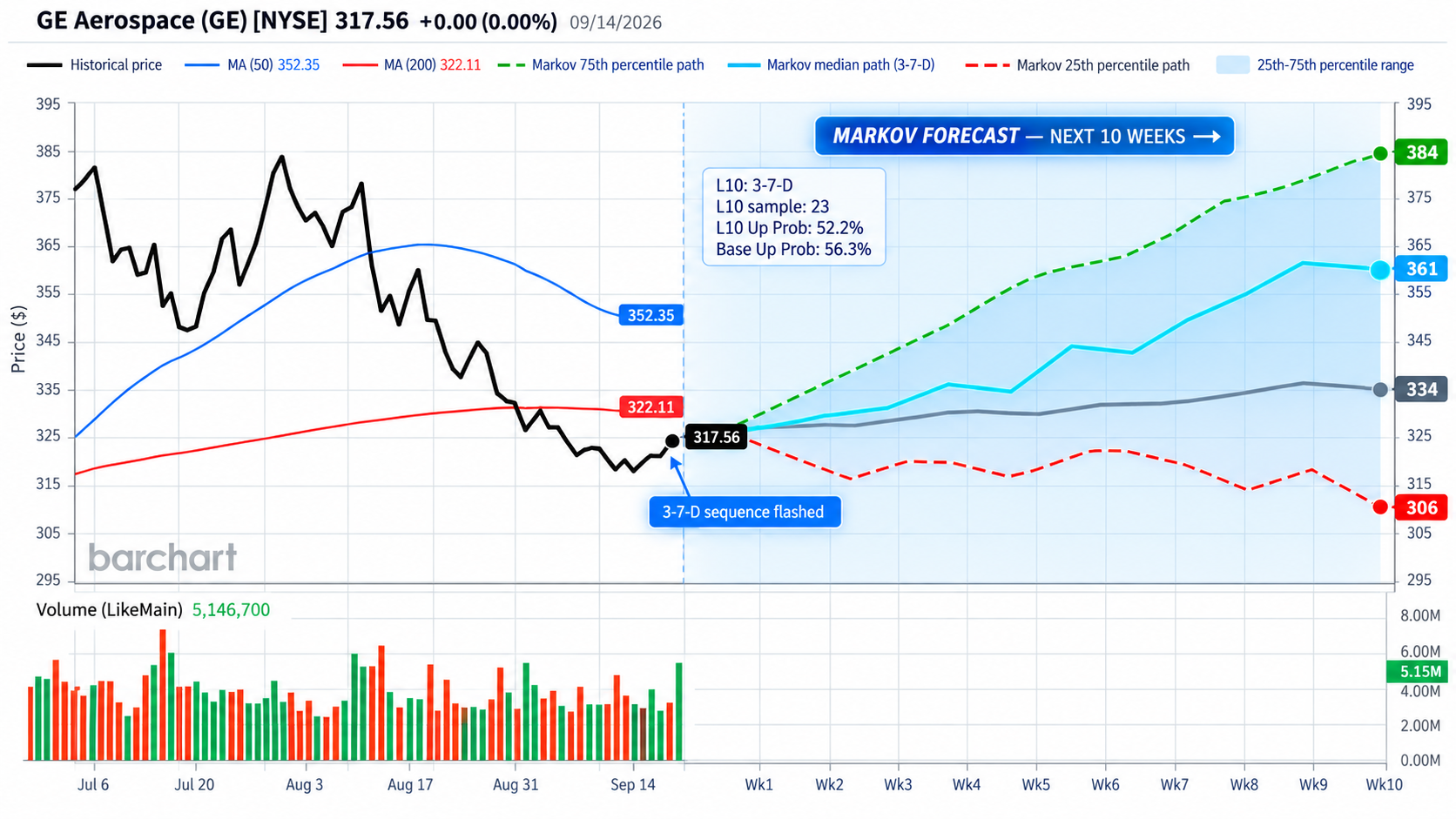
In fact, we know from historical data that since January 2019, this behavioral state has flashed 23 times on a rolling basis. Further, five weeks following this signal (which coincides with the Oct. 16 expiration date), we may observe the following:
- The median terminal expectation is 7.07% up.
- The upper median (75th percentile) expectation is about 13.4% up.
- The lower median (25th percentile) expectation is about 1.91% down.
Before jumping on the 330/340 bull spread expiring Oct. 16, it’s critical to note that a sample size of 23 occurrences is extremely small. Such an observation would be laughed out of the room under a scientific domain. However, based on a prior, paradigm-specific dataset, GE Aerospace stock has historically rebounded following the aforementioned quant state.
By inductive reasoning, there may be a better-than-perceived chance of the GE stock call spread being profitable at $340 on Oct. 16.
Why Do I Defend My Presupposition?
If you’re wondering why I defend the above framework, it’s because we generally share the same presupposition. Consider the various arguments made in the financial publication sector.
A technical analyst believes that an observed pattern in the charts embeds a probabilistically predictive argument. A fundamental analyst believes that observed financial metrics in quarterly disclosures embed a predictive argument. And in my case, I believe that order flow imbalances embed a predictive argument.
What’s the common thread? We believe that the (recent) past materially impacts or influences the future. Black-Scholes actually has a different presupposition: the past (other than price as a factual coordinate) does not shape the future. A better way to say is that the future is independent of the path that got the share price to where it currently is.
That could be the case — no one knows for sure. But I don’t find it particularly convincing that GE stock suffering a 70% drawdown in the number of sessions over a two-month period would not have an influence on where it may end up over the next several weeks.
It Comes Down to Personal Choice
To reiterate, no one knows the future so no one can say determinatively which set of probabilities is factual. To use a worn-out tautology, only time will tell. However, if we are to take advantage of a possible mispricing, we would have to enter the trade before the telling of time. Once time tells, the opportunity is already priced into GE stock.
One obvious positive about the Black-Scholes framework is that it provides a mathematically rational benchmark of understanding the time-value of risk. It’s a consistent framework that applies to all optionable securities. My core contention is that certain securities may be better represented by a path-dependent model rather than a path-independent one.
Because GE stock suffered a severe downturn (from a quantitative perspective), I don’t believe this material fact will be treated as an isolated event. Instead, I believe it will shape how GE is perceived. If that’s the case, history has demonstrated that this changed perception typically resolves in the positive direction.
On the date of publication, Josh Enomoto did not have (either directly or indirectly) positions in any of the securities mentioned in this article. All information and data in this article is solely for informational purposes. For more information please view the Barchart Disclosure Policy here.