
AI Slowdown Calls Could Be A Turning Point For Applied Materials Stock
- Applied Materials announced that its Board approved a quarterly cash dividend of $0.53 per share, payable on December 10, 2026 to shareholders of record on November 19, 2026, alongside reporting record fiscal third quarter revenue of $9.12b and non GAAP earnings per share of $3.50.
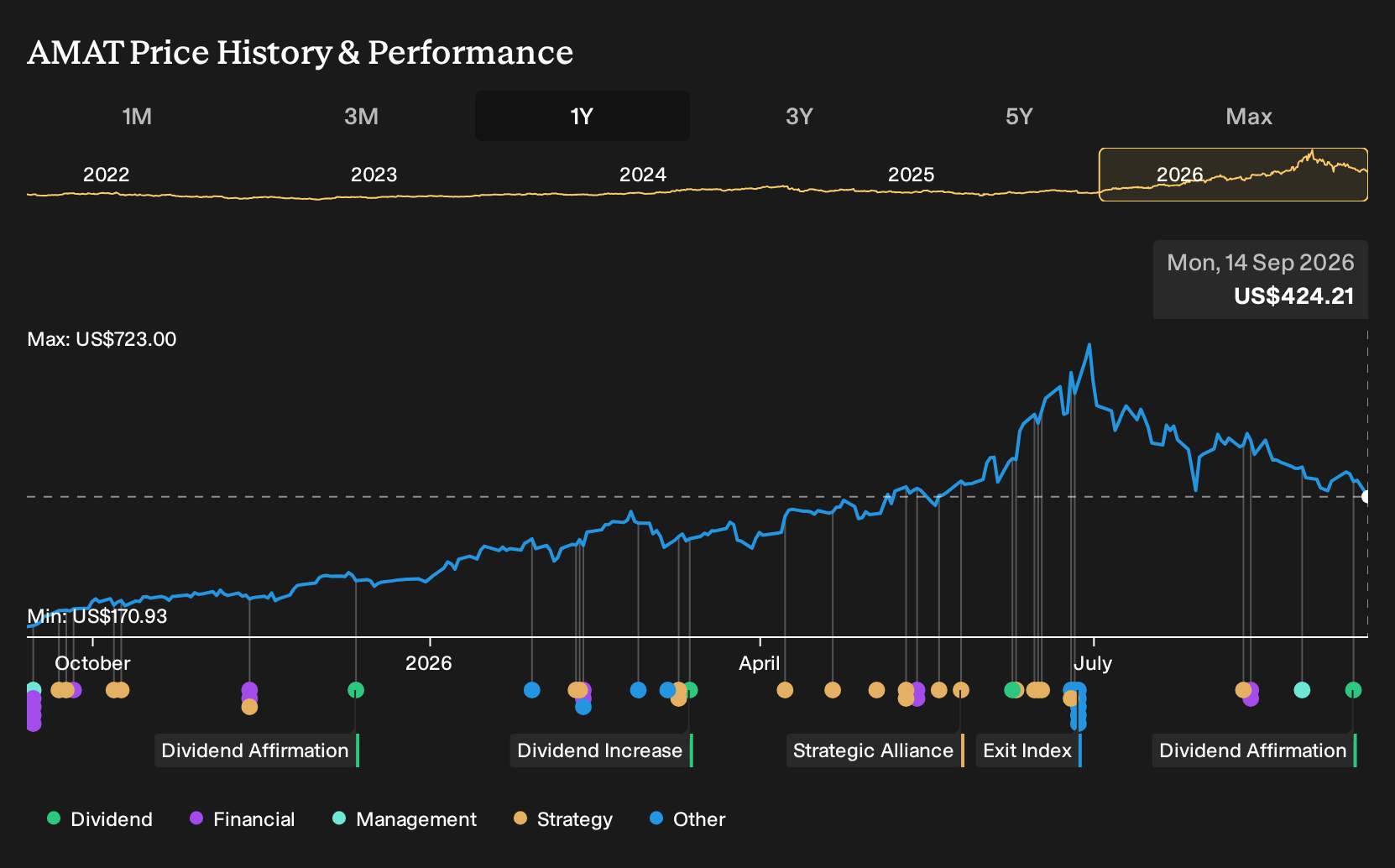
- In the same week, calls from leading AI executives to slow advanced model development prompted investors to reassess long term semiconductor equipment demand, even as Applied Materials' AGS services revenue reached a record $1.78b with over 37,000 chambers connected to its AIx software platform.
- We will now explore how Applied Materials' investment narrative could be affected by investor concerns around slower frontier AI deployment.
Applied Materials Investment Narrative Recap
For an investor to stay with Applied Materials, the core belief is that AI, high performance computing, and broader chip demand keep pulling more capital into fabs, packaging, and services. The recent call to slow frontier AI development challenges that story at the margin, since it hit sentiment around AI infrastructure. The more concrete near term driver is execution on system shipments and services, including the AGS segment and AIx connected tools.
The biggest operational risk right now sits in external factors. Export license rules around China, customer concentration in a few large chipmakers, and any pause in AI related fab spending could all disrupt order timing. The share price drop on AI concerns reflects that risk being repriced rather than a clear change in Applied Materials' current operating momentum.
The most relevant recent announcement for this setup is the record quarterly revenue of US$9.12b with non GAAP earnings per share of US$3.50. That print landed just as the AI slowdown debate flared up. It shows the business exiting the quarter with strong utilization of its tools and healthy demand for both systems and services.
For catalysts, investors are watching whether Applied Materials can convert that strength into the company's stated aim of much higher system output and expanded AGS activity in the next few years. Any signs that AI related orders are deferred, or that export controls disrupt that path, would cut directly against the thesis that current earnings power is a stepping stone to larger fabs, more installed tools, and a bigger services footprint.
Applied Materials' current analyst narrative points to forecast revenues of US$53.0b and earnings of US$17.0b by 2029, based on an assumed 22.2% yearly revenue growth rate and an earnings increase of about US$8.5b from US$8.5b today.
Uncover how Applied Materials' fair value indicates a 48% potential upside to its current price, a gap that could narrow quickly if AI infrastructure sentiment turns.
Exploring Other Perspectives
One alternate view places trade restrictions at the center of the story, rather than AI demand. In that more cautious camp, the lowest analysts were penciling in about US$53.2b of revenue and US$18.3b of earnings for 2029 before this dividend news. That is a far more conservative Applied Materials narrative. Use it as a prompt to compare multiple scenarios before deciding how you feel about AI slowdown headlines and China risk.
Explore 9 other Applied Materials fair value estimates, including one that suggests as much as 34% downside from the current price.
The Verdict Is Yours
Don't just follow the ticker. Dig into the data and build a conviction that's truly your own.
- A great starting point for your Applied Materials research is our analysis highlighting 4 key rewards and 2 important warning signs that could impact your investment decision.
- See our latest analysis for Applied Materials. The report includes a comprehensive fundamental analysis summarized in a single visual, the Snowflake, making it easy to evaluate Applied Materials' overall financial health at a glance.
Looking For More Ideas Beyond Applied Materials?
If the Applied Materials story has you thinking about how AI, cash flows, and balance sheet strength fit into your broader portfolio, it can help to line it up against other opportunities using the Simply Wall St Screener.
- If you want to focus on quality at a sensible price, compare Applied Materials with a wider group of companies that screen as 35 high quality undervalued stocks.
- For readers who care most about resilience, stress test your income and capital against a universe of 11 resilient stocks with low risk scores that may help smooth out the ride.
- Income seekers can balance a growth story like Applied Materials with potential cash return opportunities by scanning through 6 dividend fortresses that meet your yield and payout preferences.
This article by Simply Wall St is general in nature. We provide commentary based on historical data and analyst forecasts only using an unbiased methodology and our articles are not intended to be financial advice. It does not constitute a recommendation to buy or sell any stock, and does not take account of your objectives, or your financial situation. We aim to bring you long-term focused analysis driven by fundamental data. Note that our analysis may not factor in the latest price-sensitive company announcements or qualitative material. Simply Wall St has no position in any stocks mentioned.
Have feedback on this article? Concerned about the content? Get in touch with us directly. Alternatively, email editorial-team@simplywallst.com