
Dear Intuit Stock Fans, Mark Your Calendars for September 17
Intuit (INTU) remains a financial technology powerhouse, with roughly 100 million customers across its platforms. Its biggest advantage is the breadth of financial workflows it brings together, spanning everything from tax preparation to business software. But that strength has not protected the stock from a changing market narrative.
Wall Street is increasingly concerned that the rapid adoption and advancement of artificial intelligence (AI) could chip away at Intuit’s core tax and business software offerings. These concerns intensified after Intuit delivered slightly disappointing FY2027 sales guidance with its Q4 FY2026 results.
As INTU stock faces pressure and doubts about the company’s future growth emerge, Intuit will hold its annual Investor Day on Thursday, Sept. 17, at 8:00 a.m. Pacific Time at its headquarters. CEO Sasan Goodarzi, CFO Sandeep Aujla, and other leaders are anticipated to outline the FY2027 strategy and long-term goals, offering insight into how Intuit aims to tackle upcoming challenges.
What comes out of that meeting could help determine whether Intuit’s recent struggles represent a temporary reset or the beginning of a more fundamental shift in its growth trajectory. It would also shed light on a clear path to stronger customer growth, meaningful AI monetization, and recovery in areas that could ultimately determine whether the battered stock can earn back its premium.
About Intuit Stock
Headquartered in Mountain View, California, Intuit is a financial technology company that provides financial management, tax, payments, lending, and marketing solutions.
With a market cap of nearly $90.6 billion, the company operates some of the most recognizable brands in its respective markets, including QuickBooks for businesses, TurboTax for tax preparation, Credit Karma for personal finance, and Mailchimp for marketing.
Still, the growing concern that AI could take over portions of Intuit’s business has taken a heavy toll on the stock. INTU stock has plunged 48.6% in the past 52 weeks while it is down 49.4% in 2026. More recently, however, the picture has improved somewhat as shares have gained 18.8% in the past three months.
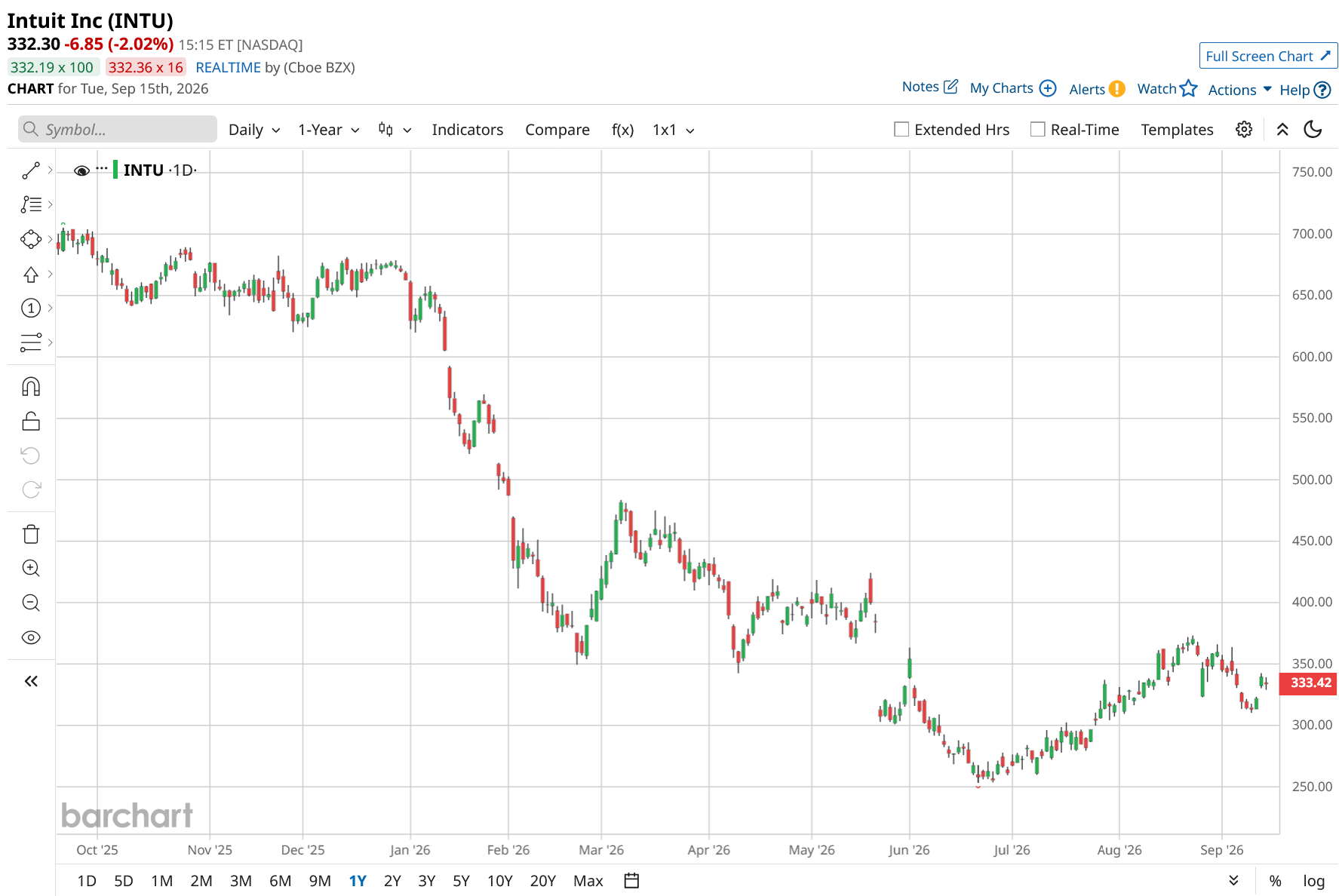
The valuation story is also beginning to look more interesting. INTU stock is trading at 14.03 times adjusted earnings. The multiple sits at a discount to both the industry average and its own five-year average multiple, creating an attractive entry point for long-term investors.
The company has also increased its dividend for 14 straight years and currently pays an annual dividend of $5.52 per share, giving the stock a dividend yield of 1.63%. Its most recent quarterly dividend of $1.38 per share is scheduled to be paid on Friday, Oct. 16, to shareholders of record as of Thursday, Oct. 8.
Intuit Surpasses Q4 Earnings
On Aug. 25, Intuit reported a strong Q4 FY2026 earnings report, with an increasing share of its growth coming from higher-value platform businesses. Revenue grew 13.7% year-over-year (YoY) to $4.35 billion, beating analyst estimates of $4.27 billion. Adjusted EPS also grew to $4.03, topping the analyst estimate of $3.59.
Global Business Solutions (GBS) remained the core growth engine. GBS revenue rose 14% YoY in Q4 to $3.4 billion. Excluding Mailchimp, it grew 15% YoY. Online Ecosystem revenue rose 17% from the previous year’s period to $2.6 billion, and excluding Mailchimp, it grew 20% in Q4.
QuickBooks showed solid operating momentum. QuickBooks Online Accounting revenue grew 20% YoY, driven by higher effective prices, customer growth, and mix. Total online payment volume, including Bill Pay, increased 32% YoY, and QuickBooks Capital loan volume jumped 54% from the previous year’s period to $1.9 billion in the quarter.
Customer acquisition remains the weak spot. Total online paying customers grew 3% YoY for the full year, and U.S. TurboTax units declined 2% YoY for the full year as price‑sensitive DIY customers shifted to lower‑cost providers.
In response, management plans to put customer acquisition and market-share gains near the top of its FY2027 agenda. That includes developing lower-friction QuickBooks offerings and sharpening TurboTax’s price-value proposition to make the product more competitive.
FY2027 guidance points to revenue growth of 9-10% YoY, representing a deliberate slowdown as Intuit invests in initiatives designed to support longer-term customer growth. TurboTax is expected to grow only 2-3% YoY, while Credit Karma is projected to perform better at 11-13% YoY.
Importantly, operating income is still expected to increase 26-27% YoY, pointing to substantial margin expansion. Non-GAAP EPS is projected to grow 23-24%, amounting to between $22.88 and $23.12.
The earnings outlook remains supportive of that longer-term thesis. Analysts forecast Q1 FY2027 EPS to rise 31.4% YoY to $2.47. For full-year FY2027, bottom-line earnings are expected to climb 39.4% from the prior year to $23.49. Analysts then expect another 11.8% increase in FY2028, taking earnings to $26.25.
What Do Analysts Expect for INTU Stock?
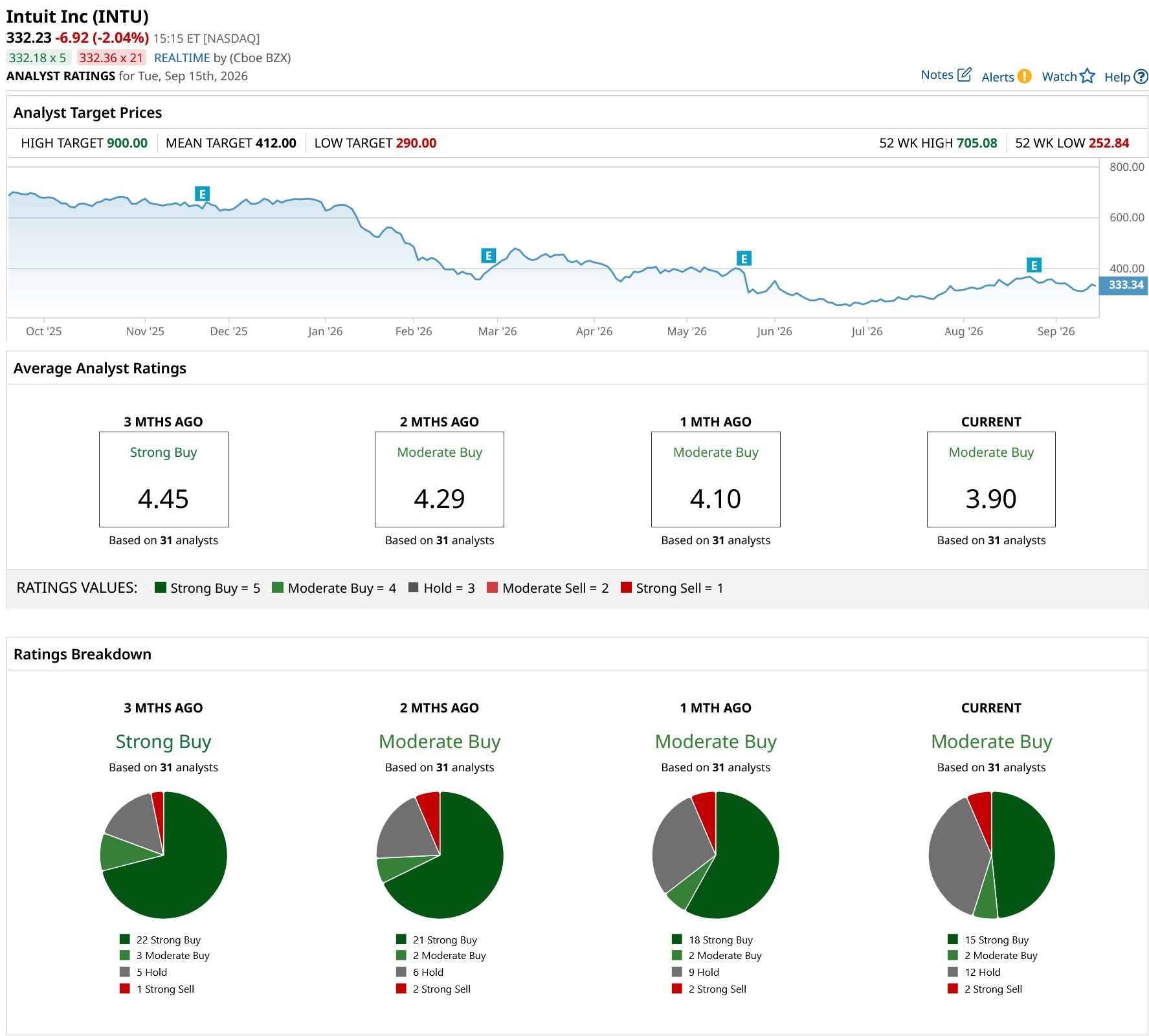
Wall Street’s broader view remains bullish on Intuit, with the stock carrying an overall “Moderate Buy” rating. Of the 31 analysts covering the name, 15 rate the stock a “Strong Buy,” two recommend “Moderate Buy,” 12 maintain a “Hold” rating, and two have issued a “Strong Sell” rating.
To that end, INTU’s average price target stands at $412, representing potential upside of 24%. At the other end of the spectrum, the Street-high target of $900 points to a potential gain of 171% from current levels.
On the date of publication, Aanchal Sugandh did not have (either directly or indirectly) positions in any of the securities mentioned in this article. All information and data in this article is solely for informational purposes. For more information please view the Barchart Disclosure Policy here.