
After the financial report was disclosed, the stock price “fell sideways”. Why did Corfu Healthcare (01187) not have a good stock price to increase revenue and profit?
On August 28, Corfu Healthcare (01187) disclosed its 2026 H1 financial report. During the reporting period, the company achieved revenue of 2,072 billion yuan, up 38.51% year on year. The growth rate far exceeded the industry average (6.5%), of which the company's overseas business revenue was 210 million yuan, up 116.97% year on year; at the same time, the company's gross margin improved for three consecutive years, reaching 55.89%; current net profit to mother was 202 million yuan, up 20.84% year on year.
On the business side, ventilators, which are an important product category of Corfu Healthcare, are the biggest highlight. Financial reports show that in the Q2 quarter of this year, the company's ventilator sales exceeded 100 million yuan in a single quarter.
Judging from the performance of the secondary market, after surging HK$40 in the intraday market on July 27, Corfu Healthcare's H share price emerged from a period of continuous decline. The decline in the range from July 27 to August 11 reached 16.21%. Subsequently, the company's stock price stopped falling and rebounded before disclosure in the interim report, and closed back to HK$34.02 on August 27.
However, this “increase in revenue and profit” financial report failed to drive the Hong Kong stock price of Corfu Healthcare to rebound further. The Zhitong Finance App observed that the day after the disclosure in the 26th report, Corfu Healthcare's stock price closed down 3.35% and fell 7.3% over the next three trading days, and has been trading sideways ever since.
Downsizing and rebound, insufficient support
As mentioned above, after breaking out of the falling range from July 27 to August 11, Corfu Healthcare's stock price ushered in a wave of “volumetric breakthroughs” before the earnings report.
Judging from market performance, within this range, Corfu Healthcare's closing price range rose from HK$31.64 to HK$34.02, with a cumulative increase of about 7.52%. At the same time, it closed up 5.13% in a single day on August 27, and the corresponding turnover increased to about HK$5.95 million, which is significantly higher than the average daily turnover of about HK$2.9 million within this range.
From a technical perspective, the dominant structure in this section is a typical breakthrough in volume after downsizing and bottoming out, and switching from “weak repair” to “short-term acceleration.” After three trading days of higher closing, Corfu Medical's closing price on August 27 reached HK$34.02, almost touching BOLL's upward trajectory of HK$34.07 on the same day. Looking at fundamentals, the core logic of multi-party transactions in the market at the time was based on the performance of the company's ventilator sales exceeding expectations on the fundamental side and valuation repair expectations brought about by the company's high growth performance in overseas business.
However, in this period of sharp rise in volume and price, Corfu Healthcare's stock price also experienced a “short-term overheating” phenomenon as the stock price rose rapidly. On August 27, while the company's stock price surged and failed to break through the BOLL online track price, RSI6 and KDJ-J were already showing signs of being overbought on the technical side, and the market showed clear short-term pullback pressure. This also became one of the main reasons why Corfu Healthcare's stock price pulled back from August 31 to September 3.
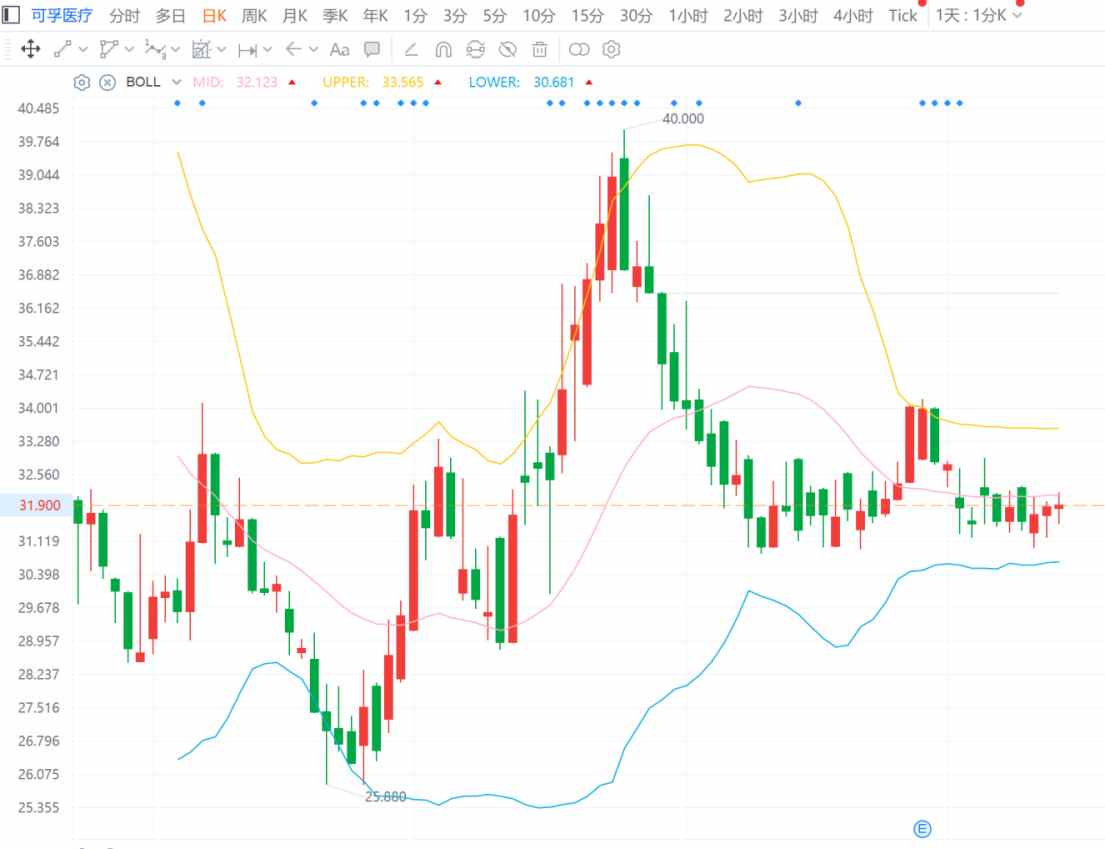
After the stock price closed down 1.07% on September 3, Corfu Healthcare's stock price did not dive all the way down the BOLL line. Instead, it rebounded one after another on September 4 and September 8, and fluctuated up and down around the middle BOLL line.
It is easy to see that the closing price of HK$32 on September 14 has surpassed the 5-day and 10-day EMA, but the stock price is still below the 20-day EMA. However, at this time, the company's stock price only deviated by 0.38% from the 20-day EMA, and only about 0.4% from the 60-day EMA. The small deviation may indicate that the current situation is not the end of panic, but rather a weak balance structure with poor liquidity.
However, from a quantitative perspective, since August 31, the average daily turnover of Corfu Medical has been only about 37,000 shares, which is only 43.3% of the average daily turnover of 85,500 shares between August 1 and August 28; in addition, the average daily turnover of the company's stocks has also dropped from about HK$2.77 million in the previous period to about HK$1.19 million. The corresponding average daily turnover rate has dropped from 0.32% to 0.14%, and the OBV range continues to decline, indicating that within this period of stock price rebound, Corfu Medical is shrinking its volume within and outside the market. Funding acceptance is weak.
In other words, at present, Corfu Healthcare's stock price is still in the short-term oversold repair stage. Only the closing price of subsequent companies reached the 20-day EMA and the high of HK$32.18 on September 8, which may indicate that a trend reversal is about to occur.
Why aren't there good stock prices with good earnings reports?
Judging from the 26H1 financial report disclosed by Corfu Healthcare this time, “increasing revenue and profit” is its core highlight.
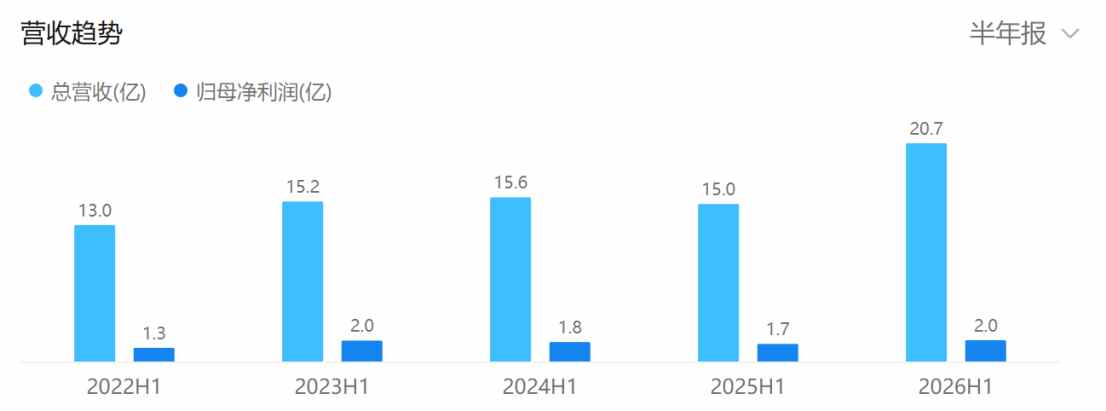
In terms of gross margin, thanks to the continuous optimization of the product structure and the release of core products during the reporting period, Corfu Healthcare's current gross margin reached 55.89%, an increase of 3.4 percentage points over the previous year, reaching a record high.
However, behind the above data, the company's current net interest rate fell to 9.78% from 11.16% in the same period last year, and the net interest rate fell further to 9.04% in the Q2 quarter of this year. The core reason for this is that the company's current sales expenses were 763 million yuan, an increase of 58.83% over the previous year. It is worth mentioning that according to previous financial data, Corfu Healthcare's sales expense ratio climbed from 26% in 2023 to 34.2% in 2025, and further rose to 36.8% in the first half of this year. That's an increase of nearly 11 percentage points over three years. This means that Corfu Healthcare's high revenue growth is partly dependent on marketing and promotion, and whether it can maintain a steady quality of growth in the future still needs to be continuously verified.
In terms of cash flow, Corfu Healthcare's net cash flow from operating activities in the first half of this year was $262 million, a year-on-year decrease of 25.33%. Currently, there is a net increase of $1,056 million in cash and cash equivalents, mainly due to a one-time contribution of HK$1,007 billion raised by the Hong Kong Stock IPO, which is not an improvement in operations. When profit growth is not simultaneously converted into cash flow, the company's medium- to long-term valuation flexibility will also be suppressed to a certain extent.
In addition, since Corfu Healthcare issued only 27 million shares, accounting for 11.45% of the total share capital, about 9.65 million Cornerstone shares were locked in until November 5 this year. In other words, the essence of Corfu's H shares is a chip structure with low circulation, low transactions, and high volatility.
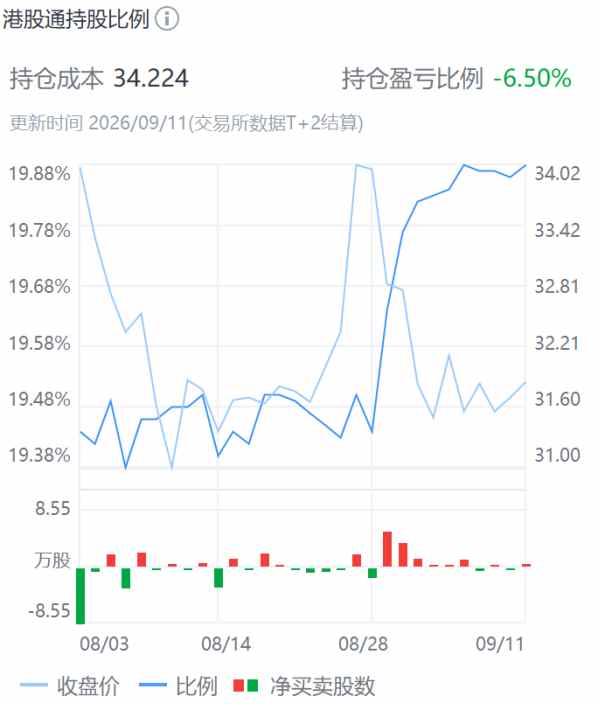
Take Southbound Capital data as an example. As of September 11, Southbound Capital held 5.3695 million H shares of Corfu Healthcare, accounting for 19.88% of the company's issued common shares. However, due to its low free circulation market, Southbound Capital has only accumulated a net increase of 133,300 shares over the past 20 trading days. Therefore, although Southbound Capital has allocated H shares for Corfu Healthcare's current “low issuance ratio+cornerstone lock-up period+limited southbound capital acceptance”, any performance of valuation discounts or insufficient funding commitments will be amplified by the market, which in turn causes short-term price fluctuations.
Overall, Corfu Healthcare's 26th report was not completely “fundamentally bad” for its H shares, but more like “good growth but insufficient valuation fulfillment conditions.”
After the financial report was disclosed, the Hong Kong stock market did not directly pay a premium for H shares due to the high increase in current revenue. Instead, it continued to price and trade influencing factors that suppress the company's medium- to long-term valuation, such as sales expenses driven growth and weak cash flow than profit. This is probably an important reason why Corfu H shares did not strengthen further after the disclosure of results.