
Interpretation of IPOs | Junxin Co., Ltd. heard the difference in the triple profit content behind the net profit of 1 billion dollars
According to the Hong Kong Stock Exchange's disclosure on September 13, Hunan Junxin Environmental Protection Co., Ltd. (abbreviation: Junxin Co., Ltd., 301109.SZ) passed the Hong Kong Stock Exchange's main board listing hearing, and CITIC Securities and CICC were its co-sponsors.
According to the Zhitong Finance App, the listing narrative of Junxin Co., Ltd. is not a simple “leading solid waste expansion”, but rather revolves around operational efficiency, industrial chain collaboration and profit quality: First, the waste incineration industry has moved from “horse riding ground” to “fine operation”, and the company ranked first in the country in 2025 for average feed-in electricity capacity in tons of garbage, indicating that its project location, furnace efficiency, and cost control have scarce barriers; Second, after the acquisition of Renhe, the company made up for household waste transit, food waste disposal, etc., and the large-scale effects of the environmental protection industrial park in Changsha Collaboration with the whole chain is expected to enhance cash flow resilience; third, Revenue and profit continued to grow from 2023 to 2025, showing that profit release is not only dependent on capacity expansion, but also from efficiency improvements and resource utilization. But the market will also ask, how can the risk of declining national subsidies, accounts receivable, capital expenditure, and offsite replication be mitigated?
What is the financial content of high profit growth?
According to the prospectus, Junxin Co., Ltd. is a company providing professional solutions for comprehensive waste treatment and resource utilization, including investment, management and operation of green and environmentally friendly energy projects. According to Frost & Sullivan, in terms of project scale, the Changsha Environmental Protection Industrial Park, where the company's main business operations are located, is one of the largest comprehensive environmental protection parks in the Chinese industry.
The business performance of Junxin Co., Ltd. in 2025 showed a clear “increase in revenue and more profit” characteristics. Annual revenue was 2,731 billion yuan, up 13.3% year on year; gross profit was 1,503 billion yuan, up 50.2% year on year; operating profit was 1,268 billion yuan, up 45.3% year on year; profit during the year was 994 million yuan, up 44.9% year on year. The profit growth rate was significantly higher than the revenue growth rate. Net interest rate increased to 36.4% from 28.5% in 2024, and gross margin jumped from 41.5% to 55.0%. This combination shows that the company's current profit improvement does not depend on scale expansion, but rather comes from a change in revenue structure and an increase in operational efficiency. In the first quarter of 2026, the company's revenue was 736 million yuan, up 5.6% year on year, but profit for the period reached 305 million yuan, up 29.2% year on year, net interest rate further rose to 41.4%, and gross margin reached 56.6%, continuing the trend of profit flexibility.
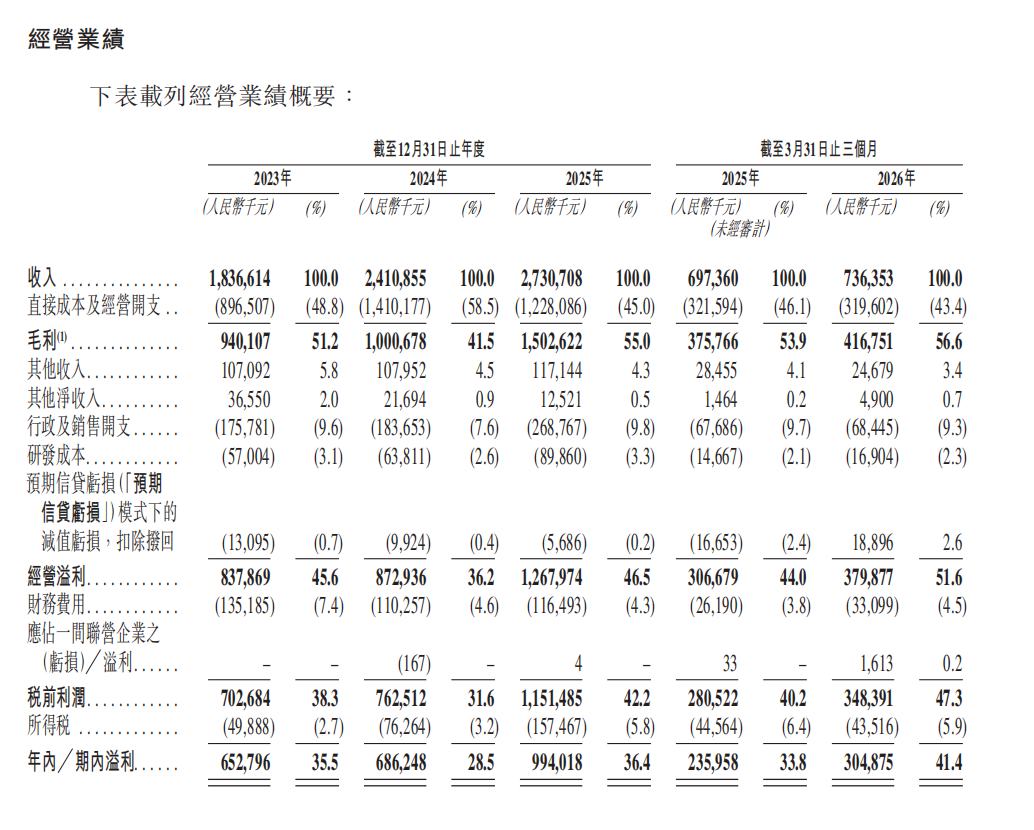
Behind the increase in decomposition profit, the company's profit increased 44.9% year on year in 2025, but profit before tax increased by only 50.9% year on year. Actual profit before tax increased from 763 million yuan to 1.151 billion yuan, an increase of about 51%, while income tax increased from 76 million yuan to 157 million yuan, and the actual tax rate rose from 10.0% to 13.7%, dragging down net profit. By the first quarter of 2026, profit before tax increased 24.2% year on year, but income tax instead fell from 44.56 million yuan to 43.52 million yuan, and the actual tax rate was reduced from 15.9% to 12.5%. This made the profit growth rate during the period reach 29.2%, which was higher than the growth rate of profit before tax.
In other words, part of the high increase in net profit in the first quarter of 2026 was due to lower tax rates and depreciation returns, rather than pure operational improvements. Impairment losses under the credit loss model are expected to be refunded in the first quarter of 2026, compared to an impairment loss of 16.653 million yuan for the same period in 2025. This positive and negative contributed significantly to profits.
Looking at the revenue structure, the most notable change is the rapid decline in construction revenue, and operating revenue becoming the absolute main body. In 2024, construction service revenue was 837 million yuan, accounting for 34.7% of total revenue. The total operating revenue of the project during the same period was 1,574 billion yuan, accounting for 65.3%; by 2025, construction service revenue plummeted to 76 billion yuan, accounting for only 2.8%, while total project operating revenue rose to 2,654 billion yuan, accounting for 97.2%. This change directly explains the fluctuation in gross margin: the share of construction revenue with low gross profit rose in 2024, dragging down the overall gross margin to 41.5%; in 2025, as projects under construction were transferred to operation, high gross profit operating income dominated, and gross margin quickly recovered to 55.0%. In the first quarter of 2026, construction service revenue continued to decrease by 49.7% year-on-year to RMB 024 million, accounting for 96.8% of total project operating revenue, and the revenue structure was further skewed towards the operating side.
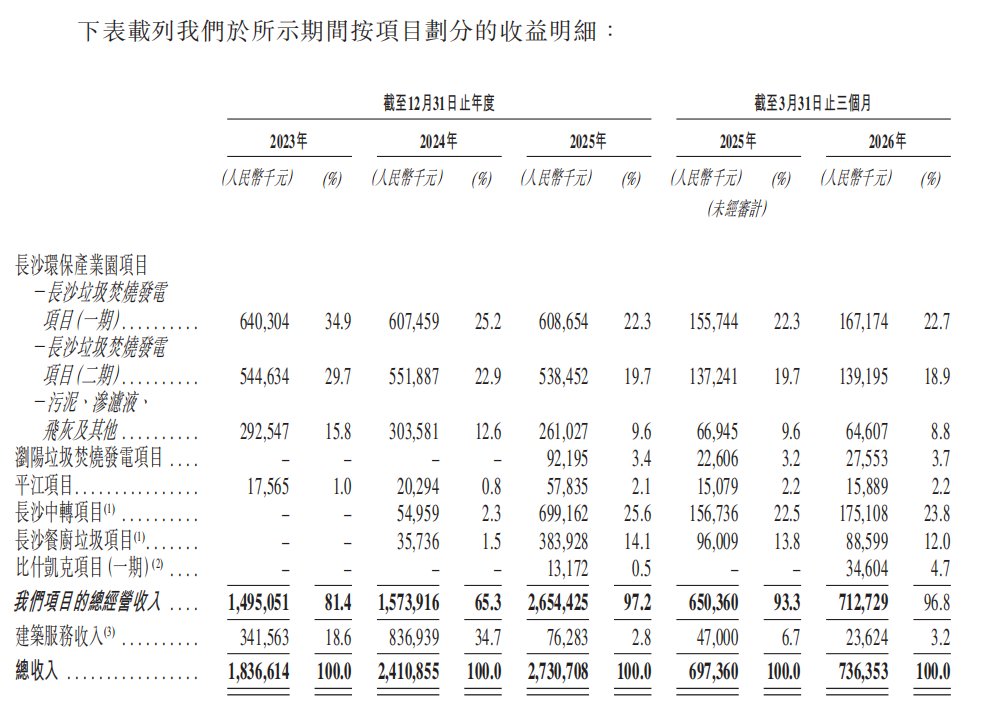
The division at the project level is also clear. The first phase and phase II of the Changsha Environmental Protection Industrial Park are still the basic revenue market, contributing a total of 1,147 billion yuan in 2025, accounting for 42.0% of total revenue, but the share has declined significantly from 64.5% in 2023, and the revenue of the second phase has declined slightly year-on-year. The revenue of sludge, leachate, fly ash and other sectors in 2025 was 261 million yuan, down 14.0% from 2024 million yuan. The share fell from 12.6% to 9.6%, and continued to shrink slightly in the first quarter of 2026. The real drivers of growth are transit, kitchen, Liuyang, Pingjiang, and overseas projects. The revenue of the transit project in Changsha jumped from 55 million yuan in 2024 to 699 million yuan in 2025, and the food waste project in Changsha rose from 36 million yuan to 384 million yuan. The combined share of the two increased from 3.8% to 39.7%, becoming the main engine of revenue growth. The Liuyang project contributed 92 million yuan from scratch, and the Pingjiang project increased from 20 million yuan to 58 million yuan, an increase of 185.0%, showing the incremental effect of newly put into operation.
Furthermore, overseas layouts have begun to be realized. The first phase of the Bishkek project was put into operation in December 2025, contributing 0.13 million yuan in revenue for that year, accounting for 0.5% of total annual revenue; in the first quarter of 2026, the project's revenue reached 35 million yuan, accounting for 4.7% of the quarter's revenue, which has already exceeded the full year level of 2025, indicating that the project is climbing rapidly. Although the current share is still small, its significance is that the company's revenue map extends from the Hunan region to the Central Asian market, providing a new direction for subsequent capacity expansion and revenue diversification. At the same time, the total operating revenue of the project accounts for nearly all, which means that the company's future growth will depend more on the operational efficiency of existing projects, the pace of commissioning of new projects, and the fulfillment of profits from overseas projects rather than one-time confirmation of construction business.
Taken together, the core logic of the financial performance of Junxin Co., Ltd. in the first quarter of 2025 and 2026 is to switch from construction-driven to operation-driven, and to achieve simultaneous increases in gross profit margin, net interest rate, and profit elasticity on this basis. Operating revenue accounts for more than 90%. Transit and kitchen projects are rapidly expanding, contributions from Liuyang and Pingjiang projects have increased, and the Bishkek project has begun to be realized, and the degree of revenue diversification has increased markedly. However, at the same time, it should also be noted that revenue growth in the first quarter of 2026 has slowed to single digits. The contraction in construction services dragged down total revenue, the kitchen and sludge sector experienced a year-on-year decline, and mature projects have limited room for growth. Although the prospects for overseas projects are promising, the current scale is still small and facing geographical and operational uncertainty.
How can the “trio” of business growth prospects be realized?
The business growth prospects of Junxin Co., Ltd. need to be examined in the macro context of the waste incineration industry as a whole shifting from incremental expansion to an inventory game. By the end of March 2026, there were 869 waste incineration power generation projects in operation nationwide, with a daily incineration capacity of about 11,300 tons/10,000 people. The average load rate in East China and South China was about 82%, and only 63% in Northeast China and Northwest China. The number of new projects dropped sharply by about 38% over the same period last year. At the same time, in 2024, the overall capacity utilization rate of waste incineration plants in cities and counties across the country was only about 63.22%, which is below the lower limit of national standards. “Not enough garbage to burn” has evolved from an individual phenomenon to an industrial structural contradiction. In 2025, the domestic bid for new waste incineration was only 0.59,000 tons/day, which continued to decline by 35% over the previous year. This pattern means that the industry's growth logic has changed from “you can lie back and make money when you get the project” to a refined competition stage of “refocusing on operation and maintenance, and improving quality”, and the operational efficiency and diversified monetization capacity of existing projects have become the core variables of differentiation.
In this context, the competitive advantage of Junxin Co., Ltd. is first reflected in its leading position in the industry in operational efficiency. The company ranks first in the country in terms of feed-in electricity in tons of garbage according to the 2025 average value, and key indicators such as the incineration plant's own electricity consumption rate are also at the forefront of the industry. In the first half of 2026, the company's domestic waste disposal capacity reached 2.173,400 tons, up 16.79% year on year; feed-in electricity volume was 1,050 billion kilowatts, up 18.48% year on year; tons of waste feed-in electricity further increased to 483.17 degrees. This efficiency advantage has clear financial implications: under the double pressure of declining national subsidies and differentiation in production capacity utilization, every unit of increase in tonnes of feed-in electricity directly corresponds to an improvement in marginal profit.
However, judging from the competitive landscape, the top ten companies in the global waste incineration market have a total share of about 62%, local Chinese companies account for more than 75% of the domestic market, and leading companies such as Everbright Environment, Green Power, and Pioneering Environmental Protection account for 28% of the world's total processing capacity. Junxin Co., Ltd. still has a clear gap with these national leaders in terms of total processing scale, and its competitive advantage is more reflected in the efficiency of a single plant than in scale effects.
Overseas expansion is the most differentiated part of a company's growth narrative and one that requires careful evaluation. In the first seven months of 2026, the total processing scale of overseas BOT projects won by Chinese waste incineration companies reached 21,378 tons/day, exceeding the level of the full year of 2025. In the list of operational projects going overseas, Junxin Environmental Protection ranked third after Kang Heng Environmental and China's Tianying. Private enterprises showed stronger investment and operation competitiveness on this track as a whole. However, overseas projects still face multiple uncertainties about how to realize profits. The asset-heavy BOT model poses a severe test to financial strength.
The basic market of domestic business is also facing objective pressure. The company's revenue is highly concentrated in the Changsha region. The risks brought about by regional concentration are already reflected in accounts receivable data: from 2023 to 2025, the company's trade receivables were 810 million yuan, 1,859 billion yuan, and 1.82 billion yuan respectively, and the number of trade receivables turnover days was drastically extended from 137.5 days to 242.5 days. Although the company said that its main customers are local governments in provincial capitals, and the risk of bad debts is low, and that waste incineration feed-in tariffs form a stable basic cash flow market, the top five major customers account for over 90% of revenue and are highly dependent on financial payments. If financial arrears weaken in the future, there is a risk that operating cash flow will fall back.
Taken together, the growth prospects of Junxin Co., Ltd. depend on the pace of implementation of the following three key variables. The operational efficiency advantage of one of the existing projects is the most solid support for current performance, but there is limited room for growth. Second, the batch commissioning of overseas projects in Central Asia is the most important source of revenue growth in the medium term. The quality of execution, capital costs, and territorial operation capabilities will directly determine whether the company can transform from a regional operator to an international solid waste treatment service provider, but it is currently still in the verification stage. Third, computing collaboration and carbon asset monetization provide room for imagination with long-term valuation flexibility, but there is still a considerable distance between strategic concepts and verifiable benefits.
In summary, the domestic waste incineration industry has entered the “strong and powerful” stock competition stage. Junxin Co., Ltd.'s operating efficiency and accumulation in overseas advance card positions have given it some room for differentiation. However, the slowdown in accounts receivable turnover, excessive regional revenue concentration, pressure on capital expenditure for overseas projects, and the long-term impact of the decline in national subsidies are all constraints that cannot be ignored.