
PPL (PPL) On New Transmission Rider Is This Pullback A Buying Opportunity
PPL (PPL) is back in focus after its Pennsylvania utility proposed a new Customer Protection Transmission Rider, a rule change that aims to make transmission charges clearer and shift some costs directly onto large energy users.
PPL’s share price has slipped in the short term, with a 1-day share price return down 1.66% and a 30-day share price return down 7.75%, even as the 3-year total shareholder return of 43.86% and 5-year total shareholder return of 39.03% point to momentum that has built over a longer horizon. This suggests that recent declines may reflect shifting views on risk and regulation rather than a simple reversal of the broader story.
Scan beyond PPL and see how other regulated utilities are pricing in similar regulatory and cost pressures with our hand-picked 11 resilient stocks with low risk scores.
PPL now trades lower after a pullback that reflects fresh regulatory questions rather than collapsing operations. The key question is whether that reset leaves enough potential upside in the current valuation to justify taking on the new policy risk.
Most Popular Narrative: 19% Undervalued
PPL last closed at $33.23, while the most followed narrative pegs fair value at $41.20. This frames the current regulatory selloff as a pricing reset rather than a verdict on long term prospects.
The accelerating growth in data center construction and new economic development (particularly in Pennsylvania and Kentucky) is driving unprecedented electricity demand, positioning PPL for outsized long-term rate base and revenue growth as it invests to serve these large new loads.
Major planned grid infrastructure upgrades and generation capacity expansions, totaling $20B through 2028 (with upside from potential data center-driven transmission and new generation projects), set the stage for nearly 10% average annual rate base growth, which directly supports higher regulated revenues and future earnings.
See why 16 investors see PPL as 19% undervalued.
Result: Fair Value of $41.20 (UNDERVALUED)
Still, the narrative around PPL could unravel if regulators take a tougher line on cost recovery, or if large data center load materializes more slowly than expected.
Find out about the key risks to this PPL narrative.
Another View On PPL’s Valuation
The fair value narrative puts PPL at $41.20 and labels the stock as undervalued, yet our DCF model paints a tougher picture. On a future cash flow value of $19.92 versus a $33.23 share price, the same utility screens as overvalued instead. Which lens do you trust more for a long term thesis?
Look into how the SWS DCF model arrives at its fair value.
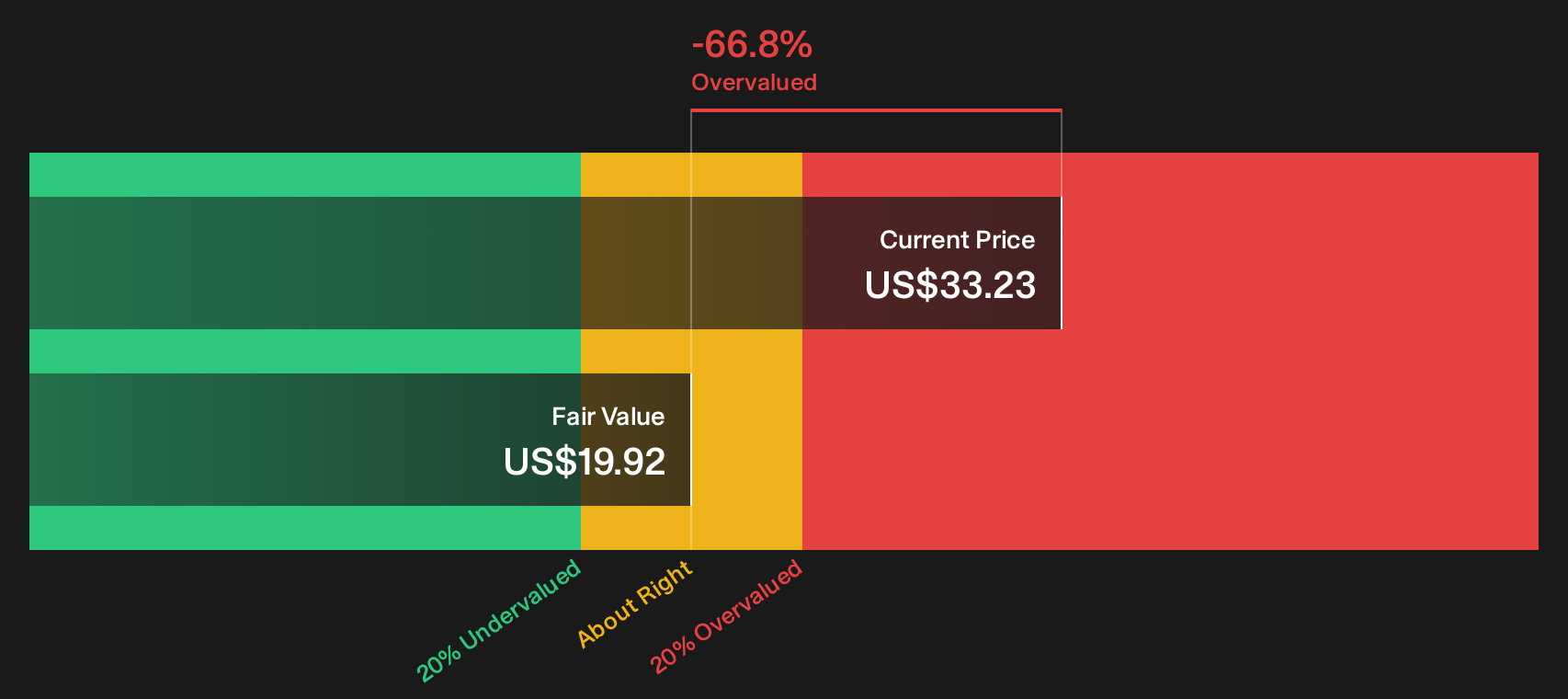
Simply Wall St performs a discounted cash flow (DCF) on every stock in the world every day (check out PPL for example). We show the entire calculation in full. You can track the result in your watchlist or portfolio and be alerted when this changes, or use our stock screener to discover 34 high quality undervalued stocks. If you save a screener we even alert you when new companies match - so you never miss a potential opportunity.
Next Steps
Mixed messages on PPL’s outlook are clear, so move quickly. Pull up the underlying numbers, compare both sides of the argument, then weigh the 5 key rewards and 2 important warning signs.
Looking for more investment ideas beyond PPL?
If PPL has you thinking harder about risk, reward, and regulation, use that momentum to widen your watchlist and pressure test fresh investment angles today.
- Target durable compounding opportunities by scanning for companies that combine quality metrics with attractive pricing through the 34 high quality undervalued stocks.
- Strengthen your income stream by focusing on businesses that offer robust payouts and yield support using the 6 dividend fortresses.
- Protect your downside by filtering for companies with sturdy financial footing and clean balance sheets using the list of solid balance sheet and fundamentals (22 results).
This article by Simply Wall St is general in nature. We provide commentary based on historical data and analyst forecasts only using an unbiased methodology and our articles are not intended to be financial advice. It does not constitute a recommendation to buy or sell any stock, and does not take account of your objectives, or your financial situation. We aim to bring you long-term focused analysis driven by fundamental data. Note that our analysis may not factor in the latest price-sensitive company announcements or qualitative material. Simply Wall St has no position in any stocks mentioned.
Have feedback on this article? Concerned about the content? Get in touch with us directly. Alternatively, email editorial-team@simplywallst.com