
How Board Appointment Will Impact Gap (GAP) Investors
- Gap Inc. has added Kirsten Green, founder and managing partner of venture firm Forerunner, to its Board of Directors, bringing more than two decades of consumer and brand building experience and a track record of supporting over 100 companies from early stage through IPO.
- Her background in identifying shifts in how people shop and backing digital first consumer brands is relevant to Old Navy’s push into activewear with Old Navy Sport and higher margin assortments. Taken together, these elements highlight where management is attempting to refine product, marketing, and profitability.
- The following section examines how Gap’s investment narrative could be influenced by Green’s board appointment and Old Navy’s recent brand initiatives.
Review how Gap’s boardroom and brand reset compares with other retailers responding to consumer trends by exploring the hand picked 16 high quality undiscovered gems in this space.
Gap Investment Narrative Recap
To own Gap, you need to believe the margin rebuild is real and can co-exist with only modest top line progress. Q2 adjusted gross margin of 41.4% sits at the center of that story, supported by higher average unit retail, better sell through, and less discounting. The key near term swing factor is whether Old Navy and Gap can keep product fresh enough to justify that pricing without leaning back on promotions.
The biggest risk right now is still uneven brand execution, especially at weaker banners and in seasonal categories, which could force heavier markdowns and pressure profitability. Kirsten Green’s appointment matters more for medium term brand and digital thinking than for immediate numbers. As a result, the near term margin and assortment work remains the main operational catalyst to watch.
The most relevant announcement alongside the board change is Old Navy Sport and the broader activewear push. Management has called active a strong category that helps offset softness elsewhere, and Old Navy is leaning into higher margin assortments and a clearer value story. For a shareholder, the question is whether this category focus can meaningfully support consolidated results as other areas reset.
Kirsten Green’s background in spotting shifts in consumer behavior and supporting digital first brands plugs directly into that Old Navy thesis. If Old Navy Sport, refreshed marketing like the Cardi B campaign, and ongoing assortment work all execute well, they offer a tangible operating catalyst. If they stall or copycats pull value shoppers away, the risk is that compressing traffic meets a margin structure that has less room for error.
Gap's current analyst narrative points to US$16.4b in revenue and US$1.0b in earnings by 2029, based on 2.1% yearly revenue growth and an earnings increase of about US$38m from US$962.0m today.
Uncover how Gap's fair value indicates that Gap has a 28% potential upside to its current price before the market closes that discount.
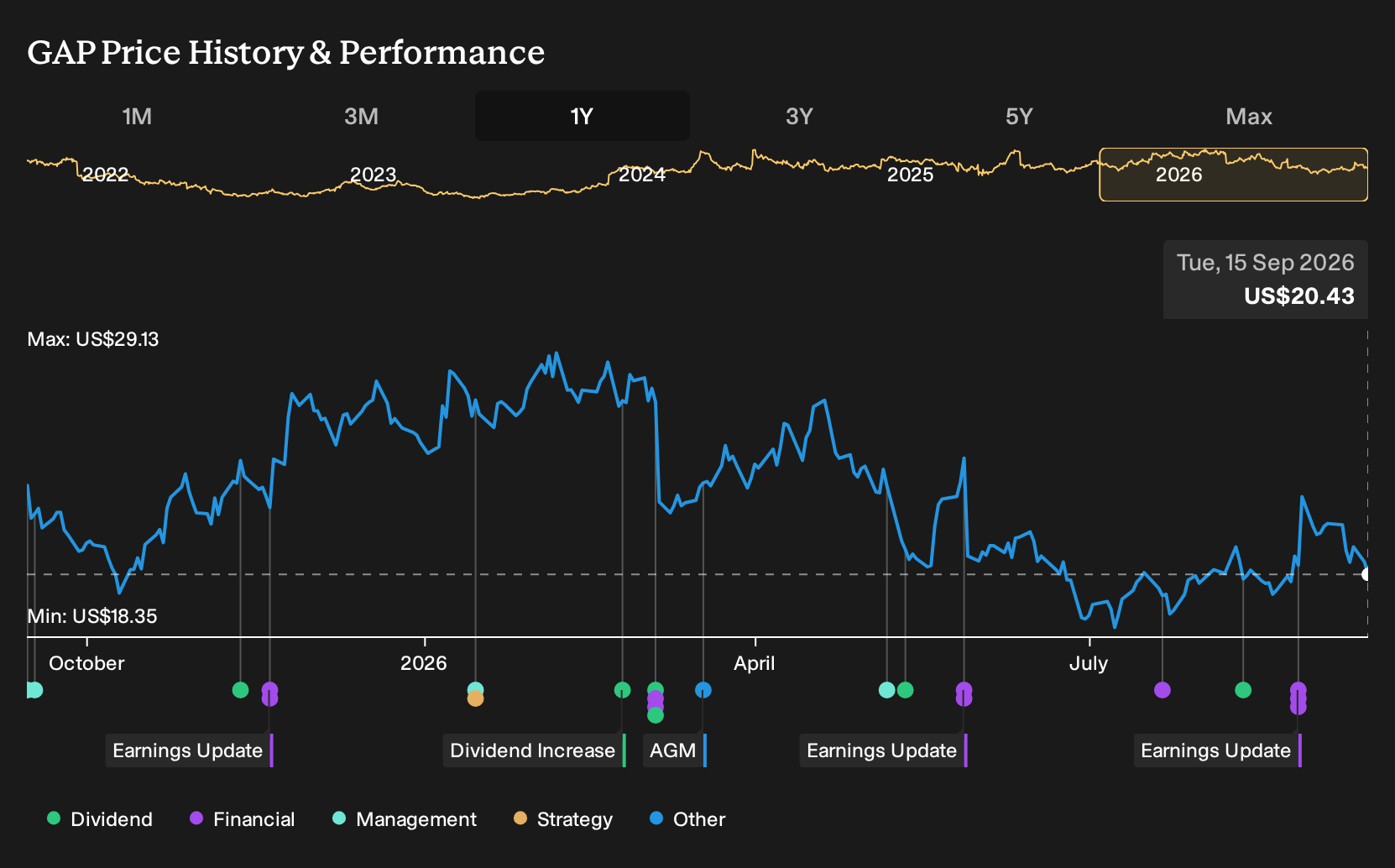
Exploring Other Perspectives
One alternate view says Gap’s heavy store footprint is the real problem for future earnings, not just merchandising or tariffs. The most bearish analysts were penciling in revenue of about US$16.4b and earnings of roughly US$878.0m by 2029, well below today’s US$1.2b. With Kirsten Green now on the board, those expectations may eventually shift. It is worth comparing several narratives before deciding how you see the story playing out.
Explore 5 other Gap fair value estimates, including one that suggests it could be worth just $21.00.
Decide For Yourself
Disagree with existing narratives? Extraordinary investment returns rarely come from following the herd, so go with your instincts.
- A great starting point for your Gap research is our analysis highlighting 3 key rewards and 3 important warning signs that could impact your investment decision.
- See our latest analysis for Gap. The report includes a comprehensive fundamental analysis summarized in a single visual, the Snowflake, making it easy to evaluate Gap's overall financial health at a glance.
Looking for more Gap investment ideas?
Once you have formed a view on Gap, it can help to widen the lens and compare it with other businesses that match the kind of risk, income, or value profile you prefer. The Simply Wall St Screener is built for exactly that.
- If you want potential value combined with quality fundamentals, scan for companies that look mispriced on the numbers using the 34 high quality undervalued stocks.
- If capital preservation matters most to you, focus on balance sheets and stability by filtering for a 11 resilient stocks with low risk scores.
- If you care about durable cash flows and income, zero in on higher yielding opportunities through a 6 dividend fortresses.
This article by Simply Wall St is general in nature. We provide commentary based on historical data and analyst forecasts only using an unbiased methodology and our articles are not intended to be financial advice. It does not constitute a recommendation to buy or sell any stock, and does not take account of your objectives, or your financial situation. We aim to bring you long-term focused analysis driven by fundamental data. Note that our analysis may not factor in the latest price-sensitive company announcements or qualitative material. Simply Wall St has no position in any stocks mentioned.
Have feedback on this article? Concerned about the content? Get in touch with us directly. Alternatively, email editorial-team@simplywallst.com