
Gold “rushed” on the eve of the interest rate decision! The Federal Reserve's dilemma is being seen through: are interest rate hikes running out of favor; without interest rate hikes, the price of gold will hit 5,000?
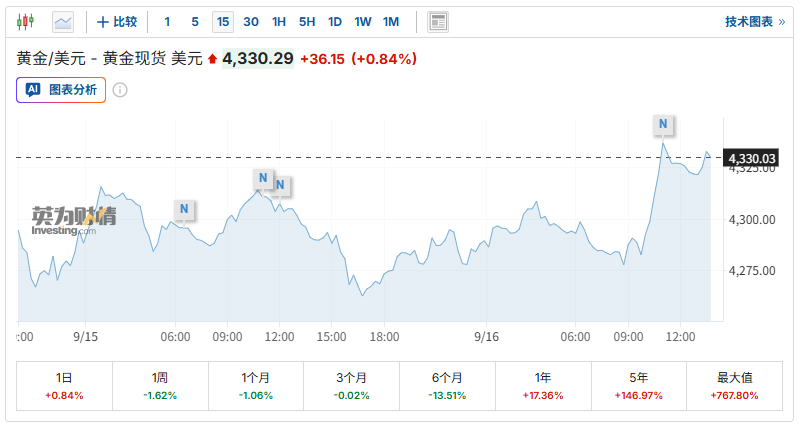
The Zhitong Finance App learned that in the past week, the gold trend was quite bumpy. Spot gold prices once fell below the 4,300 US dollar mark on Monday, hitting a low of around 4,253 US dollars. The intraday drop was more than 1.6%, setting a new low in more than a month. This decline is due only to traders pricing expectations of the Federal Reserve's interest rate hike. According to CME FedWatch data, the probability of interest rate hikes in market pricing is as high as 92.4% — at least 25 basis points, and it's basically lying within the price. The policy statement was followed by Walsh's press conference. Every word of the new Federal Reserve Chairman could be a trigger for the next direction of gold prices.
However, during the Asia Pacific session on Wednesday, before the Fed's boots were about to land, gold seemed to have begun to beat the Federal Reserve's “dovish” expectations: spot gold prices rebounded to around 4,330 US dollars, and gold futures rose to 4,382 US dollars at one point.
The performance of gold stocks is even more intriguing. Newman Mining (NEM.US) fell less than 2%, and Igor Mining (AEM.US) fell by less than 3% in the round of sell-off last Thursday triggered by repricing expectations of interest rate hikes. Over the same period, silver fell by more than 4%, more than four times that of gold. Most gold mining stocks also began to strengthen on Wednesday. This phenomenon of “miners resisting the decline” is nothing new, but at this point, it conveys much richer information than it seems on the surface.
The market has seen through the Federal Reserve's “dilemma”
The situation facing the Federal Reserve this time is indeed difficult. The core CPI rose 0.3% month-on-month in August, and oil prices regained 100 US dollars and even broke through 109 US dollars at one point. The downward trend in inflation not only stagnated, but there were signs of a rebound. On the Middle East side, Saudi Arabia issued security alerts for various regions, including Mecca and Jeddah, after a week of attacks by Iran-backed armed forces. Energy supply risks combined with inflationary stickiness made the political cost of the Federal Reserve staying on hold at the September meeting extremely high.
But if you think the Fed will go all the way hawkish because of this, you may be underestimating another possibility that the market is pricing.
Jesse Colombo, founder of BubbleBubble Report, said that if the Federal Reserve raises interest rates as scheduled, the price of gold may recover slightly after the uncertainty is removed; however, if the Fed chooses not to raise interest rates, the price of gold will “rise sharply”, which is expected to start an upward trend towards 5,000 US dollars.
There is a logic behind this judgment that is worth taking seriously: part of this round of inflation comes from supply-side shocks — energy prices are being driven up by geopolitical conflicts rather than overheating demand. The effect of monetary policy on supply-side inflation itself is limited. Colombo also mentioned another force — capital expenditure inflation spawned by AI infrastructure investment. Major cloud vendors invest trillions of dollars in computing power. This type of expenditure is far less sensitive to interest rates than traditional consumption and investment.
In other words, the Federal Reserve may be forced to raise interest rates to deal with a problem that cannot be solved by a rate hike.
More subtle are the variables at the political level. The Trump administration has publicly expressed its preference for low interest rates. When asked if Walsh's interest rate hike was correct, White House National Economic Council Director Hassett said he “respects” the Fed's decision, but also explained the reasons why the Fed should not raise interest rates. At the same time, some agencies pointed out that if Walsh sends a more dovish signal than market expectations, bond investors will instead demand higher yields due to the need to hedge against the risk of inflation. This means that the “dovish rate hike” path itself is also full of contradictions — the Federal Reserve is trying to maintain its anti-inflationary reputation by raising interest rates, but if the market believes that this rate hike is just a matter of course and will not continue to be tightened in the future, long-term yields may rise.
Bill Hartman of BMO Capital Markets said: It is extremely difficult for the Federal Reserve to maintain its credibility against inflation while choosing to keep interest rates unchanged. The market should not only be wary of suspending interest rate hikes that exceed expectations, but even a “dovish rate hike” — a bitmap or press conference sends a signal of caution — will cause the market to reprice assets.
CICC's framework provides a useful perspective: if interest rates are raised in September, they may not continue to raise interest rates in the future, and the market may “run out of profit”; if interest rates are not raised in September, it is even more beneficial to gold. Under both scenarios, the medium term direction of gold is not pessimistic. This is probably the core pricing divergence in the current market — short-term interest rates are moving upward, but the market's confidence in whether the Federal Reserve can maintain a restrictive policy stance is not as strong as shown by futures prices.
Frank Walbaum, a market analyst at the trading platform Naga.com, also summed it up: “The hawkish Federal Reserve may further lower the price of gold, but any soft wording may ease interest rate hike bets and help metals rebound.”
The story of US Treasury yields is not just the opportunity cost
The fact that the 10-year US Treasury yield exceeded 5% is widely interpreted as a disadvantage for gold because the opportunity cost of holding interest-free assets is rising. The logic itself is correct, but it's incomplete.
If you take it apart, a large part of the driving force behind this round of rising long-term yields comes from fiscal concerns, not simply economic growth or inflation expectations. The US government's demand for borrowing continues to expand, and pressure on bond supply forms a structural impetus on long-term interest rates. State Street strategist Aakash Doshi pointed out that the factors currently driving up long-term interest rates “don't seem to be higher than trending GDP growth or corporate profit margins.” In other words, yields are rising, but the reason for the increase is not that the economy is too hot.
This leads to a key inference: if the core driving force behind the rise in long-term yields is fiscal credit risk, then the direction of its impact on gold may be the opposite of what is predicted by traditional interest rate models. Gold's attributes as a “credit hedge” asset will be activated in this environment. While US bond yields soared in August, the price of gold did not fall but rose, which partially confirmed this — credit logic has overtaken opportunity cost logic to a certain extent.
Commerzbank analysts recently pointed out in a report that the price of gold has not been under greater pressure so far, which is somewhat surprising. Their explanation is that ongoing fiscal concerns — reflected in high long-term Treasury yields — and heightened US political risk are underpinning gold.
The BubbleBubble Report also mentioned a data point that is easily overlooked: the pullback in gold prices in this round is relatively limited, which may be related to the trend of continuous gold purchases by central banks around the world. The central bank's need to diversify foreign exchange reserve allocation forms the bottom support for gold demand in a context where the credit of US bonds is being questioned.
The miner's “leverage” is an oversimplified story
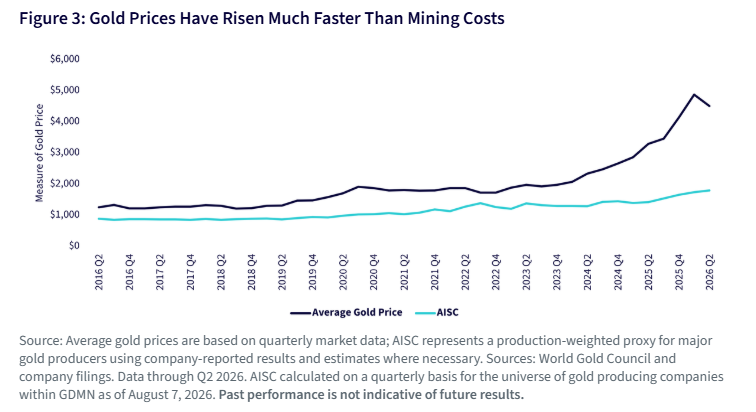
Back to gold stocks. The market's most common narrative about gold stocks is “When gold prices rise, miners' profits grow faster than gold prices because mining costs are relatively fixed.” That logic itself is correct. Currently, the industry-level full cost of maintenance (AISC) profit margin is close to $3,000 per ounce, and mining costs have hardly changed much as gold prices rise. When the cost side is fixed and the price side rises, the profit margin will indeed run faster than the price in percentage terms. This is known as “operating leverage.”
But that's only half the story.
In the round of sell-off on September 11, miners fell less than metals. The reason is that operating leverage is only a variable affecting miners' stock prices. The life span of a mine's reserves, balance sheet debt, environmental protection and licensing, and broader stock market risk exposure are completely undriven by the price of gold. Long-term research by researchers Dirk Baur, Allan Trench, and Lichoo Tay directly indicates that gold mining stocks structurally outperform physical gold over a long period of time. The reason is uncomplicated — miners must continuously invest in exploration and acquisitions to replenish reserves that have been dug up and sold. This reinvestment cycle, combined with stock market risks superimposed on the price of gold, is a burden that physical gold does not have.
WisdomTree's analysis also points in the same direction: the AISC of miners has risen much slower than the price of gold in the past ten years, which means that the structural profit margin expansion may last longer than reflected in current equity valuations. Gold miners in 2025 fully demonstrated the amplification effect of operating leverage in the context of rising metal prices. VanEck believes that this leverage may continue to push miners to outperform metals themselves in 2026. However, this judgment is based on the premise that the price of gold is on an upward trend, or at least there is no sharp drop.
Citibank's global commodities team recently pointed out in a research report that large gold miners are undervalued compared to gold bars. The bank listed Newman Mining and Eagle Mining as the preferred targets, and indicated that the price of gold implied by the current gold stock valuation is about $500 per ounce lower than the spot price. Citi expects the price of gold to reach 5,000 US dollars/ounce by the end of 2027. Even if the price of gold only remains at the current level, there is room for gold stocks to outperform.
The core underpinning this judgment is free cash flow. Citi pointed out that although the costs of large miners are rising, the rate of increase is far lower than the increase in gold prices, and profit margins are still expanding. More importantly, these companies' capital allocation strategies are becoming more rational, maintaining a balance between reinvestment and shareholder returns. Citi specifically mentioned that dividend yield is an important factor that distinguishes mining stocks from holding physical gold — if the price of gold falls, dividends can provide some downside protection, which was verified in the gold bear market from 2012 to 2016.
In terms of individual stocks, Citi's return on spot free cash flow for Newman Mining is about 6%, and for Eagle Mining, about 4.5%. Newman Mining's second-quarter adjusted earnings of $2.10 per share and revenue of $6.12 billion was slightly lower than analysts' expectations, but Raymond James raised the target price after the earnings report was announced. Eagle Mining's quarterly profit and revenue similarly fell slightly short of expectations, yet the company achieved a record quarterly free cash flow of over $1.3 billion.
The mismatch in the valuation of gold stocks may be the real opportunity
If you string the top few lines together, you can see an asymmetrical picture. Gold itself faces upward pressure from short-term interest rates, but the degree of resistance to falling gold prices exceeds the forecast of the interest rate model, indicating that the market is pricing some factors that surpass interest rates — fiscal credit risk, the credibility of the Federal Reserve's policy, and geopolitical uncertainty. These factors won't go away anytime soon.
The situation with gold stocks is more complicated. If the Federal Reserve eventually moves towards a “hawkish suspension” or “dovish rate hike” — that is, raising interest rates once but not continuing — then the turning point where interest rate expectations peak could boost gold and gold stocks quite significantly.
WisdomTree's observation is worth paying attention to: although gold prices fluctuate more in the range in 2026, the fundamental case of mining companies still holds true, and structural improvements in profit margins have not yet been fully reflected in equity valuations. This means that if the price of gold stabilizes or even rebounds after the Federal Reserve's policy path is clear, the room for valuation repair at the miner level may be more attractive than the increase in the price of gold itself.
Of course, the risks here are also clear. If inflation continues to exceed expectations, the Federal Reserve is forced to enter a cycle of interest rate hikes longer than market pricing, and long-term yields continue to rise, then gold and gold stocks will face greater pressure. Daniel Pavilonis of STONEX said that the combination of “high interest rates and a strong dollar” continues to erode the investment appeal of gold, and if interest rates continue to rise, the price may drop further. This risk cannot be ignored.
However, the problem is that the market's current interest rate hike of over 92% has taken quite a bit of the hawkish scenario into the price. What is really underpriced is what happens after interest rate hikes.