
Behind the AI giants shouting “deceleration” in unison: the capital expenditure race is in trouble for prisoners
The Zhitong Finance App learned that Anthropic CEO Dario Amoudi, OpenAI CEO Sam Ultrman, and SpaceX CEO Elon Musk rarely spoke out in groups calling for a slowdown in the development of cutting-edge AI models. On the face of it, this is a consensus on AI safety; however, Seeking Alpha contributor Valuation Rewind believes that the deeper reason is that the economic accounts of the AI arms race are becoming more and more difficult to calculate.
AI giants shout “decelerate” in unison: not just safety anxiety, but also a financial account
AI giants are facing a dilemma: if they slow down first, they may lose their leading position; if they continue to compete, training and infrastructure costs will expand dramatically. This is the classic “prisoner's dilemma” in game theory — every company pursues its own interests rationally, but the results may be worse than when they cooperate. If you look at the AI competition, it means: everyone knows that slowing down together is good for everyone, but no one dares to stop first. As a result, a seemingly contradictory situation has arisen: the more the giants are deeply involved in the AI competition, the more motivated they are to call for “everyone to slow down together.”

As you can see from the matrix, “keep investing” seems to be the safer choice no matter what your opponent chooses. But if both sides think this way, they'll end up in the bottom right corner together — both parties consume huge amounts of capital. This is at the heart of the prisoner's dilemma: individual rationality leads to collective irrationality. Because of this, giants have begun to try to use regulation to act as “coercive coordinators.”
Stronger regulation can play this role because once all major competitors are subject to the same set of rules, companies that are the first to cut their investments don't have to bear the risk of falling behind alone. For investors, the key is not whether AI executives are actually concerned about extreme risks such as “human extinction,” but rather that the financial accounts of the AI arms race are aligning their interests with policies to slow this race.
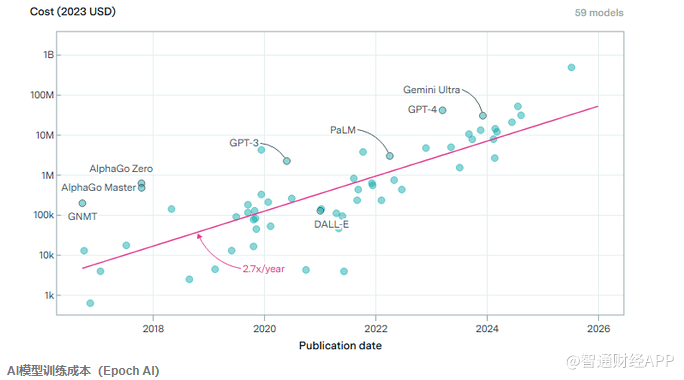
The cost of training more advanced AI models is rising exponentially. According to the data, the cost of training the new model is increasing by about 2.7 times each year. Anthropic is currently expected to report “adjusted operating profit” for the second consecutive quarter, but it is important to note that this caliber is before splitting with distribution partners such as Amazon, and does not include AI model training costs. What is really expensive is the cost of training.
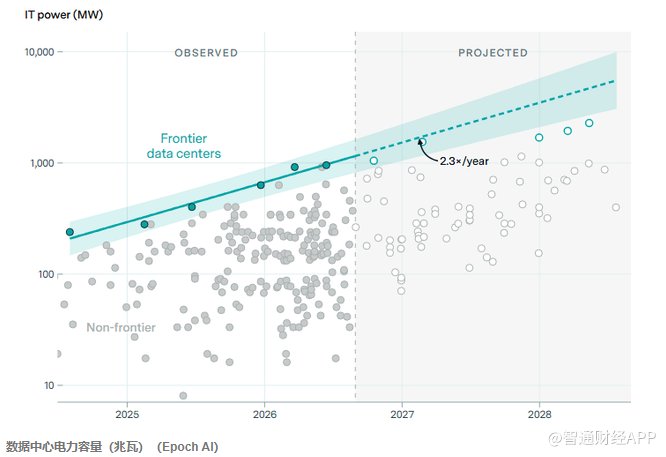
The same goes for data center costs. The electricity usage of cutting-edge data centers is measured in MW, increasing about 2.3 times per year. Currently, the largest data center, Colossus 2, has a power capacity of 946MW, and is jointly used by Anthropic and SpaceX.
This means that AI companies only appear to be “profitable” if they do not include exponential growth in development costs. It also explains why they are motivated to convince investors that capital spending and the arms race must slow down.
Regulation may become a “coercive coordinator”: another solution to the AI arms race
Whether intentional or not, stronger AI regulation will partially solve the economic prisoner dilemma faced by cutting-edge model developers. Strong regulation can build mutual trust among competitors, limit expensive arms races, and reduce competitive penalties for pioneering investment cuts.
According to Valuation Rewind, this points to a deeper paradigm shift: the biggest AI investors are facing capital shortages, making it difficult to continue expanding capital spending. However, the market's profit predictions for chip companies such as Nvidia and Micron depend precisely on this increase in capital expenditure.
For AI infrastructure investors, either outcome is not an easy one.
If competitors find mechanisms to slow down collaboratively, semiconductor and data center vendors will lose part of the increase in demand already reflected in expectations and valuations. If they fail to cooperate, the capital expenditure boom may last longer, supporting suppliers in the short term, but at the cost of leading edge model developers falling deeper into a race where costs rise exponentially, and ultimately need to prove that these investments can bring reasonable returns.
AI capital expenditure has largely driven overall stock market profit growth, and companies benefiting from AI capital expenditure are also an important part of large stock ETFs. As a result, whether collaboration slows down or the competition continues, it is difficult to reassure the market about current semiconductor valuations and even the overall stock market expectations.
Another variable is that regulation will not necessarily substantially slow AI infrastructure spending. Governments are likely to set more stringent safety standards while considering AI leadership a strategic priority to continue encouraging investment. Even with stricter regulations, the underlying capital expenditure cycle is likely to remain the same.
All in all, AI capital expenditure has become an important engine for overall stock market profit growth, and the weight of semiconductors in the stock market and economy has spurred the whole chain. If AI developers work together to slow down, supply chain demand growth will take the lead; if the competition continues, the capital expenditure boom can continue, but whether it can eventually continue depends on whether these investments can be converted into real revenue.