
Does Portfolio Reshaping Change The Bull Case For Berkshire Hathaway Stock (BRK.A)?
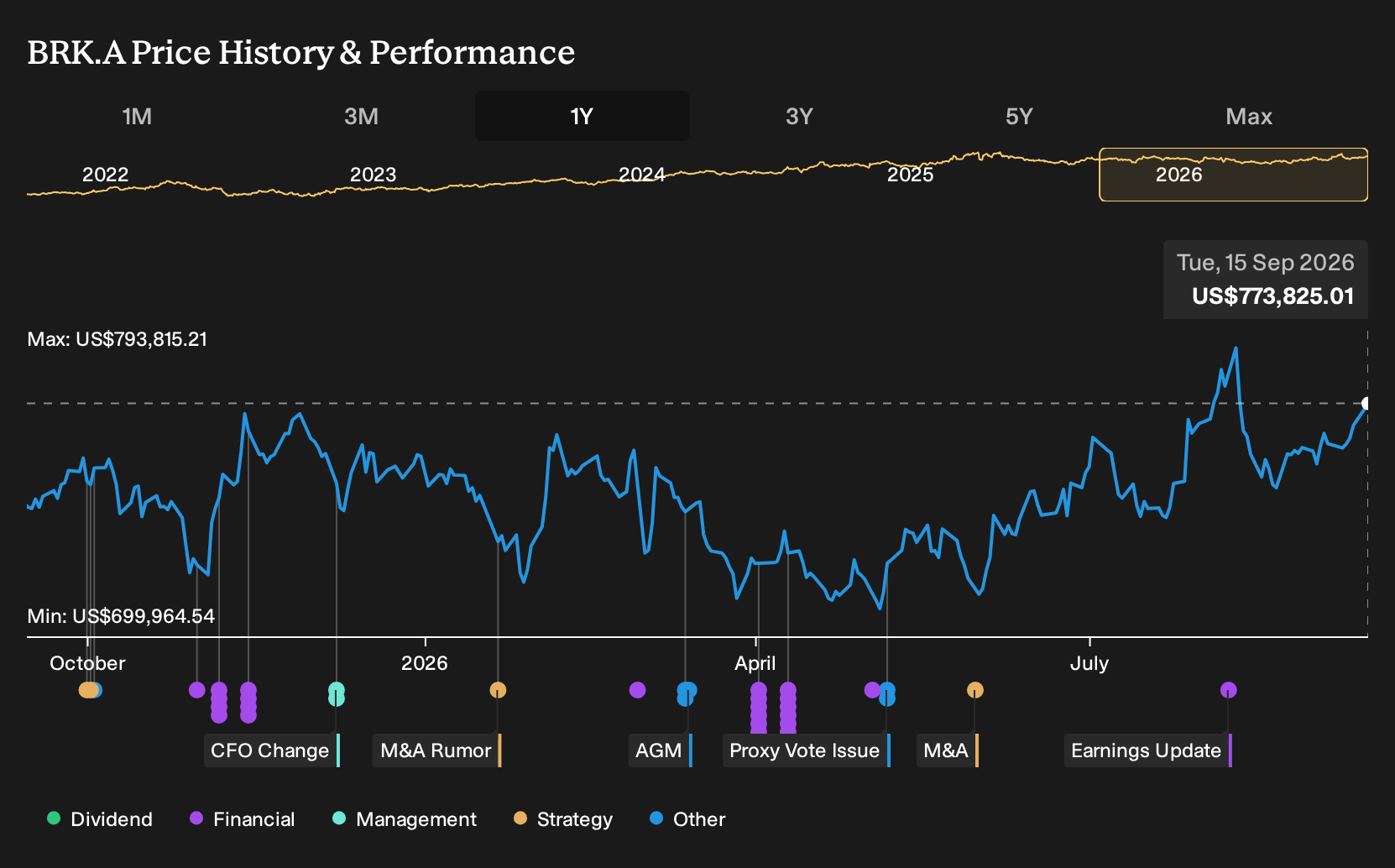
- Berkshire Hathaway, now led by Greg Abel after Warren Buffett's retirement, has reshaped its portfolio by exiting Visa and Mastercard, reaffirming long term positions in American Express and Coca Cola, and continuing large scale share repurchases and targeted acquisitions.
- The combination of aggressive buybacks, renewed equity purchases, and a tilt toward high conviction holdings signals a clearer capital allocation playbook that ties Berkshire Hathaway’s conglomerate structure more tightly to a smaller set of core cash generating franchises.
- Next, we will see how Berkshire Hathaway’s investment narrative is influenced by Greg Abel’s portfolio reshaping and sustained share repurchase activity.
Scan how Berkshire Hathaway’s capital allocation refresh compares to other large caps that combine strong balance sheets with focused buybacks by reviewing the list of solid balance sheet and fundamentals (22 results) in the same vein.
What Is Berkshire Hathaway's Investment Narrative?
Berkshire Hathaway asks you to believe in a very specific story. The core bet is on a huge, diversified operating base across insurance, rail, utilities and manufacturing that can throw off cash, plus a disciplined capital allocation machine now run by Greg Abel. Recent moves, such as tilting the equity portfolio toward American Express and Coca Cola, adding Alphabet and leaning harder into buybacks, keep that story centered on high quality cash generation rather than rapid expansion.
In the near term, the real swing factors remain insurance underwriting results, capital intensity at Berkshire Hathaway Energy and the pace of deal flow and share repurchases. The new leadership appointments at Berkshire Hathaway Specialty Insurance and the Precision Castparts exposure to AI driven power demand both speak to execution and demand more than headline trading noise. Forecasts of earnings decline over the next 3 years and low projected return on equity keep the risk side of that belief very real.
That said, there is still an underappreciated pressure point inside Berkshire Hathaway’s sprawling structure that could start to matter if...
There's only one way to know the right time to buy, sell or hold Berkshire Hathaway. Head to Simply Wall St's company report for the latest analysis of Berkshire Hathaway's Fair Value.
Exploring Other Perspectives
Three fair value estimates from the Simply Wall St Community span roughly US$799,503 to US$1,186,523 per Berkshire Hathaway Class A share, which is a wide bracket for the same business. That spread shows how far private investors can disagree. Consider those views in the context of ongoing buybacks and portfolio reshaping, and weigh several contrasting opinions before committing capital.
Explore 2 other Berkshire Hathaway fair value estimates, including one that suggests potential upside of up to 53% from the current price.
Reach Your Own Conclusion
Disagree with this assessment? Extraordinary investment returns rarely come from following the herd, so go with your instincts.
- A great starting point for your Berkshire Hathaway research is our analysis highlighting 3 key rewards and 1 important warning sign that could impact your investment decision.
- See our latest analysis for Berkshire Hathaway. The report includes a comprehensive fundamental analysis summarized in a single visual, the Snowflake, making it easy to evaluate Berkshire Hathaway's overall financial health at a glance.
Looking For More Investment Ideas Beyond Berkshire Hathaway?
If Berkshire Hathaway has you thinking about capital allocation, cash generation and balance sheet strength, it can be useful to line that story up against other potential opportunities using a consistent framework.
- For investors who want to focus on quality first and valuation second, scan a curated set of resilient cash generators through the 34 high quality undervalued stocks.
- If dependable income matters more to you than headline growth, compare Berkshire Hathaway with a group of high yielding payers using the 6 dividend fortresses.
- When capital preservation is near the top of your list, concentrate on companies with stronger financial footing by reviewing the 11 resilient stocks with low risk scores.
This article by Simply Wall St is general in nature. We provide commentary based on historical data and analyst forecasts only using an unbiased methodology and our articles are not intended to be financial advice. It does not constitute a recommendation to buy or sell any stock, and does not take account of your objectives, or your financial situation. We aim to bring you long-term focused analysis driven by fundamental data. Note that our analysis may not factor in the latest price-sensitive company announcements or qualitative material. Simply Wall St has no position in any stocks mentioned.
Have feedback on this article? Concerned about the content? Get in touch with us directly. Alternatively, email editorial-team@simplywallst.com