
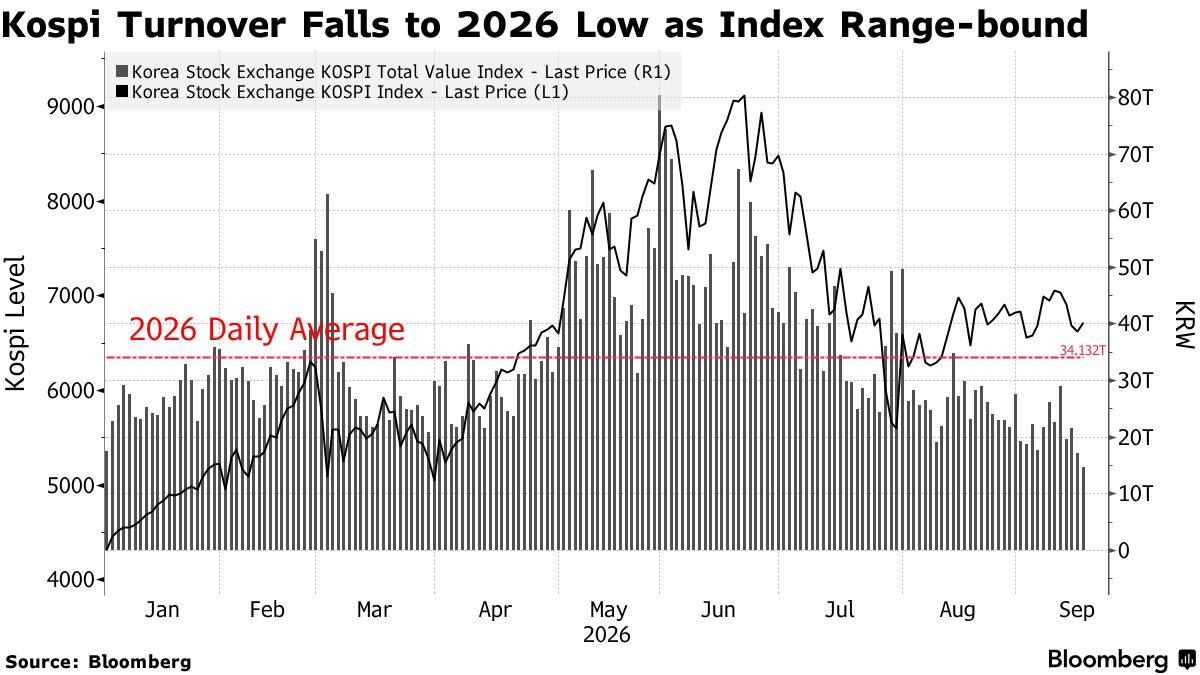
Korean stocks are at an impasse after investor fervor subsided! Turnover fell to a new low of 7,000 points during the year and remained unstable
The Zhitong Finance App learned that due to the gradual decline in investor enthusiasm, the turnover of the Korean stock market fell to its lowest level this year, which indicates that it may be difficult for the Korean stock market, which is dominated by artificial intelligence (AI), to return to its previous high. According to the data, the average daily turnover of the Korea Composite Stock Price Index (Kospi) fell to 20.6 trillion won (about US$15 billion) in September, the lowest level since 2026, less than half of the peak market trading period in May and June.
Earlier this year, the crazy buying spurred by retail investors fueled by the AI boom drove the Korean stock market to a new high. But then the market questioned how much AI investment would return, triggering a 22% correction in the KOSPI index in July. Although the benchmark index has since recovered some of its losses, it has not remained above the key level of 7,000 points.
Jason Minsang Kam, head of active stock management at Kyobo Life Insurance Co., said, “Volatility needs to be further reduced, and doubts about the chip cycle need to be resolved” before overseas investors will return. He expects the Kospi Index to remain range-bound for now.
Despite a sharp correction, the Kospi Index has risen about 59% since this year and is still the best-performing major benchmark stock index in the world. In addition to the boost from the AI boom, the repurchase of shares by companies also provided support for the index. However, the Korean stock market is still facing a lot of resistance. The Bank of Korea raised interest rates by 25 basis points at the end of August, raising the benchmark interest rate to 3%, and market research shows that the central bank will raise interest rates by another 25 basis points in the fourth quarter. Furthermore, potential interest rate hikes by the Federal Reserve may put further pressure on growth stocks.
Kang Songchul, analyst at Eugene Investment & Securities, said: “Market vitality is weakening. As domestic interest rates continue to rise, market capital has turned to savings products linked to interest rates, because in comparison, the attractiveness of the stock market has declined.”
It is worth mentioning that the Korean stock market officially entered the “closing at 8 p.m.” era on September 14. The extended trading time means that users who are unable to trade in a timely manner during the day can continue to trade stocks at night, and changes in overseas markets and important news are also expected to be reflected in stock prices in a more timely manner.
The Korea Stock Exchange added after-market trading to meet the trend of major global exchanges continuing to extend trading hours and make it easier for overseas investors to trade Korean stocks, thereby strengthening the global competitiveness of the Korean capital market. This transformation made Korea the first major Asia-Pacific economy's stock market to offer such extensive evening trading.
However, there are also many concerns in the market, particularly with regard to liquidity and price fluctuations. Liquidity during the nighttime period is far lower than normal trading hours, and investors may face lower trading volume, larger bid-ask price spreads, and more intense price fluctuations. At the same time, in the nighttime market where liquidity is relatively limited, professional investment institutions with more advanced trading systems, algorithm tools, and information processing capabilities may have a more obvious trading advantage over ordinary retail investors.
Looking at the longer cycle, Jerry Chen, a senior analyst at Jiasheng Group in the US, believes that extending the trading time will help international investors participate more smoothly in the Korean stock market and improve liquidity and efficiency. Young Jae Lee, senior investment manager at Patek Asset Management in London, also said, “Investors who are more transaction-oriented, have a higher turnover rate, or hedge fund investors may participate more frequently in after-hours trading.” However, there are also suggestions from industry insiders that whether trading is active still essentially depends on the construction of the market system itself. Extending the trading period will not create liquidity; it will only redistribute liquidity.
For the Korean stock market, the outlook will depend on a game between the sustainability of AI semiconductor profits and the fragility of the market structure. On the one hand, the profit logic based on the AI semiconductor supercycle is still strong. The dominance of Samsung Electronics and SK Hynix in the field of AI memory chips (especially HBM) is the strongest pillar of the Korean stock market. The record gap in the supply of memory chips has led to a sharp rise in corporate profit expectations. Goldman Sachs predicted a 300% increase in Korean corporate profits in 2026. At the same time, although the index has risen sharply, the valuation of the Korean stock market is still at a historically low level, which is reasonable in the context of widespread improvements in profits.
But on the other hand, the performance of the South Korean stock market in July and August revealed its huge risks. In addition to extreme volatility and leverage, the extreme imbalance in the market structure is also one of the risk points facing the Korean stock market. Together, Samsung Electronics and SK Hynix account for about 50% of KOSPI's total market value, and the profit weight is as high as 72%. This extreme concentration means that once global capital re-evaluates AI transactions, there is almost no buffer in the Korean market, and the decline will be significantly amplified. Furthermore, a large number of young retail investors (62% of liquidated account holders under 35) were hit hard by the launch of single-stock leveraged ETFs at a high point in the market. Some analysts believe that even if AI fundamentals are still improving, investors may choose to avoid the Korean stock market due to market rules and stability issues.