
Strategy (MSTR.US) preferred stock STRC is approaching a face value of $100: the financing instrument is instead a “blood loss point”, and the company buys its own market to support it
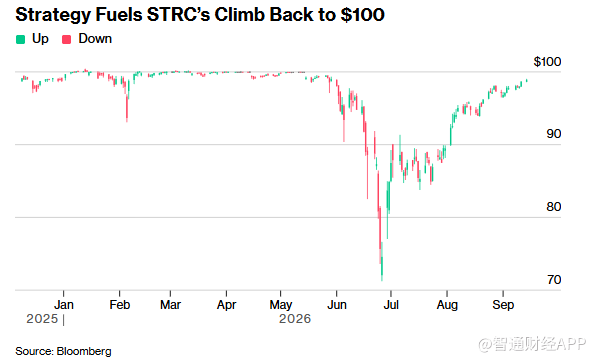
The Zhitong Finance App learned that STRC (Stretch), a sustainable preferred stock issued by Strategy (MSTR.US), has rebounded to a maximum of $99 after a round of sharp sell-off, which is only one step away from a face value of $100. But the biggest buyer supporting the rebound was the company itself.
Strategy launched this product with the intention of expanding the Bitcoin financing model beyond volatile common stocks. Bringing STRC back to a face value of $100 is Chairman Michael Saylor's proof that this “digital credit” product can be the key to a lasting source of capital, not a product that only works when the market's enthusiasm for Strategy and Bitcoin is high.
This logic was tested in June. Strategy sold a small amount of bitcoin at the time, breaking Saylor's long-standing “never sell bitcoin” advice. The subsequent sell-off caused this perpetual security to nearly $70, weakening the assertion that “STRC is a more stable participant in Saylor's leveraged Bitcoin accumulation strategy.” After weeks of major buybacks, Stretch has rebounded to a maximum of $99.
The scale of the company's own purchases is huge
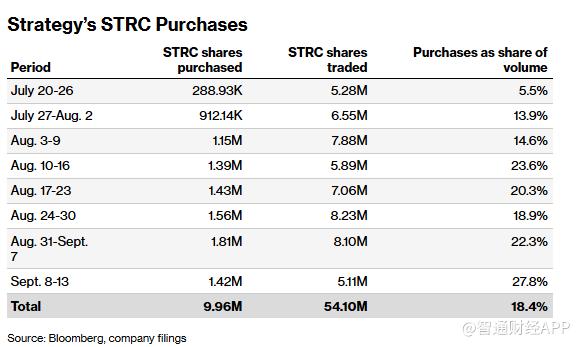
According to the data, from July 20 to September 13, Strategy bought back about 9.96 million copies of STRC at a cost of about 950 million US dollars. This is equivalent to approximately 18% of STRC's total trading volume during the same period. Strategy's buyback volume in the most recent week was announced, accounting for almost 28% of the total transaction volume.
Jay Hatfield, CEO of Infrastructure Capital Advisors, said: “There are no significant institutional incremental buyers.” He said his company bought STRC near the June low and sold most of it at over $90.
The self-purchase on such a large scale complicates STRC's recovery story. Strategy established a preferred stock system, in part to reduce reliance on issuing common shares. However, after the market turned, the company eventually had to sell common shares to support preferred shares. Over the past year, the company's common stock has declined by about 60%.
Since July 20, Strategy has used approximately $765 million (about 80% of the total repurchase amount) to buy back STRC from common share sales. An additional $161 million came from Bitcoin sales.
In other words, this financing arrangement was originally intended to reduce dependence on common stock, but now it is supported by selling common stock.
Reverse financing logic: selling common stock and buying STRC
If STRC can return to face value without Strategy being backed by a major buyer, the company can re-issue preferred shares to finance the purchase of Bitcoin while reducing its reliance on common shares. But whether this will happen is still unknown.
Alexander Blume, founder and CEO of Two Prime, said: “Now they are selling Strategy common stock to raise cash and buy STRC instead of Bitcoin. For those who buy stocks to 'amplify' their exposure to Bitcoin, this isn't profitable in the short term, nor is it what they want.”
This is the exact opposite of the logic behind Strategy's rise in the past. When common stock has a high premium compared to the value of Bitcoin holdings, the company can issue common shares, use the proceeds to buy Bitcoin, and may increase the amount of Bitcoin held per share, which helps maintain the premium, thus making further stock issuance more attractive.
The preferred share capital should make this flywheel go faster. However, STRC is to be a sustainable source of financing, provided investors are willing to buy it for $100 or more. This is the bottom line that new issuances do not dilute shareholders' equity.
Rajiv Sawhney, head of international portfolio management at Wave Digital Assets, said, “The easiest explanation is that STRC can only play a role as a product by trading at face value. If the price is $71, it's worthless as a financing tool, and it's actually a toxic asset.” “The price is the product itself,” he said.
Economic account for repurchases: cancel at a low price, reset the coupon interest
This also explains why a buyback might make economic sense. Buying back and cancelling $100 of preferred stock at a price below face value is equivalent to eliminating a debt with an annual dividend of $12 at a cost below face value.
Sawhney said the $85 to $90 buyback is a very attractive balance sheet deal; if STRC returns to parity and the dividend rate eventually decreases, it could help Strategy reduce future financing costs. He said the repurchase was “spending money to reset interest on tickets.”
Strategy also strengthened liquidity buffers and doubled digital credit securities repurchase authorizations to $2 billion.
Can STRC stand firm without the company's buyback?
The question is whether STRC can continue to be stable near face value without relying on massive buyback support from the company.
“There is no objective reason to suggest that STRC would trade for $100,” Blume said, adding that it remains to be proven whether Strategy can close the gap and thereby reactivate the “market-based stock issuance (ATM) financing” machine.
To keep STRC close to face value, retail investors may need to re-enter the market. But they've left cryptocurrencies and turned to chasing the rise in AI, tokenized stocks, and commodities.
“It requires retail participation because the institutional preferred stock market is already full of such products,” Hatfield said.
If this is not possible, the new financing logic will be completely different from the old model: sell common shares, use cash to hold preferred shares, and then expect preferred stocks to eventually revert to a tool to raise funds to buy Bitcoin.