
3 Global Trade Stocks Retail Investors Are Watching After The Russia Oil Tariff Threat
Global commodity traders and oil merchants are suddenly in the spotlight as Washington weighs tariffs of up to 100% on countries buying Russian crude. Policy risk is no longer a headline; it is a trading variable that can reshape routes, pricing power and margins. This article walks through three stocks from our Global Commodity Trading and Oil Merchants screener that appear closely exposed to this tariff story, and explains why their risk and reward profiles now look very different.
The stocks covered below are just a starting sample, since the full screen surfaced 32 more companies with equally detailed commodity trading stories that are not unpacked in this article. To identify and analyze the highest conviction angles in this tariff theme, head straight into the Global Commodity Trading and Oil Merchants screener
Aegis Logistics (NSEI:AEGISLOG)
Overview: Aegis Logistics runs oil, gas, and chemical terminals across key Indian ports, storing and handling physical hydrocarbons for trade driven flows.
Operations: Aegis Logistics generates about ₹82.9b from its Gas Terminal Division and ₹6.8b from its Liquid Terminal Division, entirely from India.
Market Cap: ₹484.8b
For the Global Commodity Trading and Oil Merchants theme, Aegis Logistics matters because its on the ground terminals touch the real barrels and molecules that get rerouted when trade rules shift.
"The company is actively expanding storage and throughput capacity at several key Indian ports (Mumbai, JNPT, Kandla, Pipavav, Mangalore). Many new terminals have recently come online or are expected soon. As these assets ramp up utilization over the next few years, they are likely to drive significant volume growth, boosting overall revenue and operating leverage."
What really moves the needle for Aegis Logistics is how one unseen pressure shapes future pricing power and margin resilience.
That pressure point is exactly what the full narrative for Aegis Logistics unpacks, showing how capacity, contracts and capital decisions could be quietly accelerating or masking Aegis Logistics margin story.

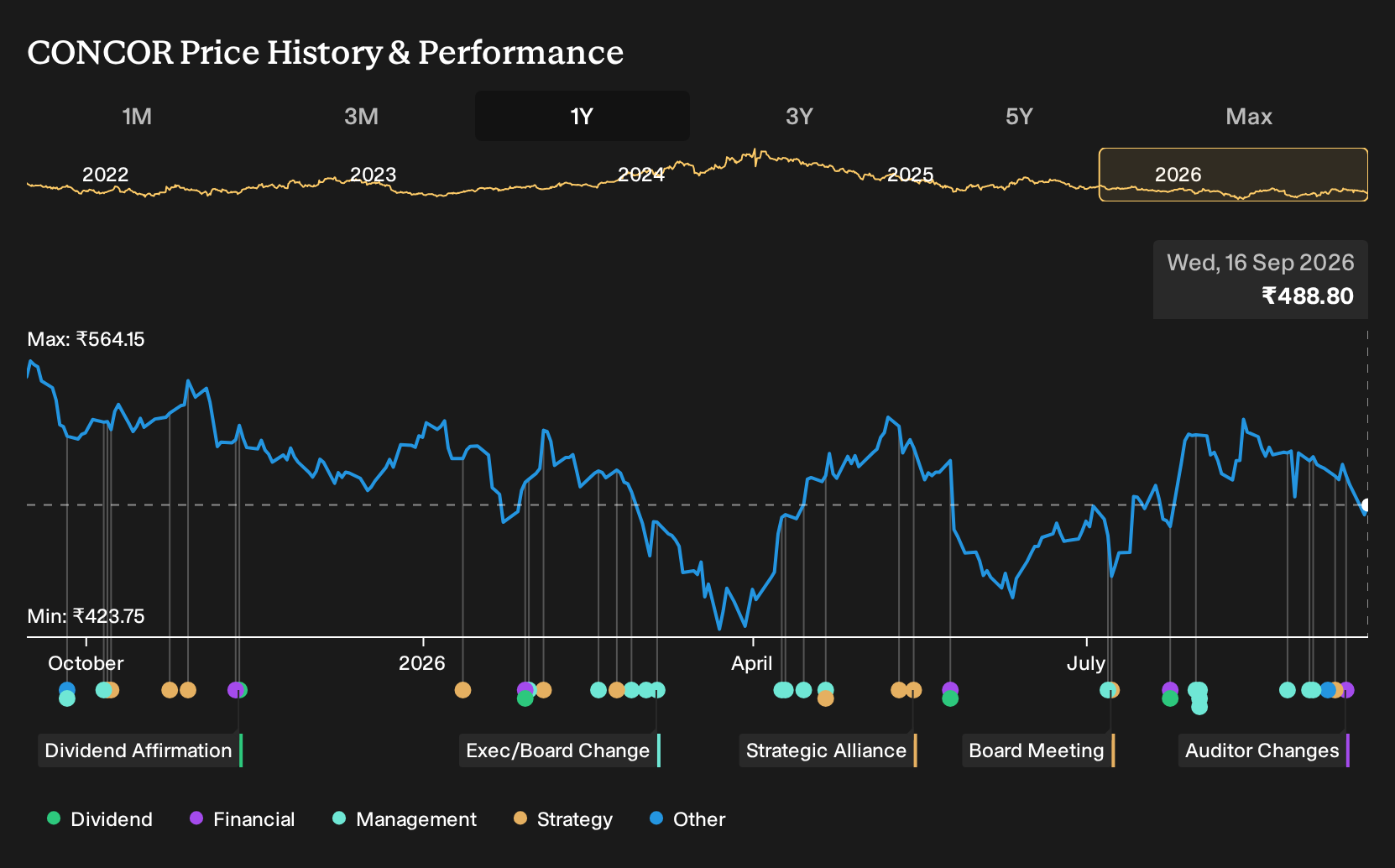
Container Corporation of India (NSEI:CONCOR)
Overview: Container Corporation of India runs rail based container transport and warehousing across India, linking ports, inland terminals, and cold-chain logistics that can see higher volumes when global commodity flows are rerouted.
Operations: Container Corporation of India generates about ₹60.6b from EXIM services and ₹30.3b from domestic operations, all earned within India.
Market Cap: ₹372.3b
Container Corporation of India matters in this Global Commodity Trading and Oil Merchants screen because it controls the boxes and rail corridors that can absorb rerouted trade when tariffs and sanctions reshape sea lanes.
"The shift of major corridors like JNPT to double-stack-enabled DFCs could double CONCOR's addressable volume, with rail share possibly surging to 40 percent. This could create a step-change in both topline and margin expansion by unlocking far greater network efficiencies."
What really counts for Container Corporation of India now is how one unresolved funding and governance question plays out against that volume opportunity.
That funding overhang is exactly where the story starts to get interesting, and the full narrative for Container Corporation of India shows how that capital question could accelerate or stall Container Corporation of India.
Targa Resources (TRGP)
Overview: Targa Resources operates North American midstream infrastructure that gathers, processes, stores and transports natural gas, NGLs and crude oil for producers, exporters and end users.
Operations: Targa Resources generates about US$13.8b from Logistics and Transportation and US$6.6b from Gathering and Processing, with other segments reducing reported totals.
Market Cap: US$61.3b
Targa Resources fits the Global Commodity Trading and Oil Merchants theme as the pipes and storage that keep NGL and natural gas trade moving, so the tariff story matters indirectly through how it reshapes flows, volatility and demand for its infrastructure.
"Targa's strategic focus on long-term, fee-based contracts with blue-chip producers and end-users has contributed to resilience in cash flows, even amid commodity price volatility, and has supported a trend toward more predictable free cash flow available for shareholder returns and potential deleveraging."
What happens if one assumed glide path for export driven NGL volumes changes direction will likely prove crucial for Targa Resources investors.
If that export path really bends, the full narrative for Targa Resources shows how Targa Resources cash flows, leverage and tariff risk could be quietly decoupling from headline commodity swings.

Seeking Alternatives Before The Crowd
Some opportunities move fast. Fresh themes start to gain momentum, prices begin to break out, and by the time headlines catch up, the best entries are gone. Act now.
- Chase income that can keep working while you sleep by scanning a curated group of high yield payers with the 161 dividend fortresses before yields get compressed.
- Spot early leaders in AI infrastructure before that story goes fully mainstream by running your filters through the 60 AI infrastructure stocks and tracking where capital is already moving.
- Front run long-cycle demand for metals by screening a tight universe of producers with the 29 top copper producer stocks while they are still under the radar for now.
This article by Simply Wall St is general in nature. We provide commentary based on historical data and analyst forecasts only using an unbiased methodology and our articles are not intended to be financial advice. It does not constitute a recommendation to buy or sell any stock, and does not take account of your objectives, or your financial situation. We aim to bring you long-term focused analysis driven by fundamental data. Note that our analysis may not factor in the latest price-sensitive company announcements or qualitative material. Simply Wall St has no position in any stocks mentioned.
Have feedback on this article? Concerned about the content? Get in touch with us directly. Alternatively, email editorial-team@simplywallst.com