
Is the AI investment frenzy poised to attack again? The Federal Reserve's interest rate hike has landed, and the “most painful moment” for US debt ushered in reverse buying
The Zhitong Finance App learned that against the backdrop of the recent surge in yield on long-term treasury bonds of 10 years or more driven by high oil prices and the Federal Reserve's implementation of the first interest rate hike since 2023, the asset management business division under Wall Street's largest commercial banking giant J.P. Morgan Chase is once again flocking to long-term treasury bonds in the US, Japan, and Australia.
The world's major central banks, including the Federal Reserve, have re-tightened monetary policy and the rise in long-term debt risk compensation (that is, long-term treasury bond maturity premiums). They are jointly testing the 10-year US bond yield trend, which is the “anchor of global asset pricing,” and has also attracted Wall Street's reverse allocation of capital, which is expected to cool down the market's fears about the sell-off of long-term bonds and the surge in yield.
If the yield on US bonds with a long-term term of 10 years or more achieves a “2023 steady peak and decline”, it is very likely to indirectly push the global stock market to continue to move towards a bullish curve under the strong profit growth trajectory driven by the AI computing power theme.
For the global bull market surrounding the big wave of AI computing power and AI applications, breaking the 5% mark above the “anchor of global asset pricing” can be called a major headwind in terms of valuation and investment sentiment. If J.P. Morgan leads the “most painful time in the bond market” and re-enters the US bond market and lowers the yield curve, it will undoubtedly greatly weaken this headwind factor for the AI bull market.
In other words, if reverse buying by large Wall Street investment institutions such as J.P. Morgan Asset Management drives back long-term US bond yields, while profit expectations of AI-related companies maintain a strong growth trajectory and equity risk premiums do not rise significantly, it will help mitigate interest rate headwinds in valuation and investment sentiment and support the continuation of the AI bull market, but this does not mean that this headwind has completely disappeared or that the stock market is bound to rise sharply.
Bob Michelle, chief investment officer of the asset management business division and head of the global fixed income business, said that his core judgment is not “the central bank is about to switch pigeons,” but rather that the ECB, the Federal Reserve, and later the Bank of Japan's austerity actions are expected to restore anti-inflation credibility, thereby stabilizing long-term treasury bond yields on the basis of lowering long-term inflation expectations; if compounded by stabilizing the situation in the Middle East, long-term yields may peak and then fall back.
Take action at the “most painful moment”! J.P. Morgan Chase buys long-term US bonds after experiencing the “most painful moment” in the bond market
Bob Michelle of J.P. Morgan's asset management business said his team has begun buying long-term treasury bonds from the US, Japan, and Australia, saying that the current prices are “really too cheap,” and that the bond market has reached the “most painful moment.”
“The dominoes are starting to fall,” Michelle said in an interview with the media on Wednesday EST. He pointed out that a series of central bank actions — starting with the ECB's interest rate hike last week, followed by the Federal Reserve, and finally the Bank of Japan may follow the pace of interest rate hikes until Friday — and the implementation of this series of rate hikes and anti-inflationary reputation are the key driving forces supporting the bond market. Another key factor is that the situation in the Middle East is likely to stabilize as the midterm elections approach.
Michelle, the chief investment officer of J.P. Morgan Asset Management and head of the global fixed income business, said that if the tightening of monetary policy and the calm geopolitical situation in the Middle East are perfectly combined, it will send a signal that yields have peaked.
Recently, US Treasury bonds have been violently sold off. Before the Federal Reserve implemented the first rate hike since 2023 on Wednesday local time, it had already pushed 10-year and 30-year Treasury yields to multi-year highs. Michelle, on the other hand, said after the Federal Reserve announced measures to raise interest rates, that the sell-off at the long end of the yield curve was excessive.
Michelle said that the longer-term treasury bond repurchase program launched by US Treasury Secretary Scott Bessent last month is an important stabilizing force; he also added that “as long as he wants, he will have enough ammunition to take more action.”
He also warned that the rapid rise in long-term US bond yields of 10 years or more “highlights the market's current feeling that the Fed has lost control,” and said that this new interest rate hike should help the Fed's monetary policy makers “once again show that they are still in control of the situation.”
The oil price storm has driven a surge in yields, reverse buying forces have arrived under the 5% US bond yield, and the AI bull market is about to set sail again?
Energy transportation in the Middle East continues to be blocked and the situation facing energy exports is becoming more serious. It is an important driving force for this round of global long-term debt repricing. After seizing Moca Port and Pelim Island, the Houthis further controlled the Greater and Smaller Hanish Islands, expanding the threat to the Mander Strait and Red Sea shipping; Saudi Arabia continued to carry out air raids on Yemen, and the East-West oil pipeline, which undertook transportation tasks around the Strait of Hormuz, was also attacked and stopped.
The number of ships that can be observed in the Strait of Hormuz on September 15 was only 4. The suspension of crude oil loading at Yanbu Port has further compressed Saudi export channels. However, news of increased Saudi supply through Oman has partly allayed supply concerns: Brent and WTI crude oil futures fell 2.7% and 3.2%, respectively, to close at $105.83 and $102.43 a barrel on September 16. The energy shock is still there, but what determines whether the inflation deal can cool down is the actual restoration of transportation and supply, not just the strength or weakness of the conflict news.
On September 16, the Federal Reserve raised the federal funds rate target range by 25 basis points to 3.75% — 4.00%, implementing the first rate hike since 2023. The day before, the 10-year US Treasury yield hit 5.041% intraday high, a record high since 2007; Japan's 10-year Treasury yield also reached a 30-year high of about 3.04%, while Japan's 30-year treasury bonds hit a record closing level of around 4.18% as early as September 1. The central bank's re-tightening policy and rising risk compensation for long-term debt holdings are jointly testing the “anchor of global asset pricing,” and are also attracting reverse allocation of capital. Against this backdrop, Bob Michelle of J.P. Morgan Asset Management has begun buying long-term bonds from the US, Japan, and Australia.
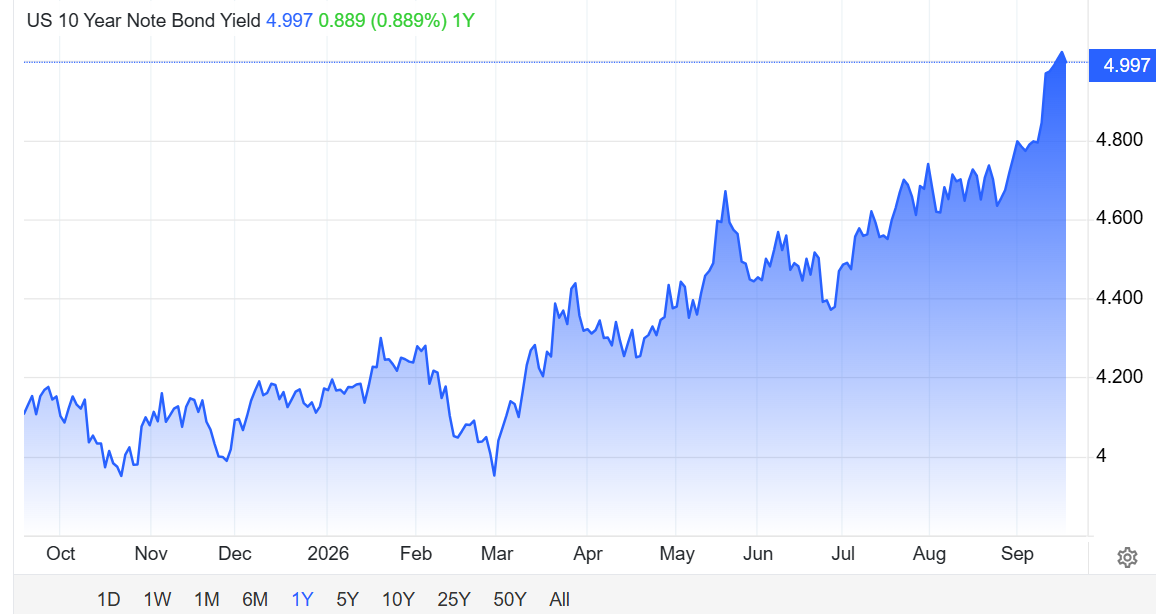
Judging from the starting point of the nominal return on additional capital, the allocation appeal of US bonds with a long-term term of 10 years or more around 5% has indeed increased, but “locking in cash flow” and “declining transaction yield” are two different logics.
For investors holding a single ordinary fixed-rate treasury bond until maturity, the contract coupon and maturing face value can be determined on the premise that principal and interest are paid as agreed: for example, buying treasury bonds with a coupon interest rate of 5% at face value will indeed receive a fixed interest equivalent to 5% of the initial principal each year. An increase in midterm market yield will not reduce this coupon interest; however, the 5% yield to maturity reported by the market does not mean that all bonds that can be purchased have a coupon interest rate of 5%.
For active managers, the appeal also includes potential capital gains from falling returns. According to the first-order approximation of the correction period, assuming that the combination period is 8 years, the yield drops by 50 basis points, and the price rises by about 4%; if the yield rises by 50 basis points, the price falls by about 4%. The above does not include interest, convexity, or other changes. A high-yield starting point provides better interest collection conditions, but it has not eliminated risks such as market capitalization fluctuations and inflation eroding purchasing power; therefore, according to some strategists, while currently acknowledging the value of long-term bonds, it is impossible to assert that the yield on long-term treasury bonds of 10 years or more has peaked.
Long-term nominal yield can be roughly understood as the average value of future short-term nominal interest rate expectations, plus term premium (Term Premium); when the central bank tightens policies to increase the credibility that inflation will be controlled, even if short-term interest rates rise in the immediate future, market requirements for longer term interest rates and debt risk compensation may decline. This is the mechanism by which Michelle's reverse trading can be established. The underlying mechanism of “interest rate hikes may benefit long-term debt” is to reprice future interest rate paths and term premiums, rather than interest rate hikes themselves automatically depressing long-term yields. Bezent's repurchase plan can be supported by improving the liquidity of old securities, but the Ministry of Finance's buyback is not equivalent to quantitative easing by the central bank, nor can it eliminate fiscal financing pressure alone; the impact on the net long-term supply of the market also depends on supporting new bond issuance arrangements.
As for the bullish trajectory of the global stock market since 2023 brought about by the wave of AI investment, the classic “AI bull market continues to enjoy” the classic “AI bull market continues to enjoy a chain” where “the value of long-term bonds appears — pressure on yield is relieved — AI computing power themes drive the profit of the benchmark index to gain a wider valuation space” is a conditionally established transmission chain.
As deduced from the pricing mechanism, if long-term yield declines mainly come from energy supply recovery, inflation risk and term premium mitigation, while credit spreads are stable and profit expectations do not deteriorate, it will help reduce the pressure on equity discount rates and corporate financing costs; conversely, if long-term bonds rise mainly reflect recessionary expectations, stocks may simultaneously withstand declining cash flow and rising risk premiums, and may not necessarily follow the rise. High yields are attracting reverse purchases of long-term bonds. If these purchases reinforce each other as the risk of inflation cools, it may create conditions for the continuation of the super-bull market driven by AI profits. The stabilization of long-term debt is a potential catalyst; profit fulfillment and valuation discipline determine how far the bull market can go.
A research report released by Goldman Sachs last weekend showed the “profit overriding everything” bullish logic that the long-term bull market in the US stock market will continue strongly since ChatGPT became popular around the world in 2022 — earnings per share of the S&P 500 are expected to reach 340 US dollars in 2026, which means that it is expected to increase sharply by 24% year over year on a high base; in 2027, it is expected to further reach 385 US dollars, an increase of 13% year on year.
At the same time, the forward price-earnings ratio fell from 22 times at the beginning of the year to 19 times, indicating that interest rate headwinds have been reflected through valuation compression. Its historical sample shows that three months after the start of the seven-rate hike cycle, the S&P 500 fell by an average of 2%, but increased by an average of 9% after 12 months. This data does not yet support “the end of the bull market trajectory after the Federal Reserve starts raising interest rates,” but it cannot be 100% used to prove that future investment returns will necessarily replicate history; Goldman Sachs emphasized in the research report that the real key is whether the profit cashing trend can offset the further decline in valuation factors.
In the AI data center computing power infrastructure chain, the demand for strong computing power resources brought by AI agents may spread rapidly to GPU/ASIC, HBM, server DRAM, enterprise-grade SSD, high-speed optical interconnection equipment within data centers, as well as data center CPUs, data center power chains, etc.; at the same time, the AI computing power industry chain undoubtedly has verifiable profit support: Nvidia's data center revenue in the second quarter of fiscal year 2027 reached 89 billion US dollars, an increase of 117% year on year; after adjustment, diluted earnings per share were 2.22 US dollars, up year-on-year 120% indicates that growth is not only limited to capital expenditure narratives, but is also reflected in profits. Strong AI computing power demand support linked to the AI computing power industry chain level, in addition to the strong performance of industry chain leaders, is also clearly reflected in South Korea's continued record semiconductor exports and long-term capacity agreement arrangements. According to South Korea Customs data, semiconductor exports reached 16.5 billion US dollars from September 1 to 10, an increase of 270% year on year. In August, semiconductor exports reached 46.65 billion US dollars, an increase of 209 percent over the previous year.
Another Wall Street giant, Jefferies recently said that the S&P 500 index is expected to soar to 8,000 points by the end of 2026, and hit 9,000 points further in 2027, driven by the AI investment frenzy and rising profits of AI-related companies exceeding expectations. Jefferies's core logic is clear and powerful: in a cycle where AI-driven profit growth exceeds the historical average by more than two times the historical average, fighting against profit trends is dangerous. Jefferies's 2026 8,000-point S&P 500 benchmark forecast is based on earnings per share (EPS) reaching $373 (up 35% year over year, well above 29% of market consensus) and a price-earnings ratio of 21.5 times.