
IPO Interpretation | Huanchuang Technology will be listed on the Hong Kong Stock Exchange: How can the “invisible champion” of technology solve the problem of increasing revenue without increasing profit?
In the wave of smart homes, sweeping robots are undoubtedly one of the categories with the fastest increase in penetration rate. And behind this revolution of “freeing hands,” spatial sensing technology as the robot's “eye” is becoming the core winner and loser in determining the level of product intelligence. Recently, Shenzhen Huanchuang Technology Co., Ltd. (hereinafter referred to as “Huanchuang Technology”) officially passed the Hong Kong Stock Exchange listing hearing. This “invisible champion”, which is deeply involved in lidar and spatial sensing technology, is only one step away from the capital market.
Spatial perception is a technology-intensive and capital-intensive industry of “investment first, profit later”. Currently, the company is still in a stage where profits are meager and operating cash flow continues to flow out net. In the context of the continuous expansion of the robot vacuum cleaner industry and the accelerated penetration of dToF and linear lasers, can Huanchuang Technology open up new growth space under the multiple tests of high customer concentration, gross margin pressure, and technology iteration with its multi-scenario product layout and self-developed chip accumulation?
Industry dividends and the rise of “invisible champions”
As mentioned at the beginning, the track where Huanchuang Technology is located is a critical upstream link in the intelligent robot industry chain—spatial perception. According to Insight Consulting's data, the global vacuum robot space sensing market is expanding at an alarming rate. It is expected to grow from 3.1 billion yuan (RMB, same below) in 2025 to 9.1 billion yuan in 2030, with a compound annual growth rate of 24.3%. The growth logic is clear: as sweeper robots evolve from “random collision” to “precise navigation” and “active obstacle avoidance,” demand for core components such as lidar, dToF, and linear laser sensors has risen sharply.
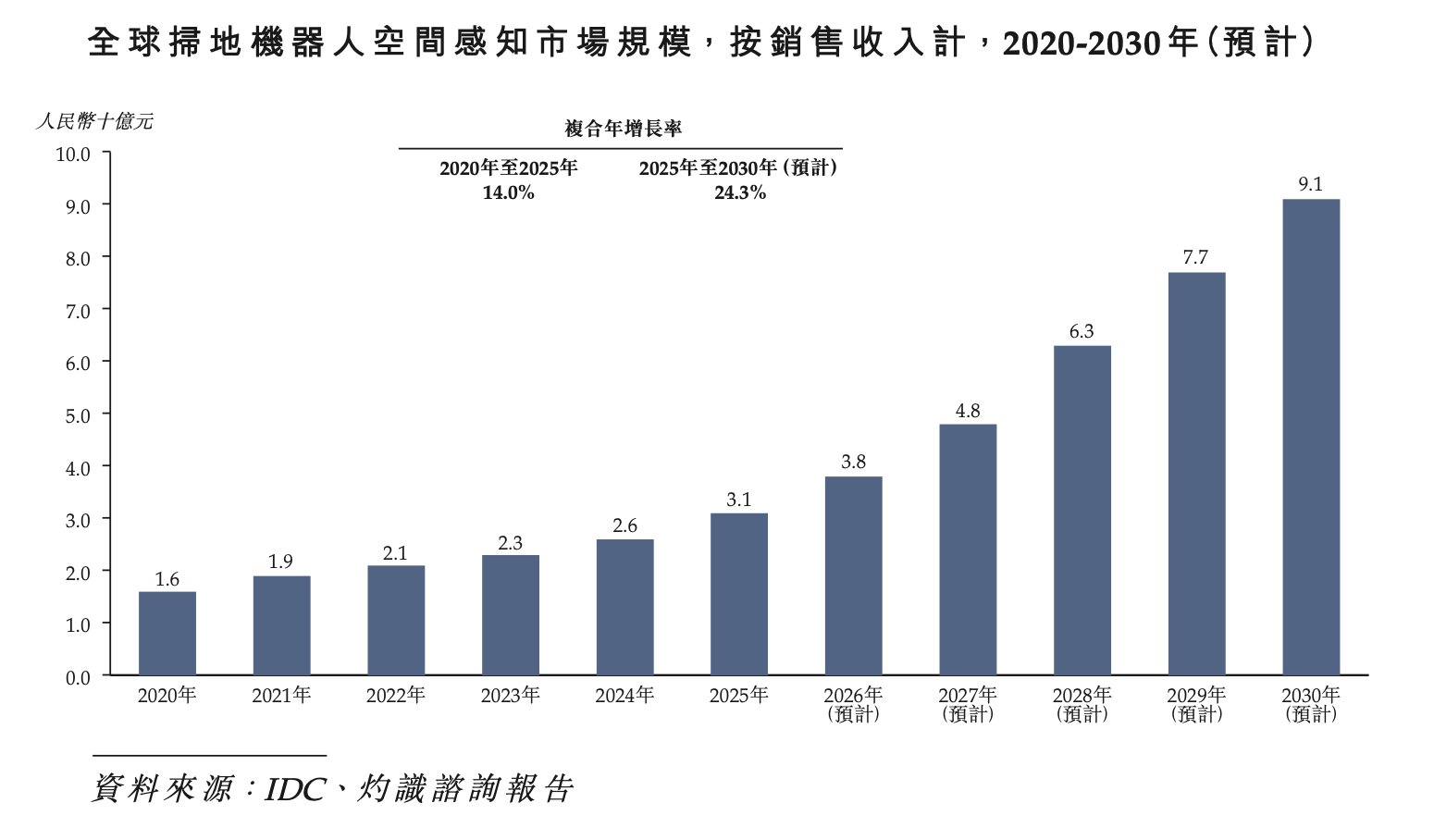
In this market segment, Huanchuang Technology has established a significant market position. According to the prospectus, based on revenue in 2025, Huanchuang Technology ranked first among space sensing suppliers for sweeping robots in China, with a market share of about 20.0%. Behind this achievement is its deep bond with leading customers in the industry. Huanchuang Technology not only served four of the top five global market participants in the robot vacuum cleaner industry, but also achieved a cumulative shipment volume of more than 39 million space-sensing products.
Judging from the business structure, Huanchuang Technology's product matrix covers triangulation lidar, dToF lidar, and line laser sensors. Among them, traditional triangulation lidar is its cash cow business, but the company is actively transforming into dToF and 3D sensing fields with higher technical barriers. It is worth noting that Huanchuang Technology is not just a hardware assembly factory. It emphasizes having self-developed sub-millimeter spatial data processing chip design capabilities and core algorithms. This vertical integration capability of “algorithm+hardware+chip” forms a moat for maintaining competitiveness in a fierce price war.
However, the industry's prosperity is not without its worries. The Zhitong Finance App notes that although the market is growing, the competitive landscape is becoming crowded. There are not only traditional lidar manufacturers, but also sweeping robot giants with self-developed capabilities. Huanchuang Technology must beat the pace of customer self-development in terms of the speed of technological iteration in order to maintain its competitive position as a core component supplier.
The “it is difficult to increase revenue and increase profit” dilemma behind the performance explosion
Financial performance provides the most direct answer to how this competitive pressure will eventually be reflected in the quality of operations.
On the revenue side, Huanchuang Technology handed over an impressive report card. From 2023 to 2025, the company's revenue was 332 million yuan, 433 million yuan and 614 million yuan respectively, with a compound annual growth rate of 35.9%. Entering 2026, this growth trend continued, with revenue reaching 196 million yuan in the first three months alone, an increase of 48.7% over the previous year. This growth is mainly due to the expansion of the downstream robot vacuum cleaner market and the commercialization of the company's new products such as dToF and line lasers.
However, on the profit side, Huanchuang Technology's performance showed some ups and downs. In 2023 and 2024, the company recorded net losses of 900,000 yuan and 31.4 million yuan respectively. Despite successfully turning a loss into profit in 2025, recording a net profit of 2.2 million yuan, and raising the net interest rate to 4.0% in the first quarter of 2026, the overall profit level is still weak.
Fluctuations in gross margins reveal deeper problems. The company's gross margin was 21.5% in 2023, plummeted to 16.3% in 2024, rose slightly to 16.5% in 2025, and rebounded to 19.2% in the first quarter of 2026. There are two direct reasons for the sharp drop in gross margin in 2024: first, the dToF lidar and line laser sensors launched that year had not achieved scale effects and recorded negative gross profit margins; second, triangular ranging lidar adopted a more competitive pricing strategy to seize market share.
Among them, traces of a price war are clearly visible. The average price of triangulation lidar dropped from 68.6 yuan/piece in 2023 to 43.3 yuan/piece in 2025, a drop of about 37%. The company admits that this is “a sales and marketing initiative to seize a higher market share” and that it “actively adjusts pricing to cope with competitive market dynamics and internal lidar development projects of several customers.” In other words, not only can customers choose other suppliers, but some leading brands are also developing their own lidars, which further reduces Huanchuang Technology's pricing power.
The performance of the new product line is one of the few reassuring signs in the earnings report. DToF lidar revenue jumped from 4.2 million yuan in 2024 to 65.3 million yuan in 2025, and line laser sensors increased from 19.3 million yuan to 134 million yuan. Together, the two new products contributed 32.4% of revenue. Triangulation lidar's revenue share fell from 98.3% to 65.7%, and progress in diversification of product structures is substantial. More importantly, as production increased, the gross margin of the new product changed from negative to positive: dToF lidar gross margin improved from -32.8% in 2024 to 7.0% in 2025, line laser sensors improved from -6.1% to 13.6%, and both were close to 20% in the first quarter of 2026.
Changes in R&D investment are also worth watching. R&D costs as a share of revenue fell from 16.4% in 2023 and 17.7% in 2024 to 9.7% in 2025 and 7.6% in the first quarter of 2026. On the one hand, this reflects that early R&D investment is beginning to be transformed into commercial results. On the other hand, it also means that the company is actively controlling expenses to improve profits.
However, the cash flow situation is still under pressure. From 2023 to 2025, the net cash used by the company in operating activities was RMB 34.83 million, RMB 39.99 million and RMB 9.04 million, respectively, and continued to record a net outflow of 5.32 million yuan in the first quarter of 2026. The number of trade receivables turnover days was extended from 75 days in 2023 to 100 days in the first quarter of 2026, and the balance pressure caused by customer concentration objectively exists.
The double challenge of deep binding giants
At the same time, Huanchuang Technology's customer concentration is at a high level. From 2023 to 2025, the five major customers accounted for 93.6%, 89.2%, and 80.4% of revenue, respectively. Although this ratio is declining year by year, it is still at a very high level.
This deep binding is a double-edged sword. On the one hand, it ensures that Huanchuang Technology can get enough orders and quickly grow on a large scale during the industry explosion period; on the other hand, it also means that the company's fate is closely linked to the rise and fall of several robot sweeper giants. The company said bluntly that if major customers reduce procurement, switch to self-development, or change suppliers, it will have a major impact on the company's business. It is worth noting that customers have begun experimenting with self-developed lidar products. Although they are currently mainly used for differentiated models, if expanded to mainstream products in the future, it will pose a direct threat to Huanchuang Technology.
Facing the risk of a single track, Huanchuang Technology is also actively looking for a “second growth curve.” According to the prospectus, the company is trying to expand spatial sensing technology to fields such as lawnmower robots, pool cleaning robots, humanoid robots, and XR. Up to now, the company has generated revenue in the field of XR and industrial inspection, and has received non-binding orders from some pool cleaning and mowing robot customers. However, the expansion of new businesses did not happen overnight. At present, large-scale mass production orders have not been formed in these emerging fields, and whether success in the field of sweeping robots can be replicated remains a variable.
Taken together, Huanchuang Technology has successfully seized the dividends of the explosion in the robot vacuum industry with its technical accumulation and market position in the field of spatial perception, but its financial data also clearly revealed the hidden worries behind high growth: meager profits, pressure on cash flow, high customer concentration, and fierce price wars.
Looking forward to the future, the story of Huanchuang Technology will revolve around two main lines: one is whether the core sweeping robot market can maintain its position and increase profitability in competition with customer-developed solutions with new products such as dToF and line lasers; the other is whether it can successfully replicate its technical advantages on new tracks such as XR and lawnmower robots, thus creating a real “second growth curve”.
For investors, the value of Huanchuang Technology lies not only in its current position as a leader in the industry, but also in whether it can successfully implement the commercial value it has accumulated under the double pressure of technology intensity and capital intensity, and ultimately achieve sustainable profit growth. And this test has only just begun.