
Did Raised Guidance Just Shift Church & Dwight (CHD) Stock Narrative?
- Church & Dwight recently initiated a voluntary Class II recall of 318,600 cartons of Zicam Cold Remedy medicated nasal swabs in the US after FDA inspectors at a contract manufacturer found out-of-limit microbiological test results for several lots.
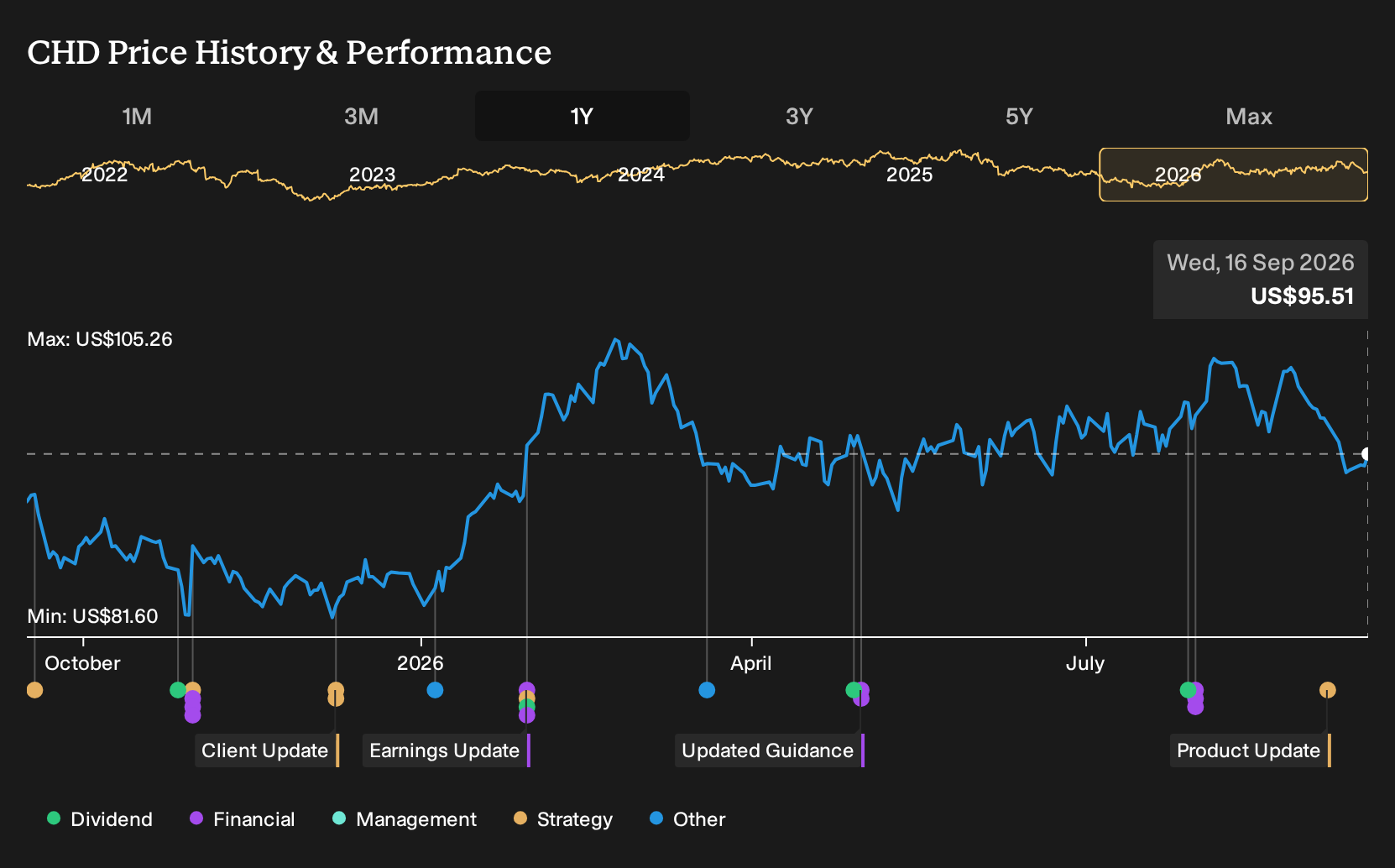
- At the same time, Church & Dwight reported Q2 2026 results with organic sales growth and revenue above expectations, and then raised full-year guidance for net sales, adjusted EPS and gross margin, signaling management confidence in underlying demand and execution despite the recall.
- We will now look at how Church & Dwight's higher full year guidance could reshape the existing investment narrative around the business.
Compare how Church & Dwight stacks up against other resilient consumer stocks by scanning our hand picked 11 resilient stocks with low risk scores that aim to balance defensiveness with upside potential.
Church & Dwight Investment Narrative Recap
To own Church & Dwight, you need to believe the core household and personal care portfolio can keep compounding steadily through brand strength, new products and e-commerce, even while some categories grow more slowly. The short term upside still sits in executing on raised 2026 guidance after a solid Q2, with organic sales and net sales above expectations.
The biggest near term risk remains pressure on margins from input costs and aggressive promotion in laundry, litter and other staples, on top of ongoing weakness in vitamins. The Zicam recall looks operational rather than demand driven, so at this stage it does not appear to alter that near term bull or bear case in a major way.
The Zicam medicated nasal swab recall is the announcement that matters most here, because it directly tests Church & Dwight’s ability to manage product quality and regulatory relationships while keeping its guidance intact. Management has already raised full year targets for net sales, adjusted EPS and gross margin after Q2, which signals confidence in broader brand momentum.
For you as a shareholder, the key question is whether recall execution and any remediation costs stay small relative to the wider portfolio, which spans ARM & HAMMER, THERABREATH, HERO, Touchland and more. If operational discipline around sourcing and testing holds, catalysts like rising online penetration and health focused brands can still drive the story while recall related scrutiny remains a watch item rather than the main thesis.
What the New Guidance Assumes About Church & Dwight
Church & Dwight's current analyst framework rests on a few clear building blocks that you can pressure test against your own expectations. Forecasts assume revenue grows by 3.4% each year over the next three years, with profit margins rising from 12.0% today to 14.5% in that same window. Consensus models see earnings at $744.8 million today and reaching $1.0b by 2029, which implies roughly a $255 million step up in profit over that period. Those numbers sit behind an earnings per share estimate of $4.33 in 2029 and a P/E multiple that moves from 32.3x now to 28.4x on those projected results, still above the 22.8x level quoted for the wider US Household Products group.
On top of growth and profitability, the scenario also leans on capital allocation choices. Analysts baking in these forecasts expect the share count to fall by 2.63% a year for the next three years, which would support earnings per share even if operating profit tracks closer to the current run rate. The discount rate used in the Simply Wall St report sits at 7.24%. This is the hurdle used to translate those 2029 cash flows back into today's value in their model. When you line all of this up against the raised 2026 guidance and the Zicam recall headlines, the question for you is whether the path to higher margins, lower share count and steady 3.4% revenue growth feels realistic, conservative or a stretch.
Church & Dwight's narrative projects $6.9b revenue and $1.0b earnings by 2029. This rests on revenue expanding at 3.4% per year and an earnings increase of roughly $255 million from $744.8 million today.
Uncover why Church & Dwight's fair value indicates a 10% potential upside to its current price that may not last much longer.
Exploring Other Perspectives
Some of the most optimistic analysts lean into e-commerce leadership as the real catalyst for Church & Dwight. Before this Zicam recall, that group was pencilling in about $6.7b of revenue and roughly $994.5 million of earnings by 2029. You should expect those upbeat digital and premium-brand forecasts to be revisited as this quality issue plays through, so treat them as one of several viewpoints to compare, not a final answer.
Explore 4 other Church & Dwight fair value estimates, including one that suggests potential upside of up to 39% from the current price.
The Verdict Is Yours
Don't just follow the ticker. Dig into the data and build a conviction that's truly your own.
- A great starting point for your Church & Dwight research is our analysis highlighting 3 key rewards and 1 important warning sign that could impact your investment decision.
- See our latest analysis for Church & Dwight. The report includes a comprehensive fundamental analysis summarized in a single visual, the Snowflake, making it easy to evaluate Church & Dwight's overall financial health at a glance.
Looking for more investment ideas beyond Church & Dwight?
Once you have a view on Church & Dwight, it can help to widen the lens and compare it with other potential holdings using the Simply Wall St Screener. That way you can see how its quality, valuation and risk profile stack up against a broader watchlist before deciding where it fits in your portfolio.
- If capital preservation is your priority, start with companies that pair resilience with lower risk by scanning a curated set of 11 resilient stocks with low risk scores that may help smooth out portfolio volatility.
- For investors hunting for value, check out candidates that combine strong fundamentals with attractive pricing through a focused group of 33 high quality undervalued stocks that could merit a closer look.
- If income is your main goal, review businesses offering robust cash returns to shareholders by filtering for 6 dividend fortresses that might suit a long term dividend strategy.
This article by Simply Wall St is general in nature. We provide commentary based on historical data and analyst forecasts only using an unbiased methodology and our articles are not intended to be financial advice. It does not constitute a recommendation to buy or sell any stock, and does not take account of your objectives, or your financial situation. We aim to bring you long-term focused analysis driven by fundamental data. Note that our analysis may not factor in the latest price-sensitive company announcements or qualitative material. Simply Wall St has no position in any stocks mentioned.
Have feedback on this article? Concerned about the content? Get in touch with us directly. Alternatively, email editorial-team@simplywallst.com