
From the token frenzy to the $1.3 trillion AI server blue ocean: AI inference computing power has exploded, leading players such as Dell ushered in a golden age of “volume price+share”
The Zhitong Finance App learned that the “2Q26 Server Market Share and Growth Prospects” research report recently released by Wall Street financial giant Goldman Sachs shows that Dell and other global AI server cluster manufacturing leaders are simultaneously sharing the dual growth dividends of “the accelerated expansion of the AI server market” and “a significant increase in order share of core AI cloud computing customers such as large enterprises and new clouds”, not just passively benefiting from hardware price increases.
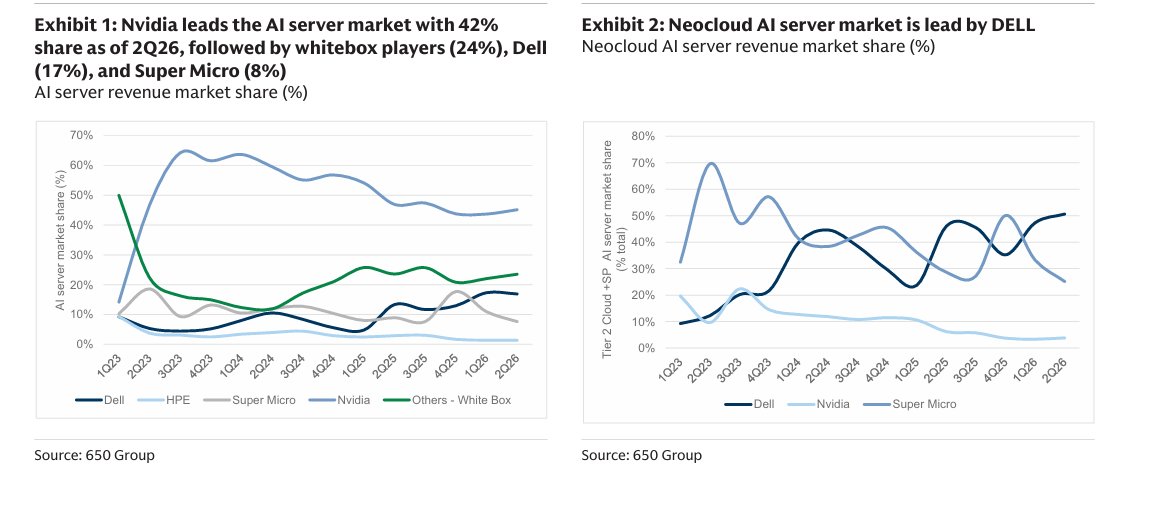
According to the 650 Group caliber presented in the Goldman Sachs research report, statistics show that in the second quarter of 2026, Dell's AI server revenue increased 146% year on year, shipment volume increased 80%, average sales price (ASP) increased 37%, and the revenue growth rate was significantly higher than 94% of the industry; AI server revenue share rose from 13% to 17%, while traditional server share rose from 15% to 29%.
Goldman Sachs maintained Dell (DELL.US)'s most bullish rating based on this, with a 12-month target price of $570, using an 18-fold forward earnings per share valuation; while maintaining HPE.US (HPE.US) “buy” and a target price of $75, using a 14x forward-looking earnings per share valuation; for SMCI.US (SMCI.US), it maintained a “sell”, target price of 34, using 7.5 times forward earnings per share valuation. None of the three targets were adjusted in this report.
Goldman Sachs emphasized in the research report that Dell is one of the most prominent brand manufacturers in this round of server share expansion. HPE retains the configuration value of enterprise infrastructure platforms, while ultra-micro computers need to face competitive problems where AI business growth is relatively poor. According to the latest forecast data given by Goldman Sachs, the overall server market is estimated to be about 1.5 trillion US dollars in 2030, of which the AI server market is about 1.3 trillion US dollars and traditional servers are about 1920 billion US dollars. In contrast, the market size estimates given by Goldman Sachs in 2026 are about 370 billion US dollars for AI servers and 137 billion US dollars for traditional servers, respectively.
AI server investment coordinates given by Goldman Sachs: the sharp rise in volume and price is unstoppable, and the share is increasingly concentrated in leading positions
Goldman Sachs's actual research and latest model estimates show that the core change at the global server industry level is that AI servers have maintained a common increase in volume and price, and traditional servers have also entered a stage of significant revenue expansion, and the market space in 2030 will be further improved.
According to the 650 Group forecast in the Goldman Sachs research report, AI server revenue increased 94% year-on-year in the second quarter, driven by a 20% increase in shipments and a 62% increase in ASP; IDC's accelerated server caliber was a 43% increase in revenue, a 10% increase in shipments, and a 30% increase in ASP. In terms of traditional servers, 650 Group predicts revenue growth of 91%, a significant increase from 24% in the first quarter. Despite a 9% drop in shipments, ASP still rose 111%; IDC's non-accelerated server data showed revenue growth of 81%, shipment growth of 17%, and ASP growth of 56%. Both sets of statistics support strong revenue expansion, but the judgment on traditional server shipments is different. The ASP-based standard is an average sales price index, which is not equivalent to simply increasing the price of Nvidia Blackwell or Rubin servers with the same configuration.
More importantly, 650 Group raised the annual revenue forecast for overall servers, AI servers, and traditional servers by an average of about 7%, 4%, and 17%, respectively, from 2026 to 2030. The overall scale for 2030 is estimated to be about 1.5 trillion US dollars, of which AI servers are about 1.3 trillion US dollars and traditional servers are about 1920 billion US dollars; the compound revenue growth rates from 2025 to 2030 are 39%, 46%, and 17%, respectively. 46% of AI servers is also supported by a compound growth of about 29% and ASP compound growth of 13%.
According to the Goldman Sachs analyst team, the expansion potential of Dell's AI server market is also very impressive: second-tier cloud and computing power rental service providers, including CoreWeave and other new cloud forces (NeoCloud), the AI server market is expected to expand from US$45.209 billion in 2025 to US$560.536 billion in 2030, a compound growth rate of 65%; the AI server cluster supply market for enterprises is expected to expand from US$14.430 billion to US$91.472 billion, compound growth rate of 45%; hyperscale cloud The corresponding AI server market reached about 646.737 billion US dollars, with a compound growth rate of 37% for computing vendors. These latest statistics and model estimates all mean that the growth of AI servers is spreading from a few hyperscale cloud computing service providers to new, more rapidly growing cloud platforms and a wide range of enterprise customers, and Dell has established a strong share of these two types of customers.
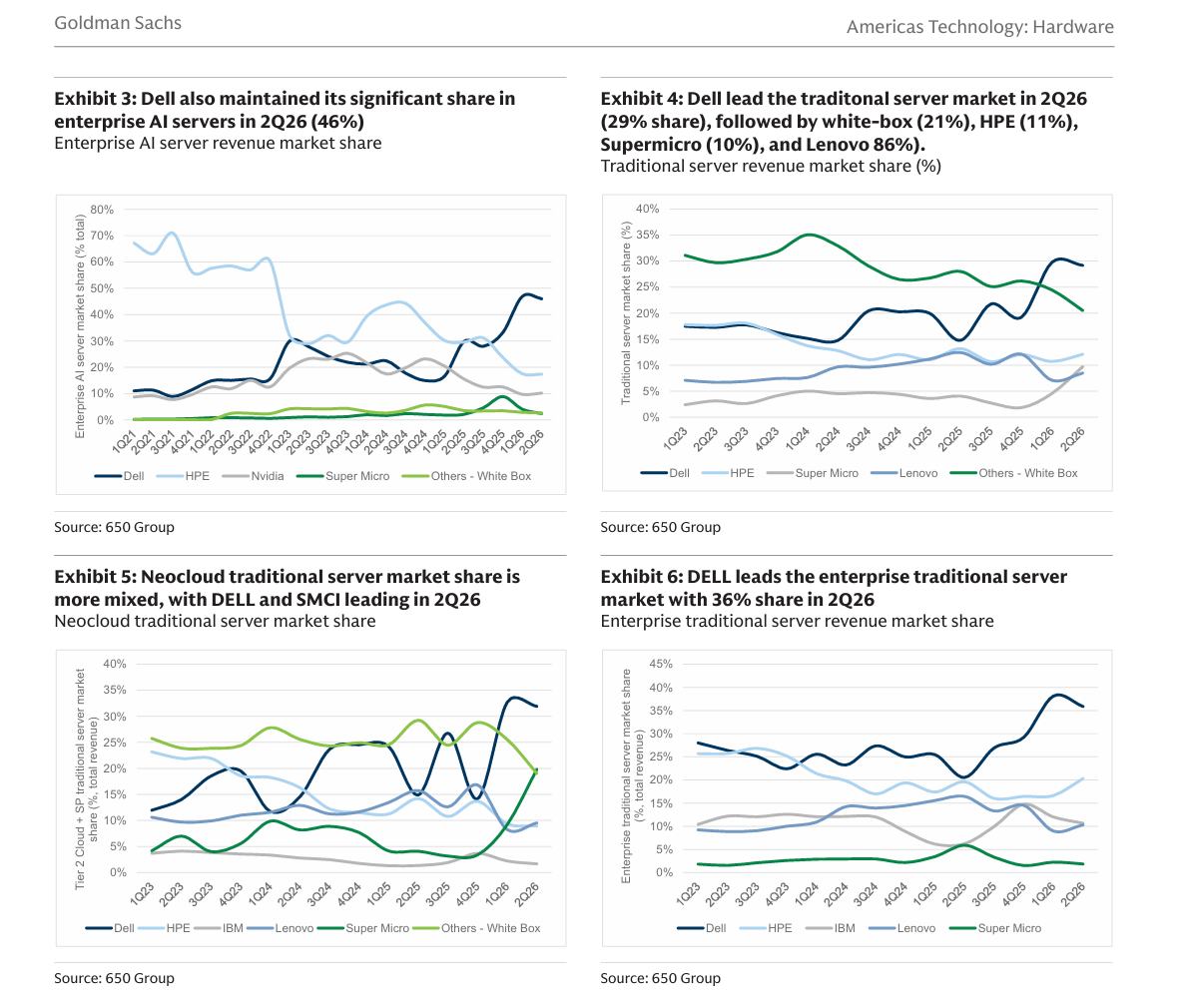
The key to the competitive landscape is not that all server vendors benefit simultaneously, but who can gain a higher share in the largest growing customer base. Dell's revenue share in the new cloud AI server market increased from 47% to 51%, and from 30% to 46% in the enterprise AI server market; the new cloud and enterprise market shares of traditional servers also rose from 15%, 21% to 34% and 36%, respectively. Corresponding customer revenue increased by 502% and 219%, respectively, reflecting its ability to expand across customers and products. 650 Group estimates and forecasts show that its traditional server revenue for the second quarter of the natural year was 11.3 billion US dollars, an increase of 278%; Dell disclosed traditional server and network revenue of 10.5 billion US dollars, an increase of 122% in the fiscal year ending July 31. Note that the differences between the two in terms of fiscal year statistics period and business classification should be maintained.
On the HPE side, 650 Group predicts that its traditional server revenue will increase by 75% and change its share from 13% to 12%, but AI server revenue will drop by 10%, shipments will drop by 42%, ASP will rise 54%, and AI share will drop from 3% to 1%; therefore, Goldman Sachs's “purchase” cannot be interpreted as an increase in AI server share this season. If you add the operating data disclosed by the company itself, you can better understand Goldman Sachs's bullish support for AI server leader HPE: its network revenue increased by 74.9% in the third quarter of fiscal year 2026, with data center network revenue increasing 112.2%; the company also raised its revenue growth forecast for fiscal year 2027 to 13% to 17%, and adjusted earnings per share growth forecast to 16% to 20%, indicating that the network and enterprise infrastructure business other than servers is also contributing to growth.
Ultramicrocomputers, on the other hand, showed a clear differentiation: traditional server revenue increased by 356% and share from 4% to 10%. Although AI server revenue still increased 66% and shipments increased 59%, it was lower than the industry revenue growth rate estimated by 650 Group. The AI share fell from 9% to 8%, and Xinyun's AI share fell from 29% to 25%, which provided a competitive basis for Goldman Sachs's cautious stance.
From Token Explosion to Whole Machine Delivery: A Golden Period for Server Growth in the Age of Reasoning
AI large model application capabilities are moving towards the AGI era, and the two major AI application leaders, Anthropic and OpenAI, are forming a corresponding expansion chain of expansion, with increasing AI chip revenue, which supports Goldman Sachs's server growth model.
Astra, which sparked discussions at AGI, strengthened programming, browsing, computer operation, and complex task execution capabilities in the official disclosure, further expanding the scope of work that AI can participate in; OpenAI also confirmed that new registrations and upgrades to the $200 monthly Pro 20X package will be suspended from September 10, and existing subscriptions will not be affected. At the capital market level, OpenAI is considering a new round of financing with a valuation of more than 1.2 trillion US dollars; Anthropic is reportedly seeking a possible record IPO with a valuation of about 2 trillion US dollars and financing of up to 100 billion US dollars. Both should currently be understood in terms of financing intentions or preparation plans.
What directly corresponds to AI hardware chain demand related to AI servers than the estimated figures is Anthropic's announced capacity arrangement: reaching a maximum 5 gigawatt agreement with Amazon, 5 gigawatt agreements with Google and Broadcom, and launching in 2027; another 30 billion US dollars of Azure computing power and 50 billion US dollars of AI infrastructure investment related to FluidStack; and additional capacity of more than 300 megawatts of SpaceX Colossus 1.
AI chips, which are the core of the AI industry chain, and the business growth data at the level of memory chip demand driven by the global AI infrastructure frenzy was as strong: Nvidia's data center revenue in the second quarter of fiscal year 2027 reached US$89 billion, up 117% year on year, and the overall revenue guidance for the next quarter was US$108 billion; South Korea's exports in August increased 68.7% to US$98.26 billion, of which semiconductor exports reached US$46.65 billion, more than three times the same period last year. From September 1 to 10, exports increased by 82.6% to about US$34.97 billion. The bullish judgment supported by these different sectors is that AI expansion is simultaneously reflected in improved application capabilities, long-term capacity procurement, and hardware revenue fulfillment. AI server vendors are facing not only training cluster construction, but also growing demand for heavyweight AI inference services for various industries.
B/C-side user demand for tokens and the simultaneous blowout expansion of enterprise-grade memory chip capacity can be described as extending this round of server growth from purchasing disposable devices to years of infrastructure upgrades. Another Wall Street financial giant, recently released a research report showing that the compound monthly growth rate of its token usage tracking data reached 31%, with a year-on-year increase of 2434% in August 2026; Citi further predicts that in 2027 HBM demand will increase 62%, server DRAM demand will increase by about 51%, and enterprise SSD demand will increase 52.9%, and believes that continuous learning, personal AI, and physical AI may continue the imbalance between storage supply and demand until 2031.
At the performance meeting, Dell management also gave an estimate that demand for inference tokens will expand about 87 times by 2030 to reach 3.6 x 10¹ tokens, and that enterprise intelligence will become the largest single workload in 2028; the industry model points to market expansion, customer orders increase revenue visibility, and AI-related revenue generation and profit proof delivery are accelerating. Together, the three form the basis for Dell to enter a stage of high growth for many years.
Looking at the underlying engineering logic, the advantage of the reasoning era for complete system vendors such as Dell is that every AI application that goes to actual work requires collaborative expansion of computing, memory, storage, network, and operation management. An agent performs a task, and may repeatedly perform planning, retrieval, tool calls, code execution, and result verification. The total demand is also driven by active users, task frequency, model call rounds, and context length expansion. When the model processes input, the prefill (prefill) stage has strong parallel computation requirements; the decode (decode) stage of generating output is often more constrained by memory bandwidth, and the capacity of the key value cache (KV Cache) also grows as concurrent requests and context length expand.
Therefore, higher inference throughput requires not only accelerator computing power, but also sufficient high-bandwidth memory (HBM), reasonable cache management, and efficient interconnection. Further deducing from the complete system, the CPU is responsible for intelligent organization, tool execution, and data processing; the server DRAM and enterprise-grade SSD support the knowledge base, data access, and hierarchical caching; the network is responsible for connecting computing and storage resources; enterprises also need to deploy these components into a production environment that can continuously provide services. The differentiation that Dell management particularly emphasizes is engineering design, global deployment, ongoing support, and the ability to finance from order to launch, to help customers start generating usable tokens faster.
This explains why AI inference expansion can simultaneously drive AI servers and traditional CPU servers: the former undertakes model computation, while the latter undertakes application and data work around the model. The increase in the dual-line share of Dell companies and New Cloud, recorded by Goldman Sachs, corresponds exactly to the commercial landing point of this kind of complete delivery capability — the growth opportunity for server leaders is being upgraded from “selling more accelerator chassis” to “delivering more large-scale AI computing power infrastructure clusters that can continuously produce tokens”, driven by market expansion, increase in the value of a single system, increase in share, and supporting services.