
Goldman Sachs's latest research on the Chinese internet sector: gaming and entertainment are favored, and it is recommended to buy these Chinese securities
The Zhitong Finance App learned that after the second quarter results season and the Asia Leaders and Communacopia+ Technology conferences, Goldman Sachs focused on sorting out key topics and focuses in the Chinese Internet sector and AI model field, and updated sub-sector preferences (increasing game/entertainment based on defensive growth, raising the Internet vertical industry/education based on attractive valuations) and corresponding key individual stock views.
Investors' topics/focuses are focused on the following five areas:
1) A mixed pattern of third-quarter results - Goldman Sachs expects weak consumption to drag down the growth of e-commerce, advertising, and local services, and believes that the gaming/cloud/ internet vertical industry is a relatively more defensive/resilient sub-sector driven by growth;
2) AI cloud growth - Under the positive cross-confirmation of tight demand for computing power and US hyperscale vendors, Goldman Sachs believes there is room for further “exceeding expectations and then increasing” (raising Alibaba Cloud's growth rate to 53% in the September quarter, compared to 50% previously); however, investors have doubts about the funding sources of capital expenditure and the sustainability of high ROIC;
3) Competition for AI models is intensifying - the performance gap is narrowing, discussions on the pace of cutting-edge advancement are also evolving, and cost efficiency, financial strength, and harness products are becoming more important drivers of differentiation;
4) Increased attention to agent applications — around the workplace (To-B and To-C) and personal AI assistants (To-C, cross-verifying consumer-grade agents recently launched by US manufacturers, including Meta Muse), related investments can be used for user acquisition and may form a sustainable data flywheel, but there are questions about their ROI and long-term retention;
5) Evolution of AI policy/regulation/taxation. The focus is on four types of risks: distillation, transactions with US suppliers, access to overseas computing power, and preferential high-tech tax rates. The impact of e-commerce merchant tax on shelf-type e-commerce is manageable. The value-added tax rate for game companies has not changed this year; offshore trust personal tax concerns have suppressed the performance of Hong Kong stocks.
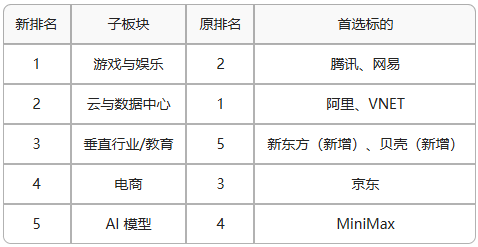
Against the backdrop of the sector's stock price weakening during the year and after the second quarter results, Goldman Sachs assessed the position of the ultra-large market valuation compared to past valuation lows, EPS correction prospects, free cash flow status/US dollar financing requirements, and updated sub-sector preferences: games and entertainment were lowered to 1st, cloud and data centers to 2nd, vertical industry/education to 3rd, e-commerce fell from 3rd to 4th, and the AI model fell from 4th to 5th. We are also updating Tencent and Ali's target price/profit forecasts to reflect investment in AI applications and the latest financing announced by Ali.
The main points of a house-to-house for an oversized market
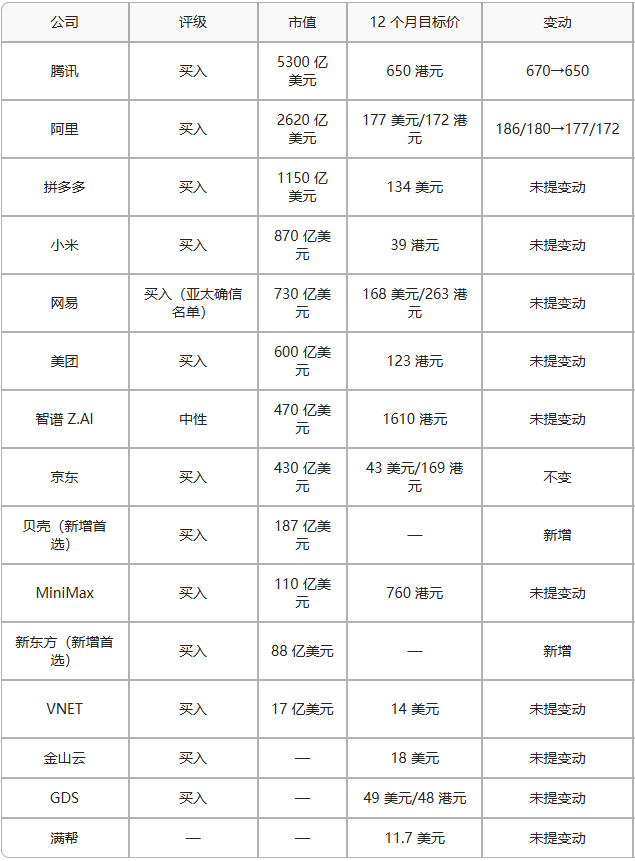
Tencent (purchase) — Profit growth was under pressure due to increased AI investment, but performance during the year reflected EPS compression and valuation contraction; visibility of the AI technology stack improved markedly within half a year. After the reduction, 3Q/4Q26E EPS growth rate was -2%/-5%, FY27E 0% (previously 4%/0%/5%); 2026-28E net profit was fine-adjusted -3% to -8%. Strong core profit+the $130 billion portfolio, which is dominated by overseas assets, can cover rising capital expenses/advance payments, and management publicly stated that there is no equity financing plan. 6-12 month stock price drive: Next-generation mixed market launch, WorkBuddy retention/payment rate, WeChat “Xiaowei” adoption, and Tencent Cloud's renewed commitment to return to China's top three hyperscale vendors.
Ali (Buy) — Performance brought positive developments: Cloud growth was the highlight; capital expenditure increased but ROIC certainty increased; EPS growth showed an inflection point since the September quarter; immediate retail unit economic efficiency improved (FY27E/28E losses halved, FY29E was on schedule). FY27E/FY28E EPS continues to be expected to be +64%/+33% YoY (+58%/+27% per share chapter caliber); the cloud growth rate will increase to 53%/55%/55% for the September/December/March quarter. The target price reduction was mainly due to the dilution effect of HK$80 billion equity financing, and management said there were no further financing plans within FY27.
Pinduoduo (buy) — 2Q26 hybrid: Online marketing +3% better than expected (domestic GMV is resilient), transaction services +13% lower than expected (Temu responds to global tariff/regulatory changes). The EU lifted the small exemption in July and imposed fixed tariffs on a piece-by-piece basis, and the pressure continues (Goldman Sachs estimates that Europe accounts for about one-third of Temu GMV). Long-term investment in 1P (new parquetry, first private label Bemuvo launched in some markets in June) and investment in local supply chains and warehousing contracts are seen as positive developments.
Xiaomi (purchase) — Concerns about smartphone gross margin are expected to ease in 2H26 (second-order negative storage pricing+steady implementation); potential inflection points in IoT revenue growth (easier domestic base, strong overseas), smart car acceleration (SkyNoMAD release), and AI progress will reignite ecological growth. Next look: MIMO-v3 may be released this month, SkyNoMad lock volume revealed after October 7, Double Eleven GMV.
NetEase (buy) — A steady “non-AI” compound interest target, with record profit margins and free cash flow. Forecast 3Q/4Q26E game revenue +5%/+5%, operating profit +20%/+16%. Catalysis: “Ananta” will launch globally in January 2027.
Meituan (purchase) — Investors are expected to worry about a month-on-month decline in takeout profits in the third quarter (narrowing the unit economic benefit advantage). Goldman Sachs believes that an uneven quarterly recovery is more like an active strategy (grabbing GTV share during peak season+seasonal rise in rider costs). The profit forecast for each order was lowered: 2026E/27E/28E was -0.1 yuan/0.6 yuan/1.1 yuan (previously 0.3/0.8/1.1), and the economic benefits of takeout units remained at 1.1 yuan EBIT per order in the medium term.
Smart Spectrum Z.AI (neutral) - 1H26 hybrid: Open platform/API monetization and ARR climbed better than expected, and overall revenue and profit were dragged down by the shift from local deployment to cloud MaaS. At the end of 2026, ARR was raised to $2.7 billion (previously 2.5 billion, compared to MiniMax's forecast of 1.2 billion). Management emphasized capturing high-value tokens rather than maximizing the amount of tokens, and programming is still the main entry point.
JD (buy) — Seen as a valuation repair/revaluation story for the second half of 2026, based on top-line recovery and year-on-year profit recovery, the target price remained unchanged; it has performed relatively well within the Chinese Internet sector during the year.
Other key points
MiniMax (purchase) — Compared with Keling's post-investment valuation of $18 billion after the latest round of financing and Smart Spectrum's significant discounts, depending on the M3 competitiveness strategy and H3 multi-modal release as positive drivers of ARR's rise, 2H26 has considerable room for valuation repair (the current revenue operating rate is about half that of Smart Spectrum). The advantages are full multimodal supply, commercialization capability, cost per token, and organizational efficiency.
Century Internet (purchase) -- Wholesale IDC has entered a revenue/EBITDA acceleration period, with a compound growth rate of 37%/35%; it has won 862 MW+355 MW bookings during the year, adding 1-1.1 GW of orders throughout the year (including about 1.4 GW of reservations). The deal with Ningde Era related parties is expected to be completed by the end of September, which is expected to bring about low-cost sustainable electricity collaboration.
New Oriental (purchase) — Valuation is relatively historic, and its EPS growth rate is attractive; 1QFY27 revenue growth should exceed the full year; overseas related revenue should be positive; shareholder returns were as high as US$500 million (accounting for 5%-6% of market value), and cash dividends increased from FY26 to US$300 million in FY27.
Shell (purchase) — the structural net beneficiary of China's new “828 Real Estate Policy” (shift to second-hand housing, high-quality completed projects, integrated housing services). Three beneficial logics: accelerated transfer of existing housing stock (minimal increase in fixed costs, expansion of profit margins), increased penetration rate of new housing brokerage channels (maintenance of commission rates), and collaboration with new initiatives such as home improvement/leasing. The valuation is less than 15 times the 2026E price-earnings ratio, 14 times the price-earnings ratio for the next 12 months, and 1 standard deviation below the historical average.