
From the stock price retreating after the results of the Chinese report were realized to rushing up the test market, is Viva Biotech (01873) about to usher in a rebound moment?
On the evening of September 16, Novo Nordisk and Anthropic reached a partnership announcing the use of AI models to support drug discovery; on the same day, Kingsley also announced a partnership with Lilly TuneLab, Eli Lilly's AI/machine learning drug discovery collaboration platform.
The intensive news coverage caused group changes in multiple targets in the Hong Kong stock CRO/AI drug discovery sector on September 17, which also directly raised the market's risk appetite for the ViaBio (01873) AI CRO platform and CDMO commercialization logic.
The Zhitong Finance App observed that in early trading on September 17, Viva Biotech's stock price opened slightly higher by about 1.12%, and quickly raised the stock price to a maximum of HK$1.46 within 40 minutes, reaching a maximum increase of 8.55%.
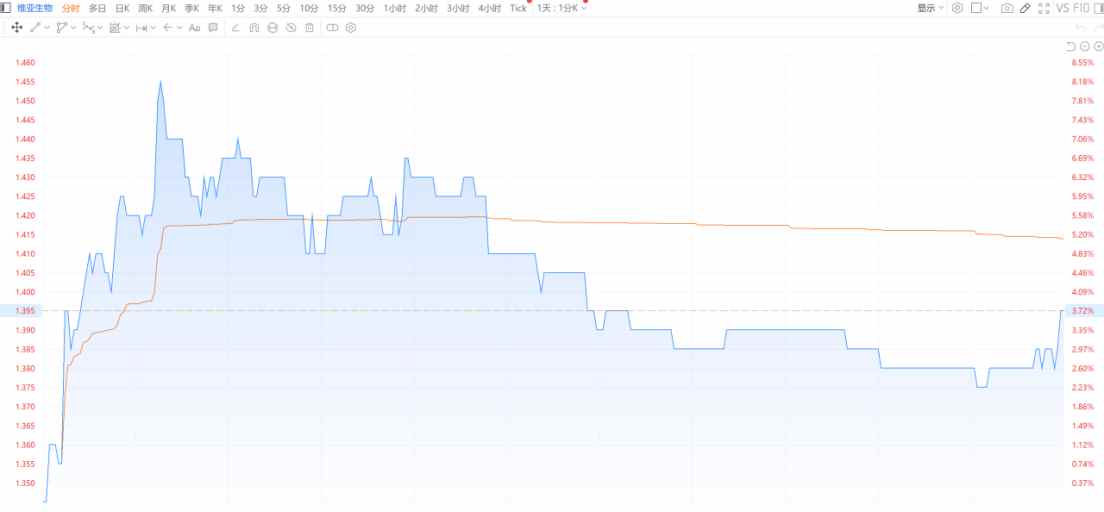
However, although Viva Biotech's stock price showed a marked increase in early trading, its stock price fell immediately after hitting the initial pressure level of HK$1.46, making the stock price rise on the same day a stress test for the upper market.
However, after the K-line appeared in this trial session, investors also paid more attention to whether the main promotion could be launched to confirm a reversal in the future.
Has the “Immortal Guide” pattern appeared?
After the market on August 26, ViaBiotech released its 26H1 financial report, showing that its current revenue reached 1,007 billion yuan, an increase of 20.99% over the previous year; however, at the same time, the company's corresponding net profit was 101 million yuan, a decrease of 32.1% over the previous year.
Although the financial report was disclosed, China Merchants Securities still maintained a “strong recommendation” for ViaBiotech in the updated research report, and the company expects revenue of about 20.2/24.9/3.27 billion yuan in 2026-2028, or about 8.5/6.4/4.5 times the adjusted PE.
However, the agency's expectations have not been fulfilled. The intuitive performance of increasing revenue without increasing profit, and the reason for the decline in profits due to declining investment returns, unfavorable foreign exchange, and increased R&D expenses for new businesses also drove Viabao's trading logic in the secondary market back from “expected transactions” to “profit cashing out transactions”, which also drove its stock price to switch from “accelerated peak” in the previous period to “retracement repair after performance was realized.”
The Zhitong Finance App observed that on August 27, ViaBiotech's stock price fell 8.01%, and the corresponding turnover increased to HK$18.32 million, indicating that after the performance was implemented, the capital first chose to fulfill the previous CDMO+AI expectations. Driven by this trading logic, the biggest retracement of Viva Biotech's stock price in the subsequent range once reached 19.50%.
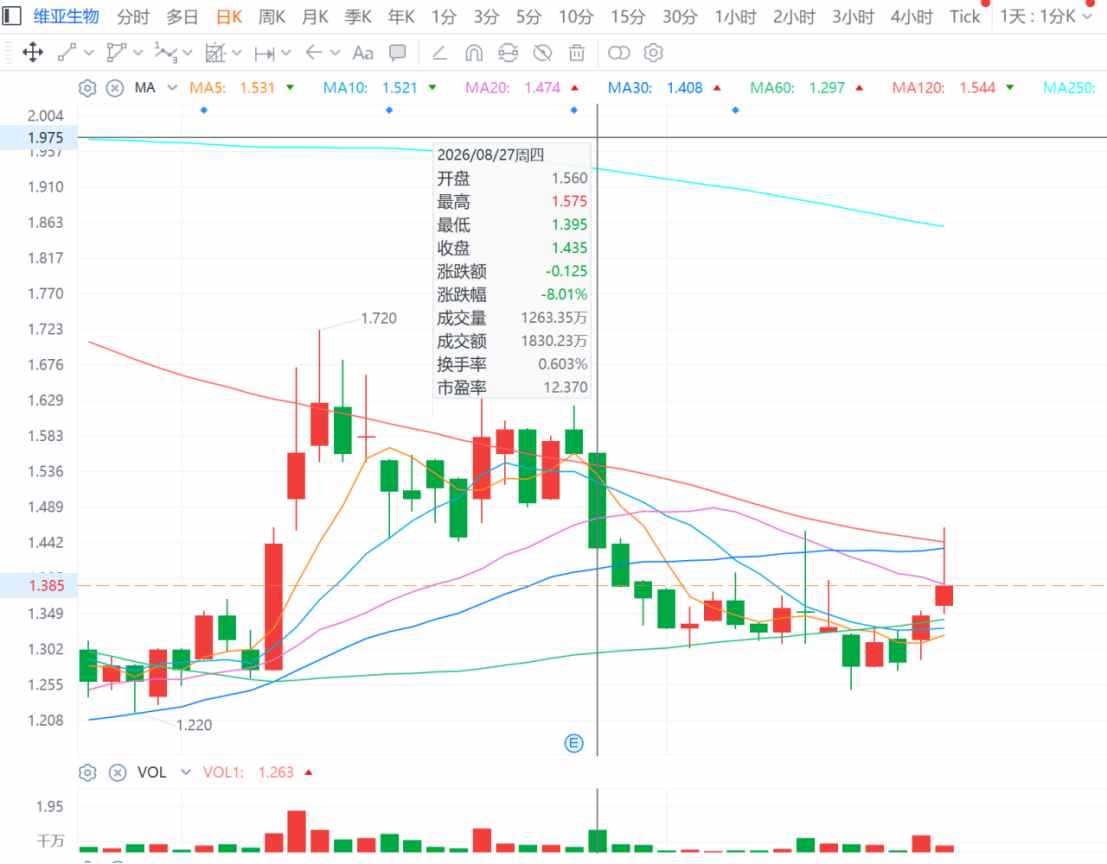
However, judging from the fundamentals of the Chinese report, Viva Biotech showed a “strong revenue side and weak profit side” performance. Therefore, the “four consecutive declines” from August 27 to September 1 essentially killed profit expectations in the market first, but it still approves the medium- to long-term CDMO and AI direction.
On September 11, ViaBio's stock price bottomed out and fell to an intraday low of HK$1.28, which also indicates that it has officially entered the overrun range. Since then, ViaBio's stock price stabilized above BOLL's downtrend, providing it with support for subsequent recovery from the overrun decline. On September 16, driven by a bullish sentiment about the A-share CXO concept, there was an obvious trend correction in the innovative drugs/CXO sectors in AH.
As the target of a small but beautiful CDMO with a market value of about HK$3 billion, ViaBio's peptide commercialization, AI drug discovery, and CRO order improvement logic matched the highly flexible repair direction of today's market preferences. Therefore, although it was suppressed by profit side disturbances in the early stages, it still received excessive capital allocation, and the market trading logic also began to shift to marginal improvements on the medium- to long-term revenue side and order side.
In the context of the market that was taken over the previous day, Viva Biotech, which emerged in a form similar to the “Immortal Guide”, gained more investor attention on September 17.
However, even though the K-line is similar, Viva Biotech's launch on September 17 is not in the form of a “fairy guide”. Generally speaking, the standard immortal guidelines emphasize “covert acceptance by the main players after the trial” and require subsequent volume to break through the high point of impact.
However, judging from the K-line position, Viva Biotech's stock price followed the trend and surged to HK$1.46 the next day after rebounding in volume on September 16, just hitting the pressure zone in the early stages. This position is a rebound stress test after a decline. It is not a typical low starting position, nor is it a relay position in a smooth upward trend.
Also, judging from quantitative energy performance, ViaBio's intraday turnover dropped to HK$5 million on September 17, and did not continue to sell even after rising to a high of HK$1.46 in early trading on the same day, and finally closed HK$1.39, indicating insufficient upside funding.
Therefore, compared to the “Immortal Man Guiding the Way” form, Viva Biotech's performance on September 17 was more like a test to repair a surge in the midst of a rebound. However, from a technical point of view, only if the subsequent company's stock price volume breaks through and stabilizes at the initial pressure level of HK$1.46 can guide the possibility of a subsequent increase in stock prices. Otherwise, this upward line may further clarify the short-term pressure on Viabao's stock price.
When will deterministic growth pricing be achieved?
Currently, the entire CRO industry has taken the lead in breaking out of the industry trough and achieving performance recovery with the advantages of capital, technology, customer resources, and global layout. Meanwhile, small and medium CROs face multiple difficulties such as insufficient orders, tight capital chains, and brain drain, and their living space is constantly being squeezed. How to deal with the Matthew effect in the industry has become a question for small and medium-sized CRO companies such as ViaBio to think about.
The 26H1 financial report shows that during the reporting period, the company's revenue increased 20.99% year on year, but the increase in revenue was not significant. While overall net profit decreased by 32.1% year on year, the company's adjusted non-IFRS net profit for the current period was 128 million yuan, a decrease of 30.08% year on year. At the same time, the company's current gross profit margin was 34.0%, a further decline from 40.8% in the same period last year. It was mainly affected by the gross profit growth rate falling short of revenue growth and the decline in gross margin of some businesses.
In the current context of external environmental shocks, downstream customers (especially overseas customers) value service quality (quality control and compliance, process quality, delivery and supply robustness, etc.), efficiency, production capacity location, etc. in service prices. Service providers with a perfect layout and experienced delivery experience in these areas can often gradually accumulate brand effects, spawning a long-term “strong” industry pattern.
However, as a small and medium-sized CXO company, in the context of external environmental shocks, its ability to withstand risks has undoubtedly become an important factor affecting the steady growth of its performance.
By business, during the reporting period, ViaBiotech's CRO business achieved revenue of 405 million yuan, a year-on-year decline of 4.2%. However, the CDMO business carried by its subsidiary Langhua Pharmaceuticals showed impressive rapid growth, with current revenue of 601 million yuan, an increase of 47% over the previous year, becoming the core engine of the company's revenue growth.
As for the reason for the sharp increase in revenue from this business, Viva Biotech clearly stated in its financial report that it is mainly driven by two CDMO commercialization projects. One of the peptide projects has entered the commercial production and preparation stage, and revenue has been rapidly released and contributed to growth; the other small molecule project is already in the PPQ production stage and is expected to be commercialized in 2027. Together, this will lay the foundation for Langhua's steady revenue growth over the next few years.
Overall, the key message revealed by Viva Biotech in this interim report is that the company's main business has not deteriorated, and its CRO business is being upgraded from traditional structural biology services to peptides, antibodies, XDC, PROTAC, molecular glue, and AI-driven projects.
In terms of the company's AI CRO capabilities, ViaBio has built a relatively complete AI CRO platform around new targets, new mechanisms, and new molecular forms, and has covered the entire FIC drug discovery process.
Financial reports show that the company's CADD/AIDD has participated in 228 projects and 92 customers. AI enabling projects have contributed about 14.0% of CRO revenue, and the share of new molecular models has risen to 17.7%. The company expects the annual CRO revenue growth rate to remain or higher than the current level. Furthermore, the company's MARS multi-modal algorithm platform, particularly PEP2Mars, is forming technical barriers in the field of peptides, cyclic peptides, and complex macrocyclic compounds; while the company cooperated with international giants to promote an AI-driven “closed loop dry and wet” drug discovery model, which has also been effectively verified.
At present, although ViaBiotech's AI CRO business is still far from being realized on a large scale, if MNC platform licenses, large-scale collaborations, or the share of AI project revenue continues to increase, its business valuation is expected to accelerate the expansion from CDMO logic to AI pharmaceutical platform logic, and obtain deterministic growth pricing from market investors.