
Passenger Transport Branch: Passenger car retail sales in the narrow sense of the word are expected to be 1.69 million in September, and 1.11 million new energy vehicles are expected
The Zhitong Finance App learned that the Passenger Link branch published an article stating that in September, the car market entered the traditional “golden nine silver ten” peak consumption season, and terminal passenger traffic is expected to continue to pick up. The trade-in and local subsidy policies continue at the current pace, providing support for the “Golden Nine” market. However, there is still no fundamental improvement in consumption expectations and fundamentals. Combined with long-term fluctuations and increases in oil prices, it is difficult for the actual market performance to replicate the “Golden Nine” success of previous years. According to comprehensive research, the passenger car retail market size in the narrow sense of September was about 1.69 million units, up 9.7% month-on-month. The year-on-year decline is expected to expand further to 24.6% from the high base of 2.241,000 vehicles in the same period last year. By energy type, new energy sources are expected to reach about 1.11 million vehicles under the dual expectations of new vehicle delivery and end-of-quarter impulse, with a retail penetration rate of 65.7%.
According to data from the Passenger Federation branch, passenger car retail sales in the narrow sense reached 1,541 thousand units in August, down 23.6% year on year, up 5.5% month on month. The domestic retail side recovered slightly at the end of the off-season, but it is still in the stage of bottoming out. Among them, retail sales of new energy vehicles reached a new high of 65.2%, and retail sales of 540,000 fuel vehicles, down 40.5% year on year. The share continued to shrink, and structural differentiation further intensified.
I. Sales trends of manufacturers
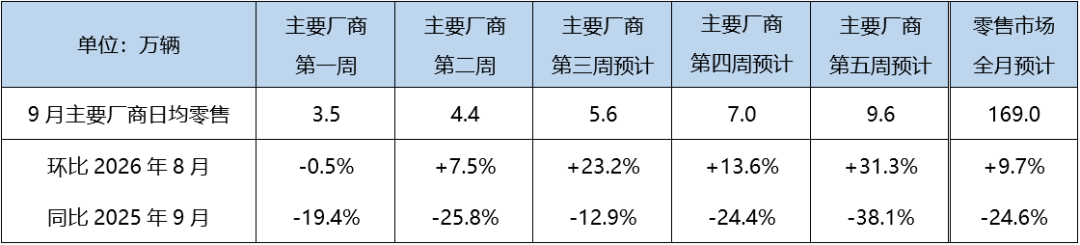
According to the latest research results, leading manufacturers, which account for more than 70% of total market sales, have retail targets for this month's increase of less than 10% over the previous month, which is weaker than the regular seasonal performance at the end of the quarter. Manufacturers' expectations for the market have returned to rationality, and their impulse intentions are less than in previous years. According to comprehensive research, the passenger car retail market size in the narrow sense of September was about 1.69 million units, up 9.7% month-on-month. The year-on-year decline is expected to expand further to 24.6% from the high base of 2.241,000 vehicles in the same period last year. By energy type, new energy sources are expected to reach about 1.11 million vehicles under the dual expectations of new vehicle delivery and end-of-quarter impulse, with a retail penetration rate of 65.7%.
II. Weekly trend estimation
In the first week of September, the market was in the restoration phase, with average retail sales of 35,000 vehicles per day; in the second week, promotions for various brands were launched, and the average daily retail sales were expected to rise to about 44,000; in the third week, promotions from various manufacturers were fully rolled out, and delivery of new cars recently launched one after another, compounded by the pre-release of demand for car purchases before the Mid-Autumn Festival and continuous improvement in terminal passenger flow and orders, the average daily retail sales are expected to rise to around 56,000 units; the mid-fourth week coincides with the Mid-Autumn Festival holiday, and orders are expected to improve further, but due to fewer working days, the pace is expected to improve further after terminal delivery Moving forward, the average daily sales volume is expected to be 70,000 units; In the fifth week, the concentrated release of consumer demand before the National Day was compounded by manufacturer impulses at the end of the quarter. The average daily retail sales are expected to reach 96,000 vehicles, forming a quarterly high. Retail sales for the whole month are expected to reach 1.69 million units, up 9.7% from the previous month and down 24.6% from the previous year.
The structural differentiation of the car market continued in March and September
According to data from the National Bureau of Statistics, total retail sales of social consumer goods increased 1.1% year-on-year from January to August 2026, and the overall operation of the consumer market was stable. Among them, retail sales of automobile consumer goods fell 13.9% year on year, and the decline further expanded. Passenger car retail sales continued to decline due to the macroeconomic environment and consumption expectations. It is still a major drag on bulk consumption, and consumer wait-and-see sentiment is still strong. The Mid-Autumn Festival and National Day are imminent in September, and some consumer demand is expected to be released early. Under the dual influence of the trade-in policy and terminal promotion, the market is still recovering continuously. In the past two months, due to the uncertain international situation, oil prices have continued to fluctuate and rise, and the recovery space for fuel vehicles has been severely pressured. Although the recovery rate has recovered along with seasonal trends, the recovery rate is far less than the “Golden Nine” peak season in previous years; however, early order reserves for new energy sources are sufficient, and new demand and untimely delivery of new vehicles are expected to be released together, and the penetration rate is still on the upward channel of acceleration.
In summary, it is initially estimated that the total passenger car market in the narrow sense of the term this month is about 1.69 million units, of which retail sales of new energy can reach about 1.11 million, and the penetration rate is expected to reach 65.7%.