
The importance of excessive interest rate decisions! Bond investors keep an eye on the Bank of England's QT plan
The Zhitong Finance App learned that the Bank of England will announce the latest interest rate decision at 19:00 Beijing time on Thursday. The market generally expects the Bank of England to keep the benchmark interest rate unchanged at 3.75%. However, the energy price shock caused by the Middle East war is causing policy makers and investors to have heated discussions about “whether to raise interest rates.” Investors are particularly concerned whether the Bank of England will release any hints that surging energy prices may force it to follow the pace of the Federal Reserve's interest rate hike.
If the Bank of England sends hawkish signals, UK Treasury yields may rise as a result. However, for bond investors, they are more concerned about the Bank of England's quantitative austerity (QT) plan for the next year rather than Thursday's interest rate decision. The Bank of England will also release an annual update on Thursday regarding the latest plans to reduce its balance sheet by selling government bonds.
The focus of the bond market is whether the Bank of England will reduce or even suspend active sales of bonds on its balance sheet, and any reduction in the size of the Bank of England's active bond sales may benefit British treasury bonds.
Since February 2022, the Bank of England has nearly doubled its bond portfolio to £489 billion. The bank said its goal is to sell all of its bond holdings and follow three principles — interest rates are still the main tool of the Monetary Policy Committee (MPC); bond sales will not disrupt market operations; and the sale process should be carried out in a gradual and predictable manner.
Mizuho strategist Evelyne Gomez-Liechtenstein said, “QT is a more important market event. The relevant announcement may be more important than the interest rate decision.” Her basic scenario was that the Bank of England would give up actively selling its bonds and instead only implement passive QT, which allows bonds to naturally exit its balance sheet when maturing. She said that this will support British treasury bonds.
The Bank of England's QT plan involves phasing out British Treasury bonds purchased under quantitative easing (QE) during the pandemic. These bond sales operations have been subject to market scrutiny because they may increase the pressure to sell bonds, and the recent round of sell-offs has pushed the UK's long-term financing costs to the highest level since 1998 and eroded the UK government's fiscal space.
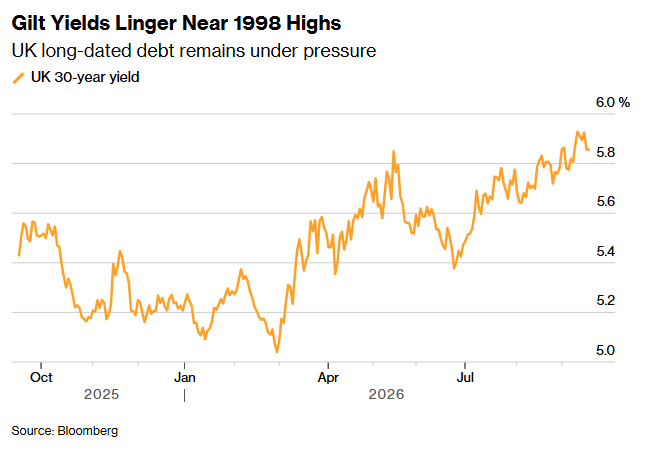
UK long-term treasury yields hovered near 1998 highs
Remi Olu-Pitan, head of Schroder's multi-asset growth and yield business, said: “I do think institutions as lenders of last resort will eventually need to support UK government bonds at some point. I think if UK bond yields continue to rise, action is needed.”
Morgan Stanley strategists Fabio Bassanin and Luca Salford said that “the sharp increase in the issuance of British Treasury bonds and the decline in Bank of England holdings” have had a more obvious impact on long-term British treasury bonds, and demand for such bonds from pension funds has weakened in recent years. They estimate that QT has increased 30-year UK Treasury yields by an additional 70 basis points.
The data shows that the premium on 30-year UK Treasury bonds over comparable swap rates — a measure of market concerns about bond supply — has generally remained stable since this year, despite a sharp rise in yields.
According to the survey, market participants expect the Bank of England to slow down balance sheet contraction to 50 billion pounds (67 billion US dollars) per year in the 12 months ending October. This means that the scale of the active sale of British treasury bonds is around £20 billion. However, a report earlier this week suggested that the Bank of England may stop selling long-term debt altogether, once again triggering market discussions on this issue.
The plan has been criticized because the Bank of England is currently losing money when selling long-term treasury bonds and has caused the British government to lose billions of pounds. However, even if the Bank of England stops selling British treasury bonds, the impact may only be marginal, as UK treasury bonds are still vulnerable to external shocks, such as the Middle East conflict driving up oil prices and increasing concerns about inflation.
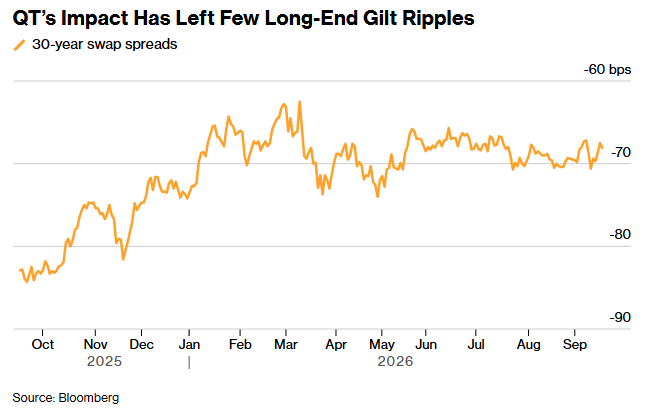
The impact of QT on long-term UK treasury bonds is limited
Some market participants warned that considering that the Bank of England is concerned that changing its bond sales strategy and catering to the government's financial needs may raise questions about the central bank's independence, the bank may not make any major adjustments beyond consensus expectations. Citigroup strategist Jamie Searle said that although it is possible to change the strategy, he doubts that the Bank of England will “maintain the status quo to avoid blurring QT's control over monetary policy.”