
Goldman Sachs: Bonds are changing from safe havens to income-generating tools, and long-term debt bottoming out needs to be wary of increased volatility
The Zhitong Finance App learned that this week, the average yield on global government debt climbed to a 19-year high. Goldman Sachs strategists, including Christian Mueller-Glisman, wrote in the report that although the past five years have been one of the worst periods for bonds in 100 years, a sharp rise in yield is increasing their appeal. At the same time, the strategist said that although the bond sell-off strengthens the reasons for holding bonds in multi-asset portfolios, investors should continue to be careful about bonds.
They wrote, “We think there are reasons to return to a more 'normal' strategic bond allocation, but there are different reasons to tactically increase long-term bond holdings.”
Goldman Sachs said that higher initial yields provide a buffer for further growth and should push optimal bond allocations closer to historical normal over a longer period of time.
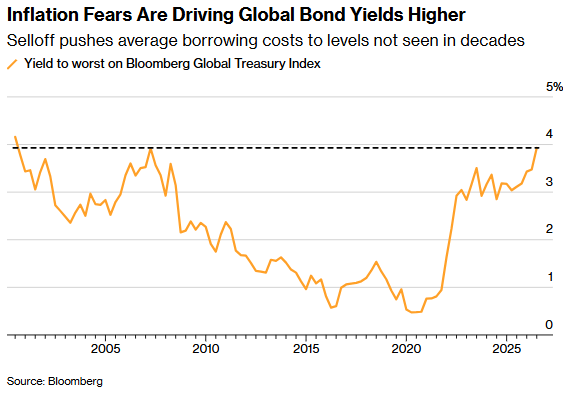
However, Goldman Sachs believes that short-term energy shocks and interest rate prospects may still be key drivers of stocks and bonds, which means that higher bond allocations may increase portfolio volatility rather than act as defensive buffers.
The bank still overallocates stocks, neutral allocation bonds, and low credit bonds in the 12-month time-frame asset allocation. Müller-Glisman and his colleagues said, “We believe that bonds are increasingly becoming an income-generating tool, while the risk mitigation function is weakening, similar to the 100 years before the end of the 1990s.”
It is worth mentioning that Goldman Sachs's cautious stance is not a market consensus. The sell-off has begun to attract some large investors. Bob Michelle, chief investment officer of J.P. Morgan Asset Management, said on Wednesday that his team has begun buying long-term US, Japanese and Australian treasury bonds, believing that the current prices are “really too cheap,” and that the bond market has reached a critical point of “extreme pain.”
Michelle pointed out that multiple beneficial factors are converging: starting with the ECB's interest rate hike last week, through the Federal Reserve, and ending with the Bank of Japan's policy actions this Friday, a series of central bank actions will form important support for the bond market.
Meanwhile, as the US midterm elections approach, the situation in the Middle East is expected to stabilize, and geopolitical risks may gradually cool down. US Treasury Secretary Scott Bessent's repurchase program for long-term treasury bonds was launched last month. Michelle sees this as a key force in stabilizing the market, and pointed out that Bezent “still has enough ammunition to increase if willing.”
Michelle believes that the sell-off at the long end of the yield curve has been seriously overstated. He pointed out that the rapid rise in long-term yields “highlights market concerns about the Fed's current sense of loss of control,” and that this rate hike helps Fed policymakers “reassert control over the situation.” In his view, “the dominoes have begun to fall”. Policy linkage from the European Central Bank to the Federal Reserve to the Bank of Japan will form a complete logical chain supporting the bond market.