
The risk of a “blue wave” looms over and compounded high valuations! US defense stocks were collectively pressured during the year and may face sharp fluctuations before the midterm elections
The Zhitong Finance App learned that after two years of breakneck gains, US defense stocks have faced bottlenecks this year. Since this year, stock performance has lagged far behind the market, from tanks, fighter jets, and naval vessels to manufacturers of missiles, drones, and other defense technology. An indicator measuring the performance of stocks in this sector — the S&P Composite 1500 Aerospace and Defense Index — has declined 13% since February 27 (the eve of the outbreak of the US-Israel conflict). Over the same period, the S&P 500 index rose nearly 10%. The fund tracking the industry — iShares American Aerospace and Defense ETF — is currently expected to see net capital outflows for two consecutive quarters, which will be the first time since 2023.
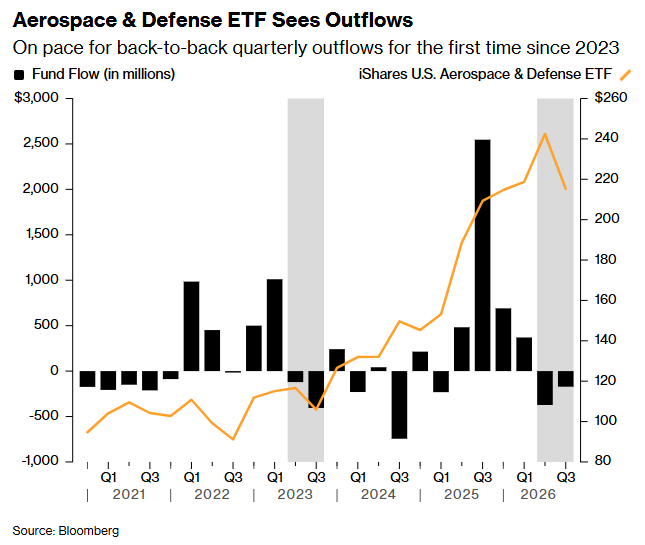
Aerospace and defense ETFs face capital outflows
Specifically, the stocks that fell the most in the US defense sector include aerospace and missile systems supplier Karman Holdings (KRMN.US), defense technology company Kritos Security (KTOS.US), and drone manufacturer AeroVironment (AVAV.US). Shares of these companies have all fallen by at least 38% since the end of February. Shares of large traditional defense contractors Northrop Grumman (NOC.US), Lockheed Martin (LMT.US), Huntington Ingalls Industries (HII.US), and L3Harris Technologies (LHX.US) all fell by at least 18%.
Earlier, US President Trump's promise to drastically raise the defense budget had ignited investors' expectations for defense contractors to receive huge orders, and fueled a record rise in defense stocks. The Trump administration has applied for $1.5 trillion for the 2027 defense budget, including $1.15 trillion in discretionary funds and $350 billion obtained through the budget reconciliation process — budget coordination is a rapid approval process that Congress can use to provide mandatory defense funding.
But now, with Trump and his Republican Party worrying about the midterm election situation, the market is currently concerned about Trump's ambitious budget plan for the Pentagon. According to the results of a poll released on September 14, the US Republican Party's approval rating lags behind the Democratic Party by 7 percentage points, and the prospects for the midterm elections are not optimistic. The poll lasted 4 days and involved 1,143 American adults. When asked who they would vote for if the US congressional midterm elections were held immediately, 44% of respondents would support Democratic congressional candidates and 37% would support Republican candidates. The difference between the two was 7 percentage points. This is the biggest gap in approval ratings between the two parties in the results of this poll since January 2025.
Furthermore, polls and forecasting markets show that after the November 3 vote, the Democratic Party is more likely to win control of the House of Representatives next year. At the same time, which party actually controls the Senate is now closer to the May 5 meeting.
As a result, investors are beginning to lay out the situation where the Democratic Party will control the first or both houses of Congress after the midterm elections. They expect that if the Democratic Party gains control, the situation surrounding lengthy negotiations and delays in disbursement of funds may further intensify, putting more pressure on defense stocks. Senate Majority Leader John Tune said he doesn't expect the Republican Party to push for a budget resolution before the midterm elections.
Bloomberg Intelligence analyst Wayne Sanders said, “If the Democratic Party wins and forms a 'split' of Congress, then the process of seeking foreign defense spending will be scrutinized more strictly, and the necessity of every project will face stricter scrutiny. This means that ammunition projects are likely to be scrutinized on a case-by-case basis rather than being funded uniformly from a larger pool of funds that can cover air defense platforms and other weapon systems.”
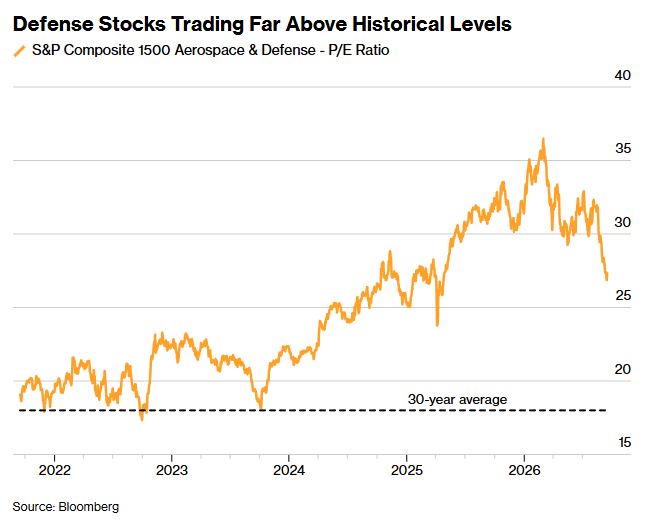
Defense stocks are valued far above historical levels
Investors are also concerned about the overvaluation of defense stocks. According to the data, the current expected price-earnings ratio of the US Defense Stock Index is 27 times; in contrast, the 30-year average of the index is about 18 times. Meanwhile, the current price-earnings ratio of the S&P 500 index is 19 times.
Eric Sterner, chief investment officer at Apollo Wealth Management, said, “Just because the sector's price-earnings ratio is at a high level, at least compared to the average over the past 30 years, we may see further pressure on the sector. We are likely to see more weakness between now and election day.”
Analysts said the temporary funding plan for fiscal year 2027 will last until December 11. Therefore, the potential “lame duck” period after the midterm elections may be an important test. At that time, it will be tested whether investors will see the recent weakness in the defense sector as a buying opportunity or whether they see it as a reason to continue allocating capital to other fields.
According to Eric Sterner, the current correction in the US defense sector “is actually a healthy thing.” He said, “Normally, the market trades sideways until uncertainty arises. And once that uncertainty is removed, we may see some of these stocks regain their vitality.”
Analysts and investors say the outlook for the defense industry remains strong in the longer term. They pointed out that although uncertainty at the level of congressional control may affect funding, supervision, and project priorities, the general direction of the US government's promotion of military modernization has not changed. Arax Chief Investment Officer Don Hagan said, “There is still a strategic need for military modernization, and this really transcends most political positions to a large extent.”
Analysts and investors also pointed out that escalating global geopolitical tension and the push for higher defense spending in Europe and around the world will benefit defense contractors. Philip Blancato, chief market strategist at Osaic Holdings, said: “We are in a situation where we have no choice but to continue to actively increase defense investment due to changes in the nature of the equipment the defense industry is manufacturing and required.”
Despite this, even investors who are optimistic about the sector agree that these stocks will experience sharp fluctuations in the coming weeks. Guggenheim analyst Michael Ciarmoli said, “Investors seem to be pricing the 'blue wave (meaning the Democratic Party's massive victory in the election) 'and seem to be assuming that the sector will face the worst.”