
Musk Calls $10 Trillion in Starship Revenue ‘Not Impossible.’ Here Are 2 Things You Need to Know About His Bold Projection.
A bold number about SpaceX (SPCX) is getting a lot of attention. Ark Invest's Sam Korus laid out the math on X: Each Starship launch carries about 61 terabits per second of connectivity at $19 million of revenue per Tbps. That works out to about $1 billion per launch. Looking at this, Cathie Wood said that if SpaceX hits Elon Musk’s target of 10,000 flights a year, that would mean $10 trillion in annual Starship revenue by 2030. Musk reposted the claim and simply added, “It’s not impossible.”
Those words should be interpreted carefully. Musk didn’t call it a plan or a forecast. The SpaceX CEO just said it wasn’t impossible, which is far less concrete — and the gap between the projection and where SpaceX stands today is huge.
The Math Depends on a Launch Rate That Doesn’t Exist Yet
Here’s something to help you understand how far SpaceX sits from these claims right now. SpaceX conducted a record 165 Falcon 9 launches in 2025. It's on a similar annual pace in 2026 as well. But the $10 trillion figure assumes 10,000 Starship launches a year. That is roughly 60 times its current rate, and Starship isn’t yet in regular service.
There’s also another problem with the numbers. SpaceX's revenue per Tbps appears to be slipping. By Korus’ own numbers, the figure has fallen from $23 million in 2024 to $19 million in 2025. So, the $1 billion per launch is a starting figure, and that’s already sliding down.
This doesn’t make the vision worthless. Starlink is already a real business, with Connectivity revenue of $4.3 billion last quarter and improving margins. But the $10 trillion figure circulating on social media is built on a launch rate SpaceX is nowhere near, and even Musk only went as far as to call it “not impossible.”
About SpaceX Stock
SpaceX designs, manufactures, launches, and operates products and services built on technologies like rockets and spacecraft. The company operates through three main segments. The Space segment designs, manufactures, and launches reusable rockets to provide access to space, while the Connectivity segment operates a broadband data and communications network powered by Starlink broadband and mobile satellites in low Earth orbit. Finally, the AI segment develops products and services like the Grok AI model, artificial intelligence solutions for consumers and businesses, the X social platform, and the computing infrastructure needed to support AI applications. Founded in 2002, SpaceX is headquartered in Starbase, Texas.
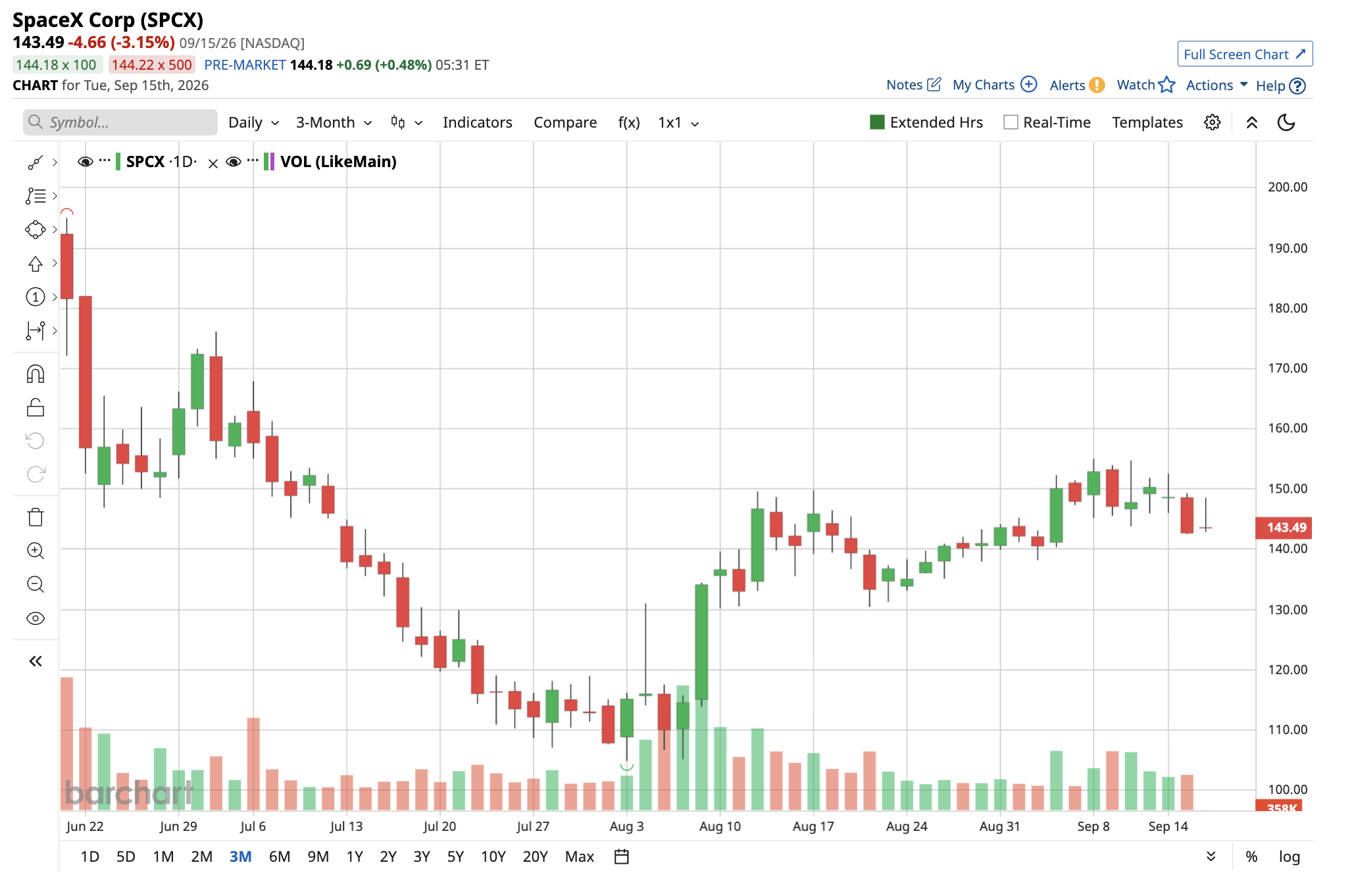
Since June 15, 2026, SPCX stock has fallen 10%, although the stock remains above its initial public offering (IPO) price of $135. Despite strong investor interest in SpaceX’s business, the stock has faced pressure from post-IPO profit-taking and valuation concerns.
SpaceX Bets Big on AI, Targets $100 Billion ARR by December
SpaceX reported its second-quarter fiscal 2026 earnings on Aug. 4. The company reported a sharp rise in Q2 revenue, which came in at $7.8 billion, up 92% year-over-year (YOY). For the Space segment, revenue grew 55% sequentially and 29% YOY to $962 million. Connectivity remained the biggest business, with revenue growing 66% YOY $4.3 billion. AI segment revenue was $2.6 billion.
The strong quarterly results underline how SpaceX is evolving from a launch company into a broader technology platform. Total capital expenditures in Q2 came to approximately $18.4 billion. Of that capex, $15.8 billion was related to AI spending.
Looking forward, management expects to reach a $100 billion annualized revenue run rate (ARR) by the end of 2026. CFO Bret Johnsen said that in the first few weeks of Q3, the company had already contracted an additional $6.7 billion of cloud services revenue over a six-month period that will begin ramping in October 2026. Moreover, the company plans to keep investing aggressively in “Starship development and production scale, next-generation Starlink broadband and mobile constellations, and AI compute infrastructure.”
What Do Analysts Expect for SPCX Stock?
Goldman Sachs analyst Eric Sheridan recently reiterated a “Buy” rating for SPCX stock and set a price target of $220. The analyst believes the company’s AI business is growing quickly and has strong long-term potential. Sheridan noted that the AI segment is generating revenue near the upper end of management’s expectations, and a recently signed compute licensing agreement increases confidence that SpaceX can reach its ARR target. At the same time, Sheridan highlighted progress in the company’s Space and Connectivity businesses. Similarly, Morgan Stanley analyst Adam Jonas has an “Overweight” rating on SPCX stock with a $300 price target.
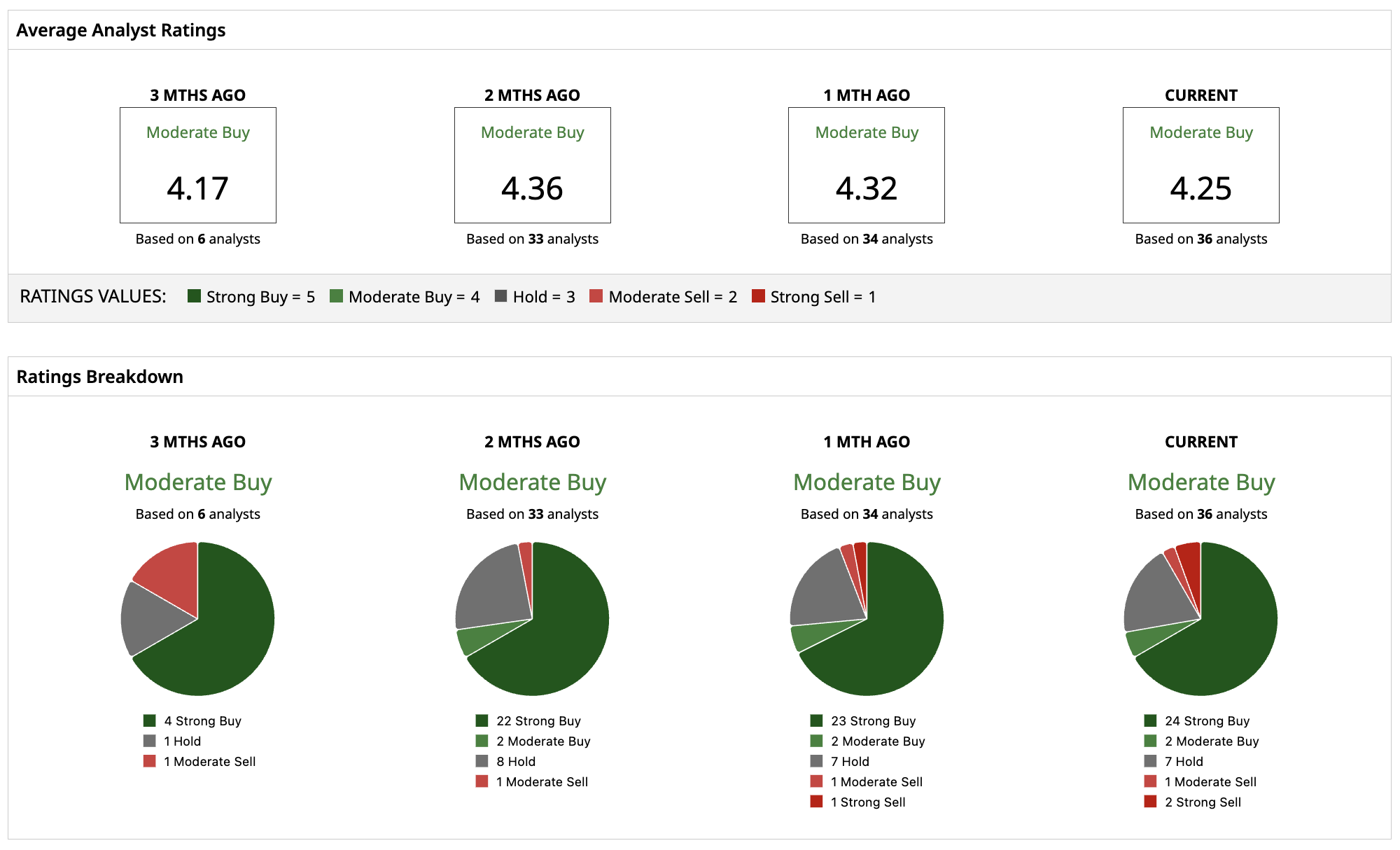
Based on 36 Wall Street analysts covering the stock, SpaceX holds a consensus “Moderate Buy” rating overall. The mean price target of $220.03 reflects potential upside of 42% from current levels. Meanwhile, the highest price target of $800 implies potential upside of 416% from here. This shows that Wall Street remains optimistic about SPCX stock’s growth prospects.
On the date of publication, Jabran Kundi did not have (either directly or indirectly) positions in any of the securities mentioned in this article. All information and data in this article is solely for informational purposes. For more information please view the Barchart Disclosure Policy here.