
DexCom (DXCM) Reshuffles Leadership, Is The Stock Fully Valued?
DexCom (DXCM) just reshuffled its leadership, promoting long-time finance chief Jereme Sylvain to a dual CFO and COO role, while adding former Stryker CFO Glenn S. Boehnlein to its expanded board.
Recent leadership moves come as DexCom trades at US$87.93, with a 90-day share price return of 21.33% and a year-to-date share price return of 32.15%. The 1-year total shareholder return of 16.03% contrasts with a weaker 3-year and 5-year total shareholder record, suggesting momentum has picked up more recently than longer-term holders have experienced.
Spot fresh momentum stories beyond DexCom by scanning our hand picked 29 high quality undervalued stocks, which pairs stronger balance sheets with earnings power.DexCom now trades close to analyst targets while still showing a sizeable gap to some fair value estimates. Has the latest leadership reshuffle already priced in the upside, or is the valuation still playing catch up?
Most Popular Narrative: 6.6% Undervalued
DexCom’s most followed narrative pegs fair value around $94.12, a touch above the latest $87.93 close. This frames the leadership shake up against a still supportive long term story built on reimbursement, product reach, and profitability assumptions.
The recent expansion of insurance reimbursement for type 2 non-insulin diabetes patients, now covering nearly 6 million lives across the three largest U.S. PBMs, opens a large, previously untapped segment of DexCom's addressable market, driving new patient growth and supporting robust multi-year revenue expansion.
Growing global recognition of CGM efficacy, with recent clinical trial evidence and expanded coverage in international markets (e.g., France, Japan, and Ontario, Canada), positions DexCom to penetrate underpenetrated regions and diversify revenue streams, creating sustainable top-line growth.
See why 78 investors see DexCom as 7% undervalued.
Result: Fair Value of $94.12 (UNDERVALUED)
Still, the DexCom story hinges on avoiding sharp pricing pressure from potential CMS competitive bidding and on keeping supply chain issues from eroding margins or disrupting sensor availability.
Find out about the key risks to this DexCom narrative.
Another View: DexCom Through The P/E Lens
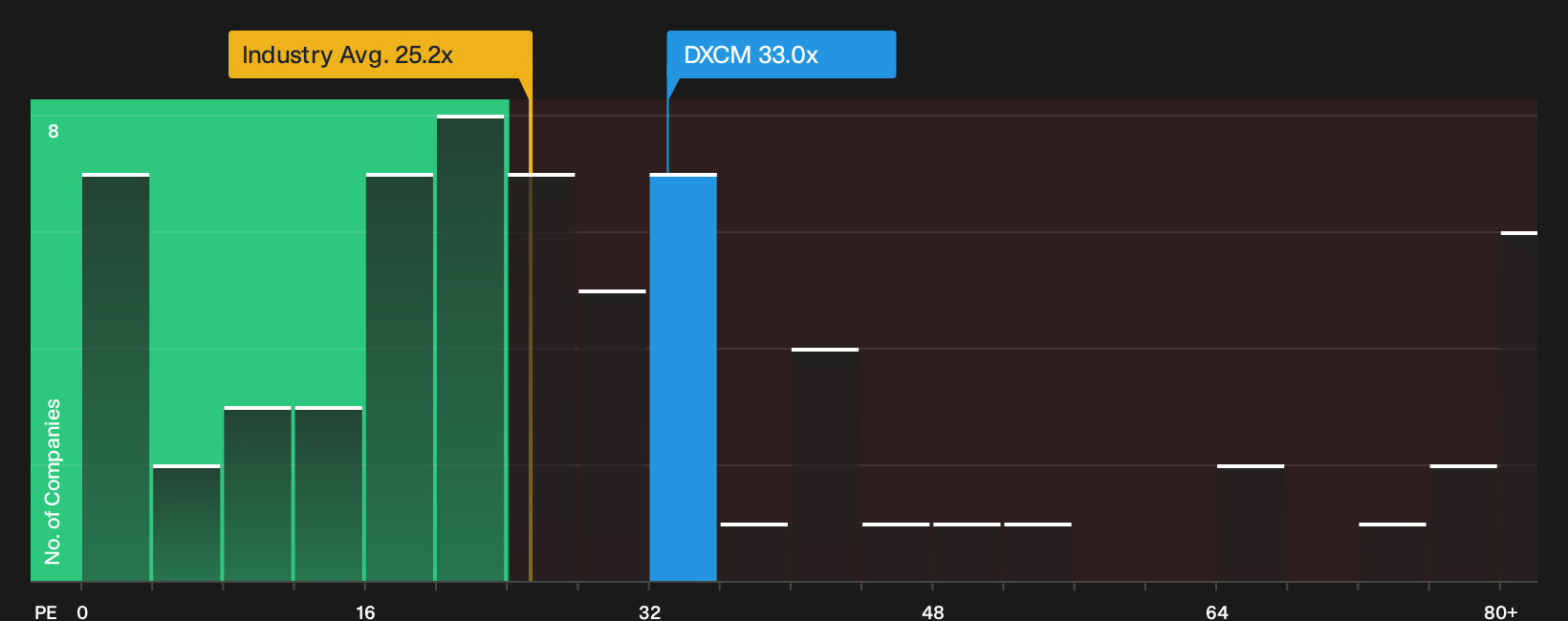
The story looks different when you shift from cash flows to earnings multiples. DexCom trades on a P/E of 33.2x, which is richer than both the peer average at 24.1x and the US Medical Equipment sector at 25.2x, and even a touch above its own 33x fair ratio.
That kind of premium can signal confidence in DexCom's earnings quality and growth, but it also leaves less room for disappointment if forecasts slip. For anyone weighing the recent leadership changes against this valuation gap, the question is simple: Are you comfortable paying above the sector and fair ratio for this narrative to keep playing out, or do you want a wider margin of safety here?
See what the numbers say about this price — find out in our valuation breakdown.
Next Steps
Whether you are positive or cautious on DexCom after all this, you can move faster than the headlines by reviewing the full data set yourself and pressure testing each assumption. To weigh those upsides directly, start with the 3 key rewards.
Ready for more investment ideas beyond DexCom?
Do not stop your research with DexCom alone. Broader opportunities often sit just outside the obvious tickers, and a structured screener can surface them quickly.
- Target durable income streams by scanning companies screened as potential income anchors through the 6 dividend fortresses.
- Hunt for quality at a discount and use the 16 high quality undiscovered gems to spot businesses with solid fundamentals that the crowd may be overlooking.
- Prioritise resilience in choppy markets by filtering for sturdier balance sheets and cash flows with the list of solid balance sheet and fundamentals (23 results).
This article by Simply Wall St is general in nature. We provide commentary based on historical data and analyst forecasts only using an unbiased methodology and our articles are not intended to be financial advice. It does not constitute a recommendation to buy or sell any stock, and does not take account of your objectives, or your financial situation. We aim to bring you long-term focused analysis driven by fundamental data. Note that our analysis may not factor in the latest price-sensitive company announcements or qualitative material. Simply Wall St has no position in any stocks mentioned.
Have feedback on this article? Concerned about the content? Get in touch with us directly. Alternatively, email editorial-team@simplywallst.com