
Claude led 26% of R&D, and Anthropic, who threw out the “AI deceleration theory”, sparked a “AI R&D AI” buzz! The RSI training paradigm catalyzes a major expansion in computing power demand
The Zhitong Finance App learned that measurement results announced by Anthropic, the world's strongest leader in AI applications, on September 17 showed that as of August, Claude had “led” 26% of AI R&D work, and the proportion of jobs that reached or exceeded the “collaboration” level was over 90%. As Anthropic and OpenAI fully focus on RSI (recursive self-improvement), the latest AI model training paradigm, the upgrading of cutting-edge AI laboratory R&D capabilities is progressing simultaneously with capital scale expansion, and the focus of investors in the global AI industry has also fully extended from pure AI big models or AI smart products to the capacity and capabilities of R&D platforms and long-term AI computing power infrastructure.
According to a series of recent media reports, citing information disclosed by people familiar with the matter, investors and OpenAI, another AI application leader, have already involved a valuation of 1.2 trillion US dollars, and the company is seeking a valuation level of about 1.5 trillion US dollars; Anthropic's post-investment valuation at the time of financing in May was 965 billion US dollars, and the IPO plan currently under discussion is seeking a valuation of about 2 trillion US dollars and a maximum financing of 100 billion US dollars. At that time, the company's issuance scale is expected to match or even significantly surpass SpaceX, becoming a new historical record — 20,000 here The billion US dollars is the proposed listing valuation, not the listed market value of the completed transaction.
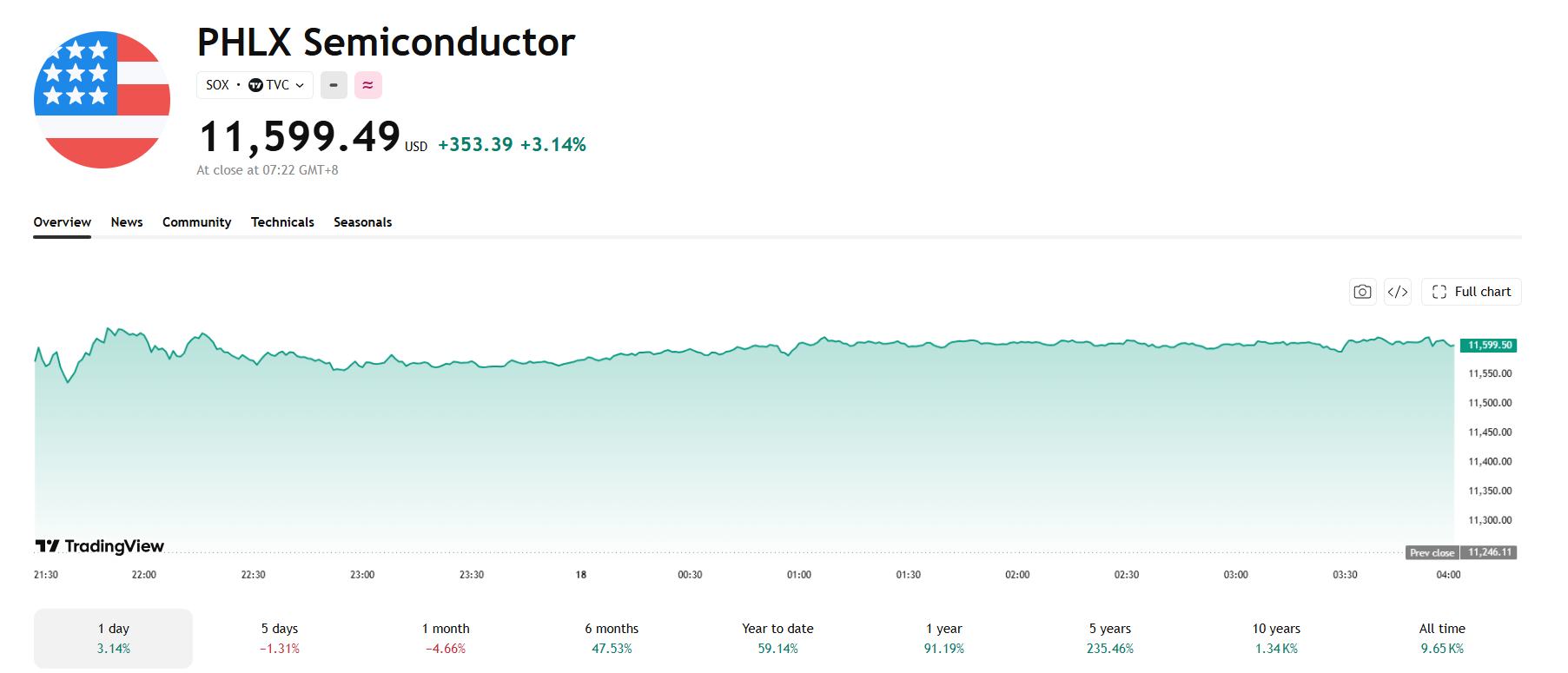
The Astra large model recently launched by OpenAI continues to actively expand the professional tasks that AI can undertake. Since then, Nvidia CEO Huang Renxun has also posted a major statement on social media that the launch of GPT-6 Astra means “AGI has arrived”, and Nvidia has confirmed the strong revenue range and subsequent strong shipping guidelines, and the AI big model development is entering “recursive self-improvement (RSI)”, an innovative stage that opens up another surge in AI computing power demand — that is, Astra is expected to expand the AI computing power surge curve for commercial applications Force requirements RSI's R&D trajectory, where AI began to “create AI,” may increase investment in cutting-edge operator experiments, evaluations, and long-term continuous training to jointly extend the computing power investment cycle. This is why US stocks related to AI computing power collectively surged on Thursday. Among them, the Philadelphia Semiconductor Index surged more than 3%.
Notably, shortly before Anthropic revealed that Claude contributed 26% of its R&D investment and made every effort to impact the largest IPO in human society, the company's CEO heavily threw out the “AI deceleration theory” last weekend, and the market also began pricing and taking into account risks brought about by factors such as AI deceleration discussions this week — global AI leaders such as Anthropic and OpenAI unanimously called for a slowdown in the development of cutting-edge AI models over the weekend.
The “AI deceleration” discussion affects the market's judgment on the pace of cutting-edge R&D, capital expenditure paths, and risk compensation. It cannot be directly equated with the cessation of growth in demand for existing AI applications. On September 12, Amodei called for slowing down the rate of improvement in model capabilities. Altman later agreed that the pace of cutting-edge development needed to be controlled, but the industry did not have a completely consistent plan on coordination methods, external evaluations, and regulatory arrangements.
Claude alone dominates 26% of R&D work! Anthropic Reveals Investment in AI Research Assistance and Safety
An Anthropic PBC disclosure report on Thursday said that more than a quarter of its artificial intelligence R&D work is driven by Claude's flagship AI chatbot or AI smart product line, which provides the clearest indication so far that AI technology can indeed significantly help accelerate the development of future models.
According to the latest official report released on Thursday, Anthropic found that Claude “led” 26% of the company's R&D work, and that percentage was actually close to zero at the beginning of the year. According to the AI developer, Claude also collaborates with about 90% of employees on work processes or complex tasks.
The data is part of a broader report to help the public track progress of AI development in response to growing concerns that AI may rapidly improve itself and exceed human control.
The company also reiterated its plans to bring in third-party evaluators from multiple organizations within the company and give them the same level of access to internal processes, systems and data as the company's own employees to improve the security of AI technology and risk control and management systems surrounding AI applications.
“The capabilities of AI systems are growing exponentially, and they have begun to completely automate more of the process of building their own. At a time when the world is considering slowing down the pace of cutting-edge AI development, the public needs more information,” the company wrote.
Anthropic is one of several AI companies focusing on “recursive self-improvement” (RSI). This concept means that AI systems can improve their capabilities with little or no human help. Some companies see it as the future of AI development, but once the superpower of this type of AI system is realized, it has also raised concerns about possible security threats.
Anthropic said in its blog that it is trying to establish a framework for tracking agents and monitoring the amount of work they complete on its platform. According to the company, as of August, more than 30,000 intelligent agents were carrying out research and engineering work within the company at any one time.
Anthropic also revealed its allocation of resources between accelerating AI development and ensuring AI security. According to its measurements, depending on the type of research being carried out, the company has between 6% and 12% of computing resources for safety monitoring.
In a blog post in early September, OpenAI, the most powerful AI model competitor, also shared its latest progress in advancing research automation, pointing out that the company suspended some model training after it was discovered that its model had invaded the startup Hugging Face's external systems.
Last week, Anthropic employee Jacob Coxon left his job in a high-profile manner, further exacerbating anxiety about the risks to human survival associated with AI. In his resignation post shared on social media, he accused the AI developer company of “betting on our lives.”
Over the past few days, a number of AI company leaders, including Anthropic CEO Dario Amodii and OpenAI CEO Sam Altman, have called for slowing down the development of this technology to address its increasingly unpredictable risks—yet they disagree on exactly how to handle it.
On Saturday, in a 3,800-word long article, Amoudai called for government regulation and for the tech industry to support broader AI deceleration initiatives. This sparked strong opposition from US President Donald Trump, who dismissed concerns about this technology risk as a “technology scam” and rejected the idea of making new rules.
Other tech industry leaders have also responded. Altman and Nvidia CEO Hwang In-hoon argued that AI companies can control the pace of AI development in a safe manner on their own; Meta Platforms CEO Mark Zuckerberg said that AI laboratories should rely on independent evaluators and safety operation consultants to ensure model safety.
From “AI research assistance” to recursive improvements, AI computing power requirements are opening up a new dimension?
The investment significance of Astra and recursive self-improvement (RSI) is that cutting-edge high-performance AI models, and AI research and development itself are becoming new scenarios that continue to consume computing power. OpenAI revealed on September 6 that it has achieved the goal of being an “automated research intern” and can complete some of the tasks that would have required skilled researchers for several days under human guidance; as of mid-August, each human working day corresponds to about 3.1 smart device operation days. This measures run time; it is not a 3.1 times increase in scientific research output. It can be deduced from this that research automation will simultaneously increase the reasoning required for code generation, experimental evaluation, and candidate model training requirements. However, the complete RSI has not yet become an established dominant paradigm, and research direction and resource allocation are still determined by humans.
The GPT-6 Astra model launched by OpenAI and the RSI technology path focused on by AI leaders are expected to become the two core driving forces driving the exponential expansion of AI computing power demand, namely the AI big model with better performance, the use of a wider range of AI application tools, and a next-generation AI training path with stronger computing power requirements, which are an important basis for the continued growth in AI computing power infrastructure demand. OpenAI recently revealed that Astra has enhanced programming, browsing, computer operation, and complex task execution capabilities, and expanded the scope of actual work that models can participate in. The product manager said that the surge in demand for Astra has put pressure on infrastructure; the company suspended new subscriptions and upgrades to the $200 monthly Pro 20X package since September 10, and existing subscriptions continue to be renewed normally.
Among them, the core of recursive self-improvement (RSI) is to allow AI to participate in the development of stronger AI, and then continue to improve R&D capabilities through stronger models, forming a closed loop of continuous iteration of feedback. It is not a new algorithm to replace pre-training or reinforcement learning, but rather an R&D paradigm covering research design, coding, execution of experiments, evaluation of results, and model iteration. The progress currently being publicly displayed by Anthropic and OpenAI is mainly automated R&D under human supervision, rather than recursive improvements that have achieved complete autonomy without human intervention.
As of August, Claude had “led” 26% of AI research and development work, accounting for more than 90% of the work that reached or exceeded the “collaboration” level. On the company's most commonly used internal platform, there are about 30,000 intelligent entities carrying out research and engineering work simultaneously. The industrial significance of these data is that AI has gone from being an auxiliary tool occasionally used by researchers to an execution resource for continuous participation in the R&D process; R&D activities themselves are becoming an important source of demand for continuous reasoning and computing power.
Anthropic and OpenAI focus on RSI, first to improve the efficiency of the entire research iteration process, and this process itself requires more parallel experiments and continuous operation of research agents. Derived from engineering mechanisms, research agents can help propose and screen solutions, modify training codes, generate experimental configurations, execute tests, and analyze results, so that researchers can explore more candidate paths at the same time; among them, intelligent thinking and programming require deductive computing power, and verification solutions also require training, evaluation, and data processing resources.
OpenAI revealed that as of mid-August, each human working day in its research organization corresponds to about 3.1 standard smart workdays; the median researchers ranked by usage, the daily inference usage converted to more than 600 US dollars based on API prices. Here are the operating time and service price conversion scales, respectively. They are not productivity multiples or actual internal cash costs. The company also notes that as other R&D bottlenecks ease, computing resources may become a more important constraint. Security research also forms an independent workload — Anthropic used about 6% of all AI R&D computing power and 12% of AI-driven R&D computing power for AI security-related work processes in the July 13-20 sample.
These latest research processes on RSI and the AGI controversy brought about by the advent of Astra's big model all mean that when the AI big model fully begins to take on more R&D tasks, the industry will no longer just “invest in computational power training models,” but will increase the demand chain for “using computing power to run research agents, and then organize more experiments”; R&D automation expands the scale of explorable experiments, and also raises the requirements for usable computing capacity, scheduling efficiency, and reliability.
RSI and Astra's most important catalyst for the AI computing power investment theme is not only “increasing model parameters”, but also expanding the scope of work that AI can undertake and deepening the execution process for each task: user-oriented application reasoning and model-oriented research reasoning, which together broadened the long-term demand space for AI computing power infrastructure resources. RSI and Astra provide direct demand signals from the commercial application side, so that the two paths of “R&D automation+user inference” computing power growth can be brought into view at the same time.
According to the forecast report of TrendForce, a well-known market research agency, in 2027, shipments of NVL72 racks increased by more than 50% year on year. The total output value of GB200/GB300 and next-generation NVL rack systems around Nvidia AI GPUs based on the Vera Rubin architecture is expected to exceed US$710 billion, an increase of 214% year over year, including the impact of product upgrades and price increases. As the advanced and cutting-edge model led by Astra brings more and more strong demand for AI computing power, Morgan Stanley expects the data center comprehensive capital expenditure of the four largest supercloud computing and AI application vendors in North America to rise from US$917 billion in 2026 to US$1.47 trillion in 2027 and US$1.64 trillion in 2028. The deployment capacity is expected to expand from 35 gigawatts in 2025 to 145 gigawatts in 2028.
Looking at the inference system architecture, more complex tasks often include longer context, multiple rounds of model calls, tool execution, and result verification: Prefill (Prefill) requires processing input, decoding (Decode) continuously generates output, and key value cache (KV Cache) takes up more memory as context and concurrency scale expand, and computational throughput, memory bandwidth, and capacity need to be increased collaboratively. Further industry inference is that GPUs and TPUs undertake model calculation, CPU undertaking tool execution and task orchestration, HBM, server DRAM, storage and high-performance network infrastructure, and data center optical interconnect devices to support efficient data transportation and state management, and ultimately require complete and increasingly large AI computing power server clusters to deliver sustainable services.