
3 Bank Stocks With Rate Sensitive Earnings Investors Should Watch
Interest rates are climbing again, inflation pressures are hanging around, and the Federal Reserve is hinting that tighter policy is not done yet. That mix can reshuffle winners and laggards across big U.S. financial stocks. Some businesses gain fresh pricing power on loans or trading activity, while others see funding costs bite. This article walks through 3 large-cap financial stocks exposed to this news and explains why their setups may deserve attention now.
The three stocks covered below are only a small sample of the opportunity set, as the full screen surfaced 220 more large financial companies with equally compelling narratives that this article does not touch. If you want to identify and analyze potential higher conviction ideas across the broader universe, head straight into the U.S. Large-Cap Financials (Banks, Brokers, Asset Managers) screener.
Regions Financial (RF)
Overview: Regions Financial is a large U.S. regional bank that earns most of its money by providing loans, deposits, and wealth services to households and businesses, giving it direct exposure to policy interest rates and broad domestic economic conditions.
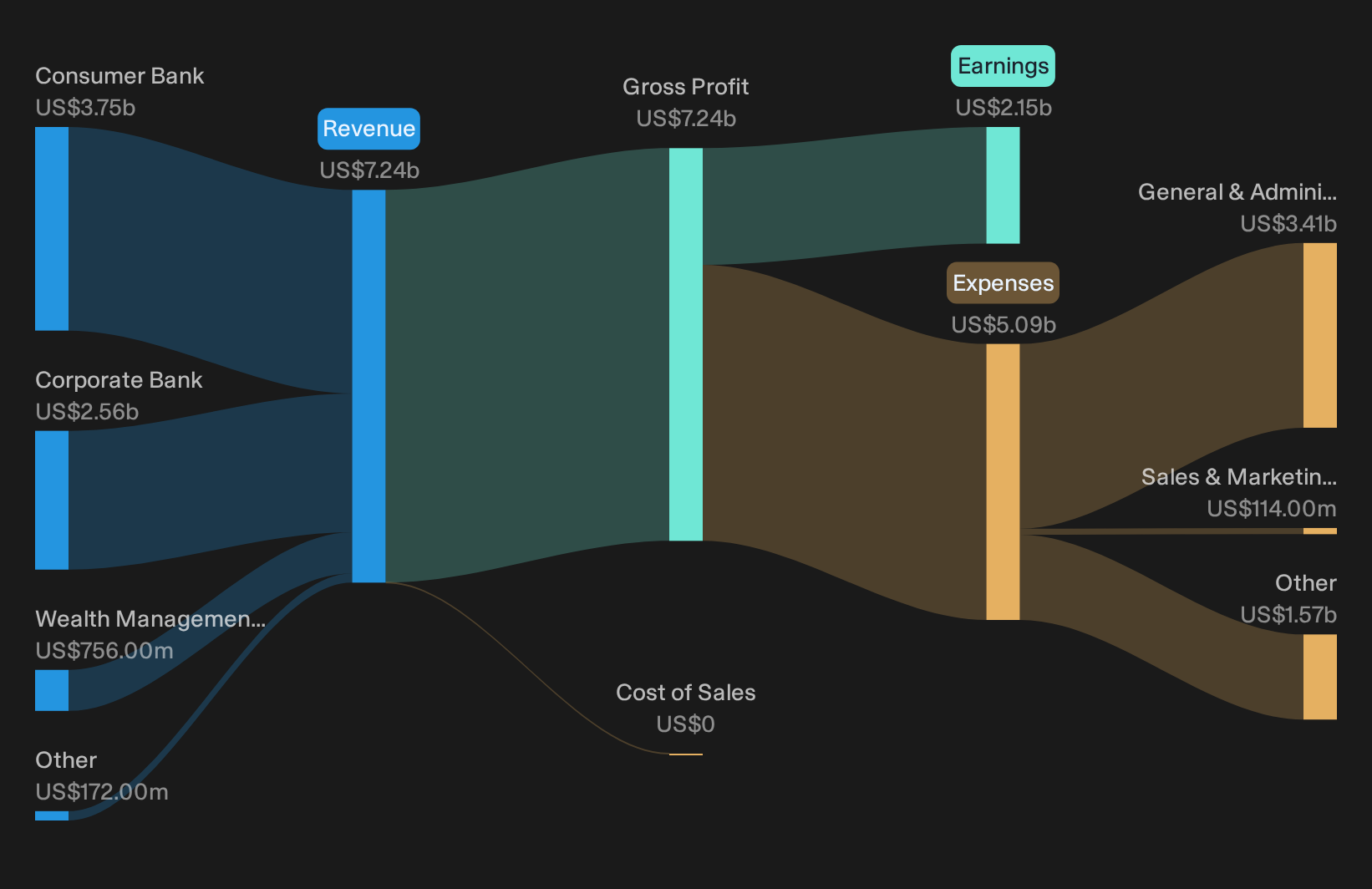
Operations: Regions Financial generates about US$3.8b from Consumer Banking, US$2.6b from Corporate Banking, US$756 million from Wealth Management, and US$172 million from other activities, with all US$7.2b of revenue coming from the United States.
Market Cap: US$24.3b
Regions Financial sits near the center of this large cap U.S. financials screen because its loan book, fee engines, and deposit base link directly to higher short term rates and a still resilient domestic economy.
Early investments in digital banking infrastructure and a forthcoming cloud-based core platform are expected to drive customer acquisition, operational efficiency, and cost control, which should improve net margins and drive sustained positive operating leverage.
What happens if one quiet source of funding pressure starts to collide with that digital-driven push to protect profitability.
As that funding squeeze builds, read the full narrative for Regions Financial to see how Regions Financial’s digital push, fee mix, and capital choices could reshape the risk reward profile.
East West Bancorp (EWBC)
Overview: East West Bancorp is a large U.S. bank that focuses on personal and commercial lending, deposits, and cross-border banking between the United States and Asia.
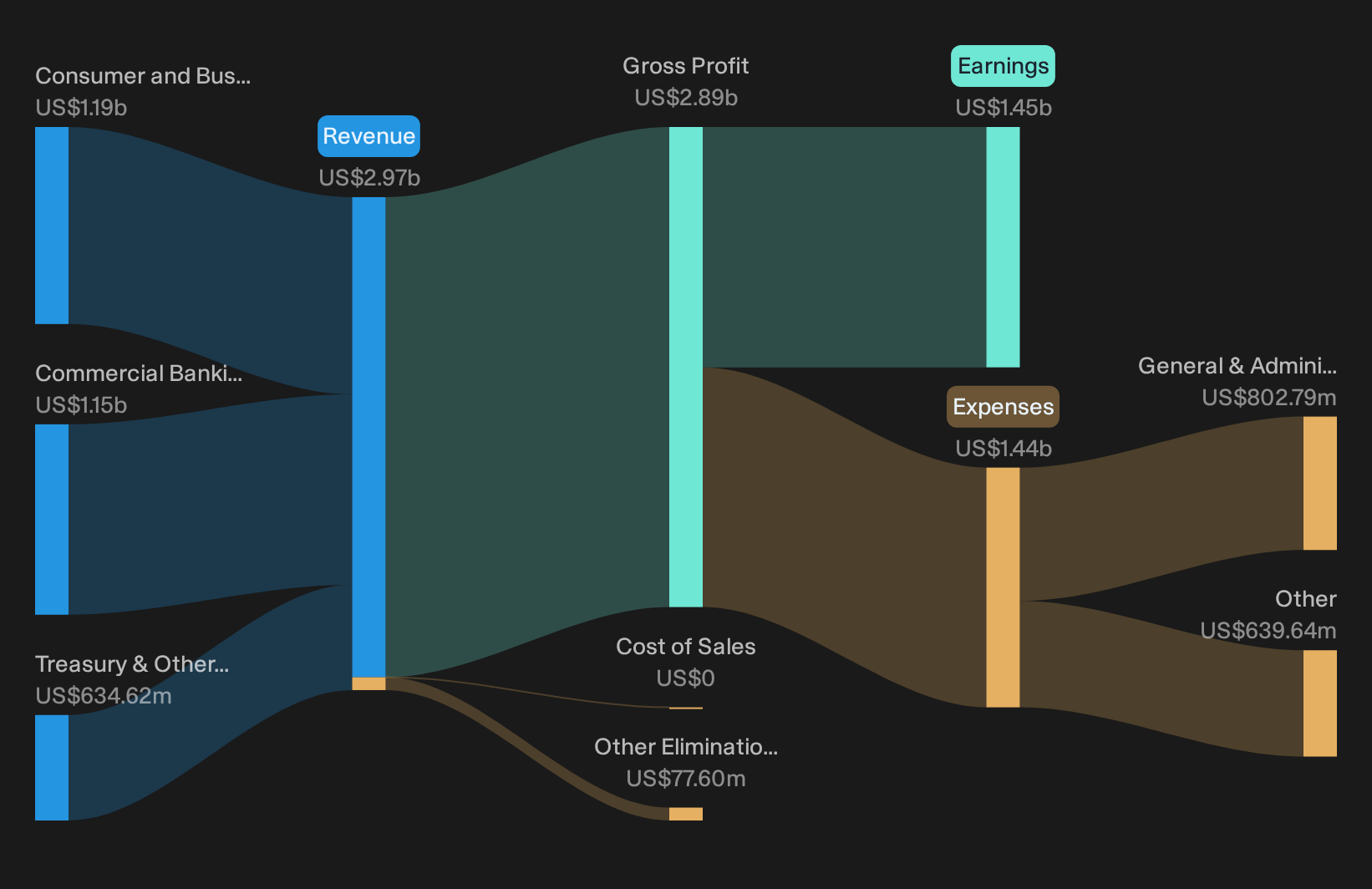
Operations: East West Bancorp generates about US$1.19b from Consumer and Business Banking, US$1.15b from Commercial Banking, and US$635 million from Treasury and Other activities.
Market Cap: US$17.29b
East West Bancorp is tightly linked to the screener’s theme because it is a sizable U.S. lender whose earnings are closely tied to domestic interest rates and credit demand across households and businesses.
Sustained investments in digital banking, automation, and technology, including areas such as mobile, cybersecurity, and operational efficiency, can allow for scalable growth and may improve the efficiency ratio, which in turn can support higher net margins and long-term cost containment.
What really matters next is how one underappreciated funding pressure intersects with that efficiency push to shape future profitability.
As that pressure builds, go straight to the full narrative for East West Bancorp to see how East West Bancorp’s funding mix and tech spend could be quietly accelerating earnings power.
Northern Trust (NTRS)
Overview: Northern Trust is a large U.S. financial holding company that offers banking, asset servicing, and wealth and asset management for institutional and high-net-worth clients.
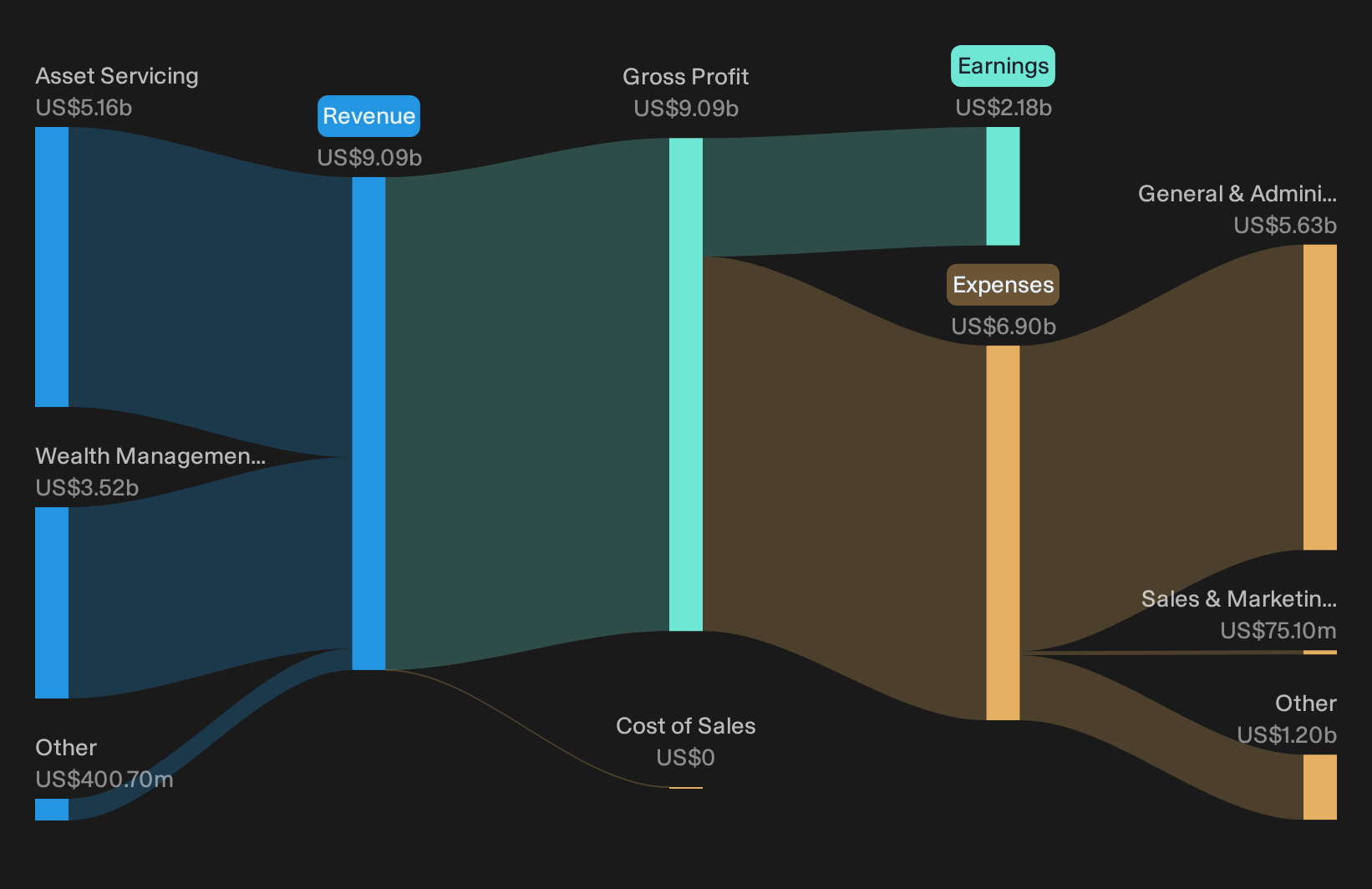
Operations: Northern Trust generates about US$5.16b from Asset Servicing, US$3.52b from Wealth Management, and US$401 million from Other activities.
Market Cap: US$32.32b
Northern Trust fits this large cap financials screen because it blends a trust bank balance sheet with fee rich custody, wealth, and asset management. This ties earnings to rate sensitive spread income as well as long term servicing relationships with large global investors.
The company's expansion in alternatives, private markets, and ETF offerings is described as an effort to tap into client demand. However, heightened competition, regulatory risk, and client concentration (especially in ultra-high-net-worth and institutional segments) may make expectations for assets under management and fee-based revenue more exposed to changes in market cycles and asset price volatility.
What matters now is how one subtle shift in client behavior could change Northern Trust’s mix between steady fee income and margin pressure.
As that shift plays out, read the full narrative for Northern Trust to see how Northern Trust’s fee engines and margins could be quietly decoupling from market swings.
Curious About Alternative Opportunities?
Fresh ideas move first. Markets reprice fast, momentum builds, and the best entry points can be gone before the crowd notices. Scan these under the radar lists and consider your options promptly.
- Spot early income workhorses by reviewing the 6 dividend fortresses before yields get repriced and the strongest payers attract broader attention.
- Track where real earnings momentum is building with the 38 profitable AI stocks that aren't just burning cash while these cash generators are still priced like experiments, not established franchises.
- Position ahead of the next power buildout using the 37 power grid technology and infrastructure stocks while grid upgrade beneficiaries are still priced as ordinary utilities and suppliers.
This article by Simply Wall St is general in nature. We provide commentary based on historical data and analyst forecasts only using an unbiased methodology and our articles are not intended to be financial advice. It does not constitute a recommendation to buy or sell any stock, and does not take account of your objectives, or your financial situation. We aim to bring you long-term focused analysis driven by fundamental data. Note that our analysis may not factor in the latest price-sensitive company announcements or qualitative material. Simply Wall St has no position in any stocks mentioned.
Have feedback on this article? Concerned about the content? Get in touch with us directly. Alternatively, email editorial-team@simplywallst.com