
Bank of New York Mellon Corporation (BNY) Raises Prime Rate, Is The Stock Still Cheap?
Prime rate move puts Bank of New York Mellon in focus
BNY announced a 0.25% increase in its Prime Lending Rate to 7.00%, effective September 17, 2026. That shift puts Bank of New York Mellon Corporation (BNY) squarely on income and lending investors’ radar.
The Prime Rate move lands at an interesting moment for BNY. The share price is US$153.02 after slipping 5.9% over the past week and 6.7% over the past month. It still carries a strong year to date share price return of 30.7% and a very high 3 year total shareholder return of 281.4%, which indicates that longer term momentum has been strong even as shorter term sentiment cools around Bank of New York Mellon Corporation.
Scan how Bank of New York Mellon Corporation compares in terms of pricing power and lending exposure by reviewing our hand picked list of solid balance sheet and fundamentals (23 results).
Recent gains for Bank of New York Mellon Corporation have been strong, yet the share price has just cooled as the Prime Lending Rate moves higher. Is this a sensible entry now, or does patience make more sense once valuation is clear?
Most Popular Narrative: 7.9% Undervalued
On the most followed view, Bank of New York Mellon Corporation screens as modestly undervalued, with a fair value estimate of about $166 per share versus the last close at $153.02. That gap rests on the idea that digital platforms and fee engines can keep doing the heavy lifting as the Prime Rate edges higher.
Accelerated investment in digital platforms (including digital asset custody, AI integration, and the NEXEN ecosystem), coupled with strong early adoption, positions BNY Mellon for improved operating leverage and net margin expansion over the coming years, as scalable technology reduces costs and increases cross-selling opportunities.
See why 40 investors see Bank of New York Mellon as 8% undervalued.
Result: Fair Value of $166.21 (UNDERVALUED)
Still, the bullish case for Bank of New York Mellon Corporation hinges on a few pressure points, including fee compression risk and the possibility that recent net interest income proves less durable than hoped.
Find out about the key risks to this Bank of New York Mellon narrative.
Another View on Bank of New York Mellon Corporation’s Valuation
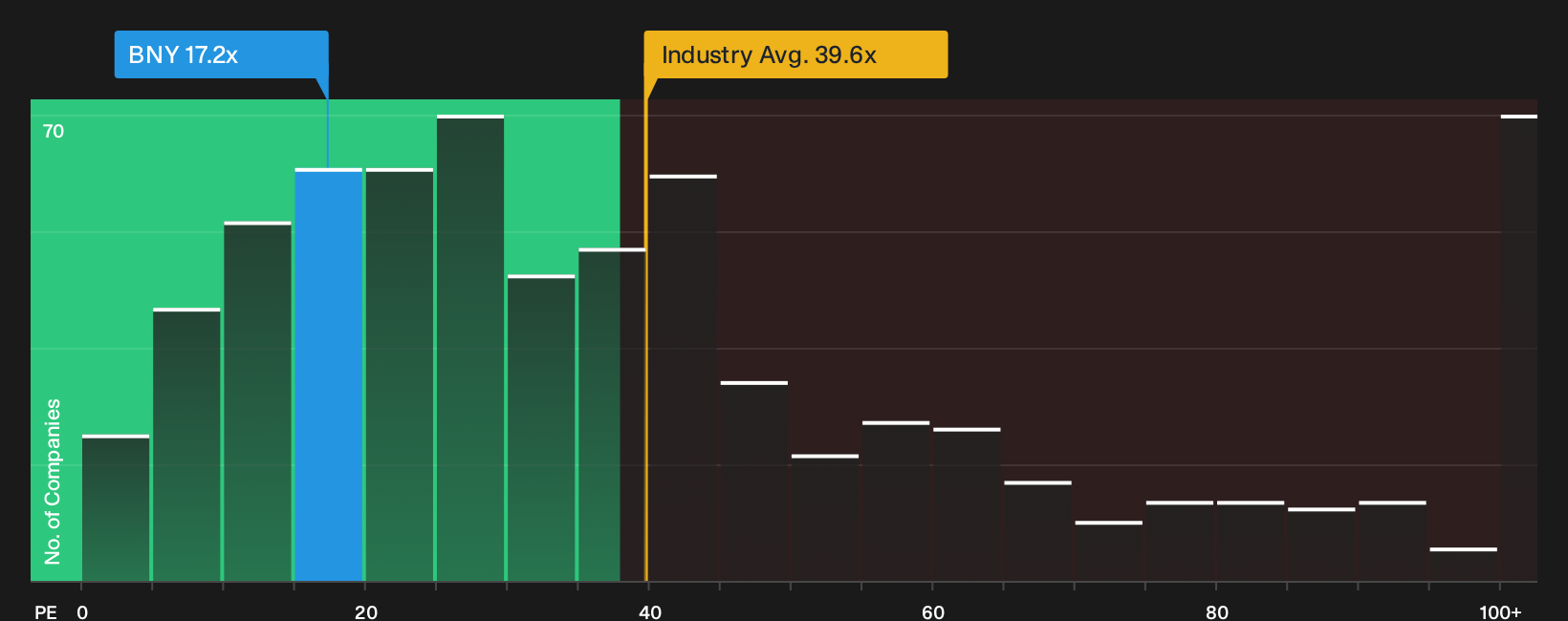
The first take leans on a fair value of about $166 per share. A second lens uses plain P/E math. BNY trades at roughly 17.2x earnings versus a fair ratio of 16.3x, which implies a richer tag. If the market moves toward that fair ratio, what does that mean for today’s upside story?
See what the numbers indicate about this price in more detail by reviewing our valuation breakdown through the See what the numbers say about this price — find out in our valuation breakdown..
The comparison with both the US market P/E of 18.3x and the US Capital Markets industry average of 39.6x, alongside the fair ratio, is set out clearly in the
Next Steps
If this mix of optimism and concern around Bank of New York Mellon Corporation feels familiar, use that as a cue to move quickly, examine the data and assumptions on your own, and consider the findings from its 4 key rewards and 1 important warning sign.
Looking for more investment ideas beyond Bank of New York Mellon Corporation?
If you are weighing Bank of New York Mellon Corporation, it pays to widen your lens and compare it with other opportunities that could sharpen your overall portfolio mix.
- Spot potential mispricings early and size up companies that combine quality with a discount by scanning our 29 high quality undervalued stocks.
- Lock in reliable income streams by reviewing a curated set of high yield opportunities through our focused 6 dividend fortresses.
- Reduce unwanted shocks in your portfolio by filtering for companies with steadier risk profiles using the targeted 30 resilient stocks with low risk scores.
This article by Simply Wall St is general in nature. We provide commentary based on historical data and analyst forecasts only using an unbiased methodology and our articles are not intended to be financial advice. It does not constitute a recommendation to buy or sell any stock, and does not take account of your objectives, or your financial situation. We aim to bring you long-term focused analysis driven by fundamental data. Note that our analysis may not factor in the latest price-sensitive company announcements or qualitative material. Simply Wall St has no position in any stocks mentioned.
Have feedback on this article? Concerned about the content? Get in touch with us directly. Alternatively, email editorial-team@simplywallst.com