
“Calm” has become the new normal in the foreign exchange market: selling volatility and arbitrage, but institutions warn that a “time bomb” may have already been planted
The Zhitong Finance App learned that at the TradeTech FX 2026 industry conference held in Amsterdam, the long-term downturn in exchange rate volatility became the dominant topic for the second year in a row. The participating investors described a market with drastic changes in bonds, crude oil, and geopolitics, yet still unable to push for long-lasting exchange rate fluctuations.
“We lament the long-term downward trend in exchange rate volatility,” said Harish Neelakandan (Harish Neelakandan), co-chief investment officer of AlphaEngine Global Investment Solutions, a systematic trend tracking fund. “This is the card we got. We can only learn to live with it.”
For a market with an average daily trading volume of up to $9.6 trillion, the absence of volatility is becoming a problem for traders year after year — they are hoping to feed off the big market. However, this calmer environment is likely to be a good thing for asset managers and physical businesses looking to hedge against their own exposure.
According to the organizer's official website, the conference was held from September 15 to 17 at the Mövenpick Hotel in Amsterdam. There were more than 800 participants, including more than 300 representatives from buyers and physical businesses.
Central bank coordination suppressed the fluctuations, and the shock left only a pulse
Nirakandan said that stronger coordination among central banks has helped contain exchange rate fluctuations, so that geopolitical shocks can only generate brief fluctuations. Unless there is a fundamental change in this context, traders are likely to continue to see such pulses as an opportunity to short volatility again.
“What we're seeing is 'nothing's going to happen, 'people are just always selling volatility,” said Thomas Carreau (Thomas Carreau), currency portfolio manager at CN Investment Division, which manages Canada's National Rail Pension Plan.
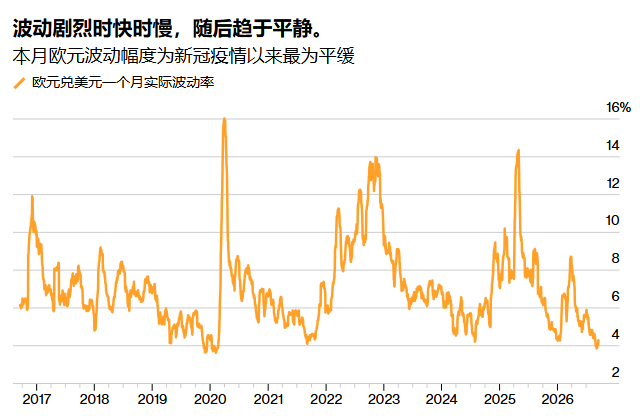
Karu said that even the recent trend of yen is relatively restrained. Over the past few months, the yen remained the focus of the market: it first fell all the way to its weakest level in 40 years, then the joint intervention of the US and Japan fueled a series of sharp increases. Despite this, its level of volatility is still at the end of its history.
The yen fell below 160 in late July, approaching 164 yen per dollar, a record low since 1986; on July 30, Japan's Ministry of Finance and the US Treasury sold the dollar and bought the yen through the New York Federal Reserve on July 31. On August 3, Japan's Finance Minister Katayama Satsuki and US Treasury Secretary Scott Bessent jointly confirmed that this is the first time since 1998 that the US and Japan have jointly bought yen.
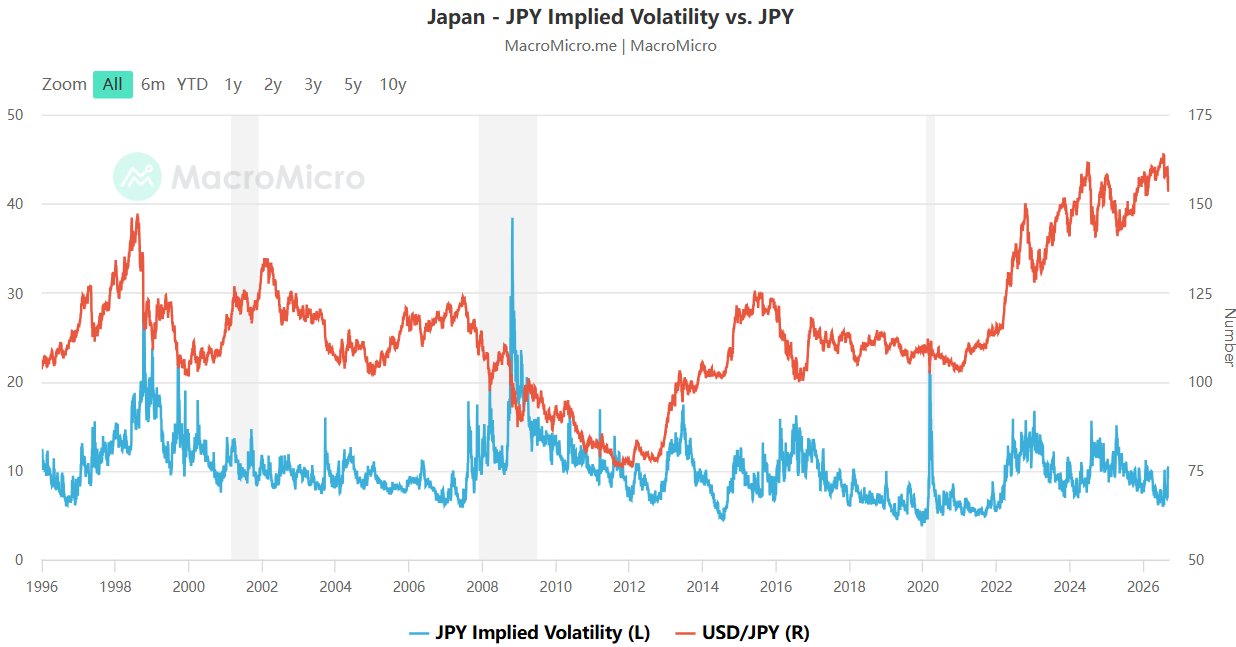
According to data from Japan's Ministry of Finance, from July 30 to August 26, the Japanese government spent a total of 15.4 trillion yen (about 96.4 billion US dollars) to intervene in the market, setting a historical record for the scale of intervention in a single month. The initial results of the intervention were obvious. The yen rebounded rapidly from around 164 and once rose to 155.20 on August 3, but the boost did not translate into a continuous upward trend — the yen fell below 160 again on August 31, and did not strengthen again to 152 until September 8. The dollar closed at 156 against the yen at the end of the New York exchange market on the same day. A joint intervention on a scale of nearly 100 billion US dollars eventually brought the exchange rate back close to the starting point.
In addition, advances in electronic trading and algorithmic trading are also believed by some market participants to be reducing volatility. Some have warned that the lack of drastic changes in the market will cause market makers to quit because it is difficult to profit.
“Arbitrage is king”
Kalu added that arbitrage trading — where investors borrow low-yield currencies and buy high-yield assets — continues to perform well. He is inclined to make this type of transaction structure dollar-neutral, because US President Trump's social media posts may still cause the dollar to fluctuate slightly during the day. This is a strategy that performs well in a low volatility environment.
“Arbitrage is king,” he said.
His judgment is consistent with the overall pattern of the foreign exchange market this year. Recently, the volatility of various types of assets was surprisingly low, driving investors to invest in arbitrage trading, making this most enduring foreign exchange bet ushered in the best market in decades; the data showed that the “borrow the euro and buy a basket of currencies in the Brazilian real, Colombian peso, and Turkish lira” strategy recommended by strategists from institutions such as Citigroup rose by about 18% during the year until mid-July, the biggest increase in the year since 2005.
Low volatility also rewards arbitrage traders on a wider scale: at the beginning of this year, the J.P. Morgan Volatility Index showed that emerging market currencies had been less volatile than G7 currencies for nearly 200 consecutive days, the longest record since 2008.
The seller also directly converted low volatility into a strategy. In May, Deutsche Bank's foreign exchange strategy team led by George Saravelos (George Saravelos) recommended that traders shift their attention away from the US dollar and shift their attention to the relative value in the foreign exchange market; Wells Fargo analyst Alvaro Vivanco (Alvaro Vivanco)'s team suggested buying South African rand and selling Mexican pesos; J.P. Morgan's strategist team said that against the backdrop of global economic growth withstanding the test of rising energy costs, holding long positions with arbitrage trading is still one of their most confident forex strategies.
Businesses are adapting
Low volatility isn't bad news for everyone. It may also reflect a market with abundant liquidity, efficient operation, and the ability to continuously absorb shocks in a turbulent world. “The world may be unreliable, but the foreign exchange market is reliable,” said Allan Guild (Allan Guild), chairman of the conference and director of Hilltop Walk Consulting.
Businesses are adapting their strategies. Georgios Velissariou (Georgios Velissariou), head of financial risk management at Hitachi Energy Group's capital department, said that lower volatility makes options a more attractive way to hedge against exposure to certain currencies. He was also one of the guest speakers at this conference.
Meanwhile, for some banks, this environment is prompting them to rethink some of their operations. Karel Sanders (Karel Sanders), head of foreign exchange product management at Rand Merchant Bank (Rand Merchant Bank), said that the dollar/rand volatility is at a 20-year low level, which is forcing the South African bank to reconsider how to operate the options business.
“Will we continue to be foreign exchange volatile market makers or switch to an agency business? We prefer agency business,” he said.
The signs on the floor also showed that traders are looking for quotes outside of traditional foreign exchange. At one booth, participants were drawn to vote by Dutch syrup waffles to guess the most volatile currency pair of the day — silver won against the US dollar.
A time bomb?
There are a few things that should have stirred up the foreign exchange market during the same period, but none of them have been done. The Federal Reserve raised interest rates by 25 basis points on September 16, raising the federal funds rate target range to 3.75%-4.00% for the first time since July 2023; the US dollar index rose 0.70% to 100.33 on the same day, the euro fell 0.67% to 1.1464 against the US dollar, the 10-year US Treasury yield was 5.021%, the 30-year report was 5.361%, and the Brent crude oil main contract remained above $105.
The next day, US bond yields declined across the board. The 10-year term fell 9.1 basis points to 4.934%. The US dollar index closed at 100.248, EUR/USD 1.1475, and USD/JPY 156.04. In other words, an interest rate hike, 10-year US bonds fluctuating around 5%, repeated Brent crude oil at the 100 yuan mark, and the ongoing conflict in the Middle East only caused the euro to move less than 0.1% against the US dollar in two trading days.
The problem is that the market is not lacking in catalysts that can ignite volatility. According to public data, the Federal Reserve's bitmap shows that 16 officials expect interest rates to be raised again in 2026. The KKR expects the Federal Reserve to raise interest rates again in December and then in March next year. Interest rates will remain unchanged until early 2029. KPMG's US chief economist Diane Swonk (Diane Swonk) believes that this rate hike “did not end all at once,” and that the actual amount required may exceed official estimates.
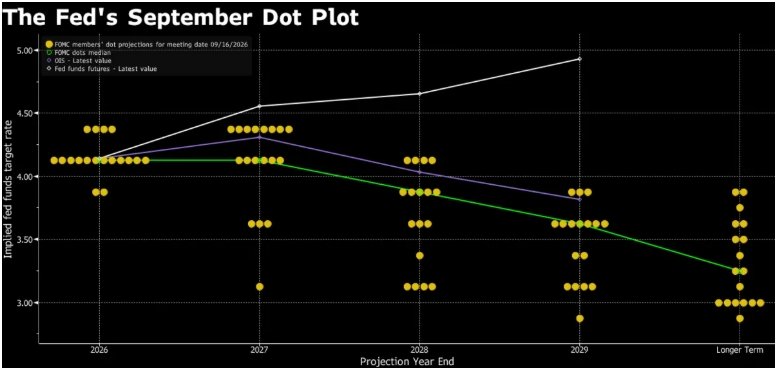
A market that is increasingly built on low volatility may be seriously underprotected when calm is rarely broken. Some people think there's no reason to prepare ahead of time.
“The market is in such a situation: we don't know what the catalyst for the next explosion will be, and no one is placing positions on it, because if you are early, you are wrong,” Carou said.
Long-term calm does present risks. Harel Jacobson (Harel Jacobson), deputy portfolio manager at hedge fund Capstone Investment Advisors, said that lower volatility forces traders to establish larger positions to generate the same returns, and once rare large swings hit, the portfolio's exposure would be greater.
“At the end of the day, there's a ticking time bomb sitting in your portfolio,” Jacobson said. His fund routinely buys cheap hedging tools, specifically to prevent abnormally large market fluctuations, and pointed out that last year's sharp rise in the Taiwan dollar was the kind of event they wanted to cover — on the two trading days of May 2 and 5, 2025, the cumulative appreciation of the NTD was 1.872 yuan against the US dollar, an increase of 6.21%. On the 5th, the intraday period once hit 29.59 yuan against 1 US dollar, a record high of nearly three years. According to reports, major insurance companies in Taiwan have invested about 700 billion US dollars overseas, of which about 200 billion US dollars are not hedged by any exchange rate.