
3 ETFs to Beat Away a Bear Market
2026, so far, hasn't exactly gone the way most investing prognosticators thought it would.
Rather than continue the rally off the April 2025 bottom, stocks flattened out to start the year, then dropped like a rock as America went to war with Iran, sending global oil prices sky-high and sowing uncertainty across both the economy and stock market.
Perhaps even more bizarrely, promises and agreements to cease the violence and reopen the Strait of Hormuz sent equities to fresh all-time highs. And even after ceasefires were repeatedly violated, markets largely remained elevated and even made another push to new records. More recently, oil is on the rise again and stocks are wavering a bit. But as it stands right now, the S&P 500 isn't in a bear market (a drop of 20% from a peak)—in fact, it hasn't even fallen into a correction (a drop of 10%).
Still, there are enough investor jitters out there that it's probably best to remind people of some popular options for fading equity downturns. After all, the best time to know your options is before the worst is upon us.
Read on as I shine a light on some of the top bear-market ETFs. I'll explain their strategies, as well as why they tend to perform well when the rest of the market isn't.
Disclaimer: This article does not constitute individualized investment advice. Individual securities, funds, and/or other investments appear for your consideration and not as personalized investment recommendations. Act at your own discretion.
No Two Bear Markets Are the Same
The reason I'm about to offer up a wide selection of ETF ideas is because there's no silver-bullet bear-market ETF … because no two bear markets are the same.
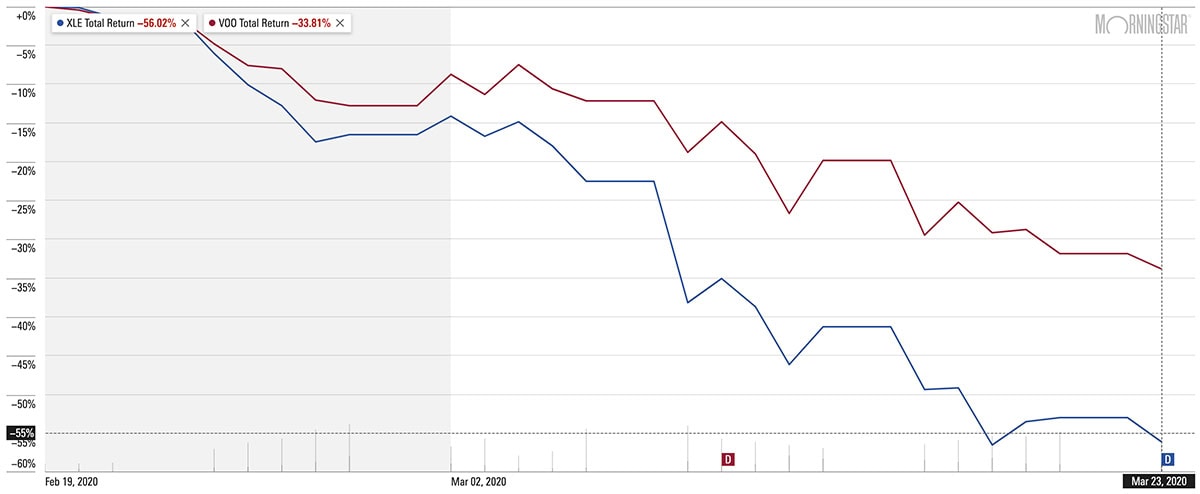
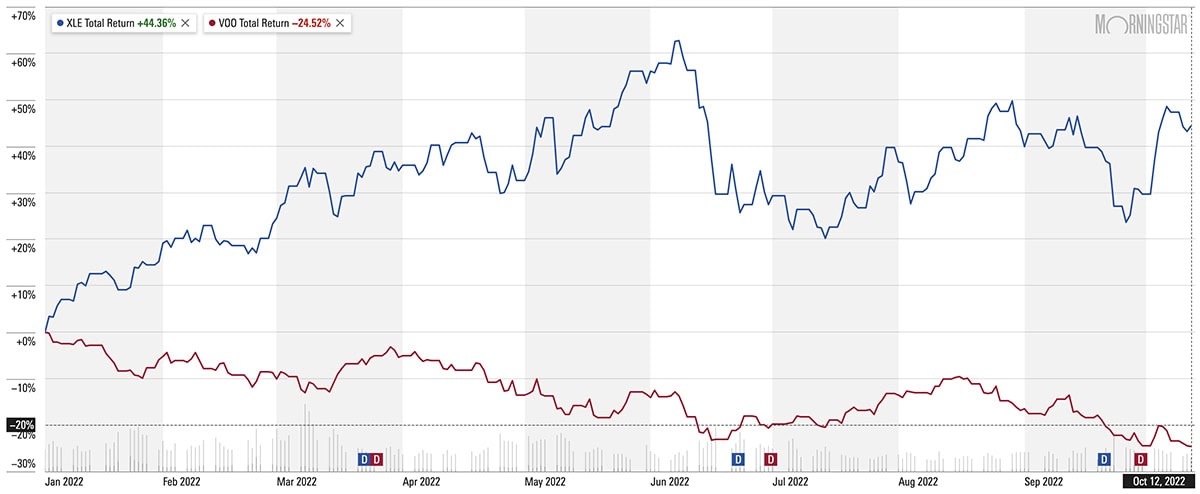
One of the best examples of this lies in the performance of the energy sector during the 2020 and 2022 bear markets.
In 2020, energy commodities crashed amid global travel restrictions, with oil briefly trading at negative prices. Energy stocks—represented here by the Energy Select Sector SPDR Fund (XLE)—lost more than half of their value by the bear market's nadir, reached on March 23, 2020.
However, 2022 was a completely different story altogether. The post-COVID rebound resulted in high levels of inflation that were exacerbated by Russia's invasion of Ukraine, which sent energy prices skyward. That forced the Federal Reserve and other central banks to authorize steep interest-rate hikes, which ultimately sent every market sector but one—energy, propped up by high oil, natural gas and other commodity prices—into the red.
Go further back: The 2007-09 bear market was set off by collapse in the financial markets. The dot-com bear market of 2000-02 was triggered by wild overvaluation and speculation in the tech sector.
You get the picture: Each bear market has its own causes and characteristics, so naturally, which investments will protect you the most will vary from one bear market to the next.
Plus, your goals might vary. You might simply want to limit your risk but still be able to participate in most of the upside in case you incorrectly anticipate a bear market. Or you might be more aggressive and want to actually produce positive returns if stocks circle the drain.
For that reason, it's good to have options—rather than having one go-to fund for a rainy day, it might behoove you to have a handy list of several bear-market ETFs to meet your needs.
The following are three picks from our list.
Related: Do These 7 Bear Market Tips Hold Up to Scrutiny?
1. Invesco S&P 500 Low Volatility ETF
- Style: U.S. low-volatility large-cap stock
- Assets under management: $7.2 billion
- Dividend yield: 2.2%
- Expense ratio: 0.25%, or $2.50 per year on every $1,000 invested
High volatility and market losses are frequently mentioned the same breath. That's because volatility, put very simply, is how much an asset moves up and down—so higher volatility typically includes a higher risk that prices will go down.
Logically, then, investors looking to survive a bear market will often seek out low-volatility investments. Reduced swings during a time in which most stocks are heading lower should theoretically limit downside during a down market.
The Invesco S&P 500 Low Volatility ETF (SPLV) is the biggest low-volatility stock ETF on the market. This straightforward ETF tracks the S&P 500 Low Volatility Index, which starts with the S&P 500's components, narrows it down to the hundred components with the lowest realized volatility over the past 12 months, then "weights" each stock based on its lack of volatility. (Weighting refers to the percentage of fund assets invested in something, be it an asset, industry, sector, country, etc.)
Related: The 13 Best Mutual Funds for the Rest of 2026
Right now, the resultant 104-stock portfolio is extremely loaded up on utilities (27%) thanks to their more recent outperformance. It also includes double-digit allocations to to financials (24%), real estate (17%), and industrials (13%). Many other sectors have low-single-digit weights, so it's not very balanced from that perspective. However, no company accounts for more than 1.4% of SPLV's assets, so there's minimal single-stock risk. Top positions are filled with utilities such as FirstEnergy (FE) and Duke Energy (DUK), and the fund holds other traditional blue-chip names such as Johnson & Johnson (JNJ) and Coca-Cola (KO).
Volatility can be measured by several metrics, but a commonly used one is "beta." Beta measures a security's volatility compared to a benchmark—and with stocks, that benchmark is typically the S&P 500. The benchmark will always have a beta of 1. SPLV has a three-year beta of 0.34, implying that over the past three years, the ETF has been roughly a third as volatile than the broader stock market.
A low beta (or any measure of low volatility) isn't a guarantee that an asset will outperform during a bear market. For instance, SPLV actually underperformed the S&P 500 by 2 percentage points during 2020's COVID bear market.
Fortunately, quick crashes tend to be the exception. Invesco's low-volatility ETF has performed very well during longer periods of market sluggishness. For instance ...
- Between June 2015 and May 2016, the SPLV delivered a 9% total return (price plus dividends) while the turbulent S&P 500 was marginally negative.
- During the 2022 bear market, SPLV only lost 15% compared to 24% for the S&P 500.
- It fared well during 2025's near-bear downturn, off just 6% between Feb. 19 and the market low on April 8, versus a 19% loss for the S&P 500.
- It also outperformed the S&P 500 during March 2026's downturn, but by a thinner margin (-6% to the index's -8%).
Low volatility is a double-edged sword—if stocks are generally heading higher, owning a fund that doesn't swing as dramatically means you'll probably leave some gains on the table. Still, SPLV gives you the ability to protect against some downside while still participating in some of the upside of a bull market. That makes it one of the best bear-market ETFs for investors who just want to exercise a little caution.
Related: The 13 Best Mutual Funds for the Rest of 2026
2. JPMorgan Limited Duration Bond ETF
- Style: Short-term bond
- Assets under management: $4.0 billion
- SEC yield: 4.6%*
- Expense ratio: 0.24%**, or $2.40 per year on every $1,000 invested
Of course, if you're convinced a bear market is coming for stocks, you might want to avoid stocks no matter how defensive they are.
One of the more common defenses against a downturn in equities is the relative safety of bonds. Historically, bonds haven't held a candle to stocks when it comes to their returns across all economic cycles. However, bonds are far more stable, with most of their returns coming in the form of interest income—and those traits begin to look a lot more appealing when stocks are dropping like rocks.
The JPMorgan Limited Duration Bond ETF (JPLD) is one of the best options within the world of bond funds, for several reasons.
For one, short-term bonds are considered safer than longer-dated bonds. That's because the less time a bond has remaining before it matures, the likelier it is that the bond will be repaid. And JPLD's management team—Robert Manning, Sajjad Hussain, and Cary Fitzgerald—have built a 766-bond portfolio with an average life to maturity of a little more than two years. This results in a low duration (a measurement of a bond's risk) of 2.1 years, which effectively implies that for every 1-percentage-point increase in interest rates, JPLD would suffer a short-term loss of just 2.1%.
Invest With CIBC
CIBC Investor's Edge lets you trade U.S. and Canadian stocks and ETFs, options, mutual funds, and bonds through registered accounts like FHSAs, TFSAs, RRSPs, and RESPs, as well as non-registered accounts.
Sign up with our link today and use promo code EDGE2026 to get 200 free trades with CIBC Investor's Edge.
Second, management isn't limited to any one type of bond—they can hold a variety of different debt products to maximize results in any environment. Right now, JPLD has invested more than a quarter of its assets in agency mortgage-backed securities (MBSes), and roughly the same in asset-backed securities (ABSes). It has another 20% in Treasuries, and 15% in commercial mortgage-backed securities (CMBSes). The rest of the portfolio's assets are spread among non-agency MBSes, collateralized loan obligations (CLOs), money market funds, and other credit. And that portfolio generates more than 4% in yield right now despite the short-term nature of its holdings.
The Federal Reserve lowered its benchmark interest rate three times in 2025. Additional rate cuts would be good news for JPMorgan's fund, as lower interest rates are generally positive for the price of existing bonds, and the federal funds rate (an overnight lending rate used by rates) is much more likely to have an impact on shorter-term portfolios such as JPLD's. Conversely, rate hikes could hinder JPLD's performance.
Lastly, JPMorgan Limited Duration Bond ETF is run by skilled managers. "[Michael] Sais, the lead manager on the strategy since 1995, announced his April 2026 retirement a year in advance, providing time to facilitate a smooth transition to Cary Fitzgerald and securitized specialist Sajjad Hussain," says Paul Olmstead, an analyst at Morningstar, which gives JPLD a Gold Medalist rating. "This pair should be able to get up to speed with the help of Sais and comanager Bob Manning, who's been on the strategy since 2013 and has more than 25 years of industry experience."
JPLD has only traded since 2023, but it was converted from a mutual fund, so it does have a long track record—and a decent one at that, beating its Morningstar category average over every meaningful time frame.
Moreover, it suffered minimal losses during the Great Recession, COVID, and 2022 bear markets, as well as the current downturn. Better still: It actually produced small gains during the near-bear of 2018, did so again between the February 2025 highs and April lows, and suffered only minimal losses during this year's March swoon.
* SEC yield reflects the interest earned across the most recent 30-day period. This is a standard measure for funds holding bonds and preferred stocks.
** 0.30% gross expense ratio is reduced with a 6-basis-point fee waiver until at least June 30, 2027.
Related: The 10 Best Dividend ETFs for the Rest of 2026
3. ProShares Short S&P500 ETF
- Style: Inverse stock
- Assets under management: $863.2 million
- Dividend yield: 4.3%
- Expense ratio: 0.89%, or $8.90 per year on every $1,000 invested
All of the aforementioned funds dance around bear markets.
The ProShares Short S&P500 ETF (SH) uses them to its advantage.
The view from 10,000 feet is that when the S&P 500 goes down, SH goes up. How it does that is fairly complex—rather than simply holding stocks, bonds, or physical assets like the aforementioned ETFs, this fund needs to use a series of futures, swaps, and Treasury bills to create the inverse performance of the S&P 500. I normally say that investors should "look under the hood" before they buy an ETF, but in this case, knowing what the ProShares Short S&P500 ETF holds isn't helpful in understanding the fund.
What is helpful is understanding how SH behaves.
SH provides the inverse daily return of the S&P 500. This means if the S&P 500 declines by 1% on Monday, this ETF will gain 1% on Monday (minus expenses, of course). But because this only occurs on a daily basis, that doesn't mean if the S&P 500 declines by 10% in a year, SH will gain 10% in a year. That's in large part because of how returns compound over time.
Related: 7 Best Value Stocks to Buy for the Rest of 2026
Fees are much higher in SH than they are for your average S&P 500 index fund. Not to mention, if the market goes up, you're not participating in any upside whatsoever—SH will lose money. That's not an argument against SH. Far from it. I'm simply explaining the risks, which are important to know before you dive into any fund.
But this ETF can do quite well for itself. From Feb. 19 through April 8 of 2025, SH generated a positive 23% total return. It gained 9% during 2026's market decline.
In fact, SH not only has a permanent place in my annual best ETFs roundup, but I've owned it before, and I actually owned it for a large part of 2025's downturn (though I have since sold off my position).
While this ProShares ETF might not provide perfect negative-1-for-1 performance, it comes pretty darn close—certainly close enough to make it useful if you're anticipating a significant downturn. It's also a safer hedge than leveraged funds that provide -2x or even -3x the market's performance, which can get out of hand in a hurry. And it's a better alternative than jettisoning stocks you already own, which can not only result in taxable events if done outside of tax-advantaged retirement plans, but (in the event you're selling dividend stocks you've owned for a while) can snuff out attractive yields on cost.
One last important note: SH isn't meant to be held forever. Funds like this are tactical in nature—you hold it for as long as you find it useful, but once you think the tide is going to turn, get out. Leaving it in your portfolio in perpetuity will provide an unnecessary drag as long as stocks go up in the long term.
Learn More About These and Other Funds With Morningstar Investor
If you're buying a fund you plan on holding for years (if not forever), you want to know you're making the right selection. And Morningstar Investor can help you do that.
Morningstar Investor provides a wealth of information and comparable data points about mutual funds and ETFs—fees, risk, portfolio composition, performance, distributions, and more. Morningstar experts also provide detailed explanations and analysis of many of the funds the site covers.
With Morningstar Investor, you'll enjoy a wealth of features, including Morningstar Portfolio X-Ray®, stock and fund watchlists, news and commentary, screeners, and more. And you can try it before you buy it. Right now, Morningstar Investor is offering a free seven-day trial and a discount on your first year's subscription when you use our exclusive link.
Read More
- Should You Max Out Your 401(k) Each Year? [Yes ... and No]
- 6 Best Money Market Funds [Protect Your Savings in 2026]
- 10 Common IRA Money Mistakes to Avoid